
Catalogue Search | MBRL


Are you sure you want to remove the book from the shelf?

{{itemTitle}}
65
result(s) for
"Architecture coloniale."
Sort by:

The architecture of conquest : building in the Viceroyalty of Peru, 1535-1635
\"The Architecture of Conquest deals with the practice and ideology of colonial architecture in Latin America, referring particularly to the Viceroyalty of Peru during the period 1535-1635. Colonial building has generally been regarded as being merely a provincial reflection of mainstream European art, but Valerie Fraser argues that, on the contrary, it had its own distinct identity and architectural projects were a powerful tool in the subjugation of the native peoples of South America by the Spaniards. Although the majority of labourers and craftsmen responsible for the churches, towns and cities of the Spaniards were natives, very little evidence of their own traditions of craftsmanship can be found in this colonial architecture. Thus, while the architecture forms employed by the early conquistadores are clearly derived from the European tradition, their purpose and meaning are completely different, being defined by the colonial context. The deliberate display of architectural motifs, the organization of building practice and labour are all shown to have served the ends of the political, religious and economic conquest.\"--Back cover.
Book

The British Empire through buildings
Buildings provide tremendous insights into the character of imperialism, not least in the manner in which Western forms were spread across the globe. They reveal the projection of power and authority in colonised landscapes, as well the economic ambitions and social and cultural needs of colonial peoples in all types of colonies. They also represent a colonial order of social classes and racial divisions, together with the ways in which these were inflected through domestic living space, places of work and various aspects of cultural relations. They illuminate the desires of Europeans to indulge in cultural and religious proselytisation, encouraging indigenous peoples to adopt western norms. But the resistance of the supposedly subordinate people led to the invasion, adoption and adaptation of such buildings for a post-colonial world. The book will be vital reading for all students and scholars interested in the widest aspects of material culture.
eBook

Spaces of Global Cultures
This book brings together a series of new and historical case studies to show how different phases of globalization are transforming the built environment. Taking a broad interdisciplinary approach, the author draws on sociological, geographical, cultural and postcolonial studies to provide a critical account of the development of three key concepts: global culture, post colonialism, and modernity. Subsequent case studies examine how global economic, political and cultural forces shape the forms of architectural and urban modernity in globalized suburbs and spaces in major cities worldwide.
The first book to combine global and postcolonial theoretical approaches to the built environment and to illustrate these with examples, Spaces of Global Cultures argues for a more historical and interdisciplinary understanding of globalization: one that places material space and the built environment at the centre and calls for new theories to address new conditions.
'This outstanding volume by Anthony King is empirically rich and sends deep theoretical tremors as well; an invaluable read.' - Jan Nederveen Pieterse, author of Globalization or Empire, Routledge 2004
'The book is very interdisciplinary—and inherently geographical ... It is sensitive to political and cultural context and highlights the various hegemonies at play in architecture.' - Environment and Planning A
'King's importance in shaping the way we understand globalization as an unequal and uneven system not only of economic but of material and cultural processes cannot be understated.' 'The empirical material in this book is excellent.' 'This is architectural history at its best.' - Rob Shields, Building Research and Information, 2005
'King provides an accessible and significant contribution to the literature on how transnational and global identities play out within the built environment ... it will be of considerable interest to a range of courses, from architecture and planning history to the sociology and geography of consumption.' - Journal of Consumer Culture
'...an excellent book that maps the multifaceted ways in which the built environment is influenced by transnational processes in general and a good overview of the research of one of its most important students in particular' - International Journal of Urban and Regional Research
Anthony D. King is Bartle Professor of Art History and of Sociology, State University of New York at Binghamton. He has been Visiting Professor in Architecture, University of Califonia Berkeley and, for five years, Professor, Humanities and Social Sciences, Indian Institute of Technology, Delhi.
Introduction. Part I: Theories 1. Worlds in the City: Wonders of Modern Design to Weapons of Mass Destruction 2. Interrogating Global Culture(s) 3. Cultures and Spaces of Postcolonial Knowledges 4. The Times and Spaces of Modernities 5. Writing Transnational Planning Histories: The Dialectics of Dual Development Part II: Histories 6. Suburb/Ethnoburb/Globurb: The Making of Contemporary Modernities 7. Villafication: The Transformation of Chinese Cities 8. Imagining the World at Home: The Distant Spaces of the Indian City 9. Transnational Delhi Revisited: The Spatial Language of Three Modernities 10. Imperialism, Colonialism and Architects of the Arts and Crafts in Britain Part III: Pasts/Presents/Futures 11. Ways of Seeing: Serendipity, Visuality, Experience
eBook

The British Empire through buildings
Buildings provide tremendous insights into the character of imperialism, not least in the manner in which Western forms were spread across the globe. They reveal the projection of power and authority in colonised landscapes, as well the economic ambitions and social and cultural needs of colonial peoples in all types of colonies. They also represent a colonial order of social classes and racial divisions, together with the ways in which these were inflected through domestic living space, places of work and various aspects of cultural relations. They illuminate the desires of Europeans to indulge in cultural and religious proselytisation, encouraging indigenous peoples to adopt western norms. But the resistance of the supposedly subordinate people led to the invasion, adoption and adaptation of such buildings for a post-colonial world. The book will be vital reading for all students and scholars interested in the widest aspects of material culture.Buildings provide tremendous insights into the character of imperialism, not least in the manner in which Western forms were spread across the globe. They reveal the projection of power and authority in colonised landscapes, as well the economic ambitions and social and cultural needs of colonial peoples in all types of colonies. They also represent a colonial order of social classes and racial divisions, together with the ways in which these were inflected through domestic living space, places of work and various aspects of cultural relations. They illuminate the desires of Europeans to indulge in cultural and religious proselytisation, encouraging indigenous peoples to adopt western norms. But the resistance of the supposedly subordinate people led to the invasion, adoption and adaptation of such buildings for a post-colonial world. The book will be vital reading for all students and scholars interested in the widest aspects of material culture.
eBook

Urban Space as Heritage in Late Colonial Cuba
According to national legend, Havana, Cuba, was founded under the shade of a ceiba tree whose branches sheltered the island's first Catholic mass and meeting of the town council (cabildo) in 1519. The founding site was first memorialized in 1754 by the erection of a baroque monument in Havana's central Plaza de Armas, which was reconfigured in 1828 by the addition of a neoclassical work, El Templete. Viewing the transformation of the Plaza de Armas from the new perspective of heritage studies, this book investigates how late colonial Cuban society narrated Havana's founding to valorize Spanish imperial power and used the monuments to underpin a local sense of place and cultural authenticity, civic achievement, and social order.Paul Niell analyzes how Cubans produced heritage at the site of the symbolic ceiba tree by endowing the collective urban space of the plaza with a cultural authority that used the past to validate various place identities in the present. Niell's close examination of the extant forms of the 1754 and 1828 civic monuments, which include academic history paintings, neoclassical architecture, and idealized sculpture in tandem with period documents and printed texts, reveals a \"dissonance of heritage\"—in other words, a lack of agreement as to the works' significance and use. He considers the implications of this dissonance with respect to a wide array of interests in late colonial Havana, showing how heritage as a dominant cultural discourse was used to manage and even disinherit certain sectors of the colonial population.
eBook

\Portuguese\ style and Luso-African identity : precolonial Senegambia, sixteenth-nineteenth centuries
In this detailed history of domestic architecture in West Africa, Peter
Mark shows how building styles are closely associated with social status and ethnic
identity. Mark documents the ways in which local architecture was transformed by
long-distance trade and complex social and cultural interactions between local
Africans, African traders from the interior, and the Portuguese explorers and
traders who settled in the Senegambia region. What came to be known as
Portuguese style symbolized the wealth and power of Luso-Africans, who
identified themselves as Portuguese so they could be distinguished from
their African neighbors. They were traders, spoke Creole, and practiced
Christianity. But what did this mean? Drawing from travelers' accounts, maps,
engravings, paintings, and photographs, Mark argues that both the style of
Portuguese houses and the identity of those who lived in them were
extremely fluid. Portuguese Style and Luso-African Identity sheds light
on the dynamic relationship between identity formation, social change, and material
culture in West Africa.
eBook
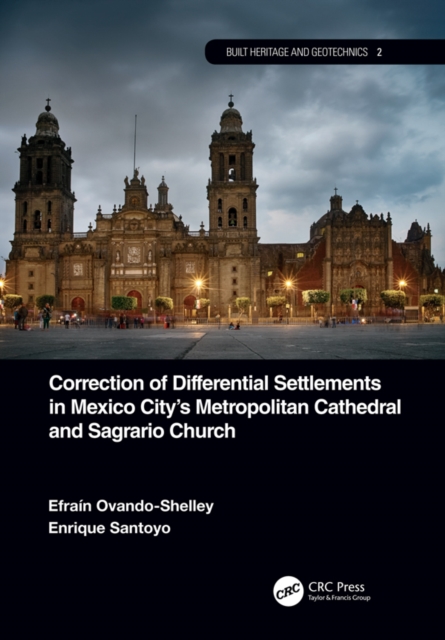
Correction of Differential Settlements in Mexico City's Metropolitan Cathedral and Sagrario Church
This book describes the geotechnical aspects for correcting the geometry of Mexico City's Metropolitan Cathedral and of the adjoining Sagrario Church. It describes the main aspects of geotechnical conditions in the city and of the most important hazards affecting these monuments. It discusses the analyses performed and the actions taken to achieve the corrections required. The book aims to provide non-specialists with a clear picture of the magnitude and importance of the project and of the achievements it fulfilled. It is expected that the book will also appeal to specialized geotechnical engineers that will be provided with references to follow up the project in depth. The book will contain a large number of illustrations and will be written so as to provide \"down to earth\" explanations of the basic theories applied and of the actual construction procedures. The work will appeal to both students and professionals in the fields of Architecture and Civil Engineering. It will also interest specialized audiences of geotechnical engineers and conservation architects and it may also be of value to art historians.
eBook

Building Apartheid
Through a specific architectural lens, this book exposes the role the British Empire played in the development of apartheid. Through reference to previously unexamined archival material, the book uncovers a myriad of mechanisms through which Empire laid the foundations onto which the edifice of apartheid was built. It unearths the significant role British architects and British architectural ideas played in facilitating white dominance and racial segregation in pre-apartheid Cape Town. To achieve this, the book follows the progenitor of the Garden City Movement, Ebenezer Howard, in its tripartite structure of Country/Town/Suburb, acknowledging the Garden City Movement's dominance at the Cape at the time. This tripartite structure also provides a significant match to postcolonial schemas of Self/Other/Same which underpin the three parts to the book. Much is owed to Edward Said's discourse-analytical approach in Orientalism - and the work of Homi Bhabha - in the definition and interpretation of archival material. This material ranges across written and visual representations in journals and newspapers, through exhibitions and events, to legislative acts, as well as the physicality of the various architectural objects studied. The book concludes by drawing attention to the ideological potency of architecture which tends to be veiled more so through its ubiquitous presence and in doing so, it presents not only a story peculiar to Imperial Cape Town, but one inherent to architecture more broadly. The concluding chapter also provides a timely mirror for the machinations currently at play in establishing a 'post-apartheid' architecture and urbanity in the 'new' South Africa.
eBook

Making Lahore Modern
William J. Glover investigates the traditions that shaped colonial Lahore, focusing on the conviction that both British and Indian actors who implemented urbanization shared: that the material fabric of the city could lead to social and moral improvement. Glover reveals that urban change in colonial India was not a monolithic process and establishes Lahore as a key site for understanding the genealogy of modern global urbanism.
eBook

Imperial heights
Intended as a reminder of Europe for soldiers and clerks of the empire, the city of Dalat, located in the hills of Southern Vietnam, was built by the French in an alpine locale that reminded them of home. This book uncovers the strange 100-year history of a colonial city that was conceived as a center of power and has now become a kitsch tourist destination famed for its colonial villas, flower beds, pristine lakes, and pastoral landscapes. Eric T. Jennings finds that from its very beginning, Dalat embodied the paradoxes of colonialism—it was a city of leisure built on the backs of thousands of coolies, a supposed paragon of hygiene that offered only questionable protection from disease, and a new venture into ethnic relations that ultimately backfired. Jennings’ fascinating history opens a new window onto virtually all aspects of French Indochina, from architecture and urban planning to violence, labor, métissage, health and medicine, gender and ethic relations, schooling, religion, comportments, anxieties, and more.
eBook