
Catalogue Search | MBRL


Are you sure you want to remove the book from the shelf?

{{itemTitle}}
3,991
result(s) for
"Archives Philosophy."
Sort by:


Documenting Performance
Performance in the digital age has undergone a radical shift in which a once ephemeral art form can now be relived, replayed and repeated. Until now, much scholarship has been devoted to the nature of live performance in the digital age; Documenting Performance is the first book to provide a collection of key writings about the process of documenting performance, focused not on questions of liveness or the artistic qualities of documents, but rather on the professional approaches to recovering, preserving and disseminating knowledge of live performance. Through its four-part structure, the volume introduces readers to important writings by international practitioners and scholars on:
the contemporary context for documenting performanceprocesses of documenting performancedocumenting bodies in motiondocumenting to create In each, chapters examine the ways performance is documented and the issues arising out of the process of documenting performance. While theorists have argued that performance becomes something else whenever it is documented, the writings reveal how the documents themselves cannot be regarded simply as incomplete remains from live events. The methods for preserving and managing them over time, ensuring easy access of such materials in systematic archives and collections, requires professional attention in its own right. Through the process of documenting performance, artists acquire a different perspective on their own work, audiences can recall specific images and sounds for works they have witnessed in person, and others who did not see the original work can trace the memories of particular events, or use them to gain an understanding of something that would otherwise remain unknown to them and their peers.
eBook


Stirrings in the archives
Like most of Wolfgang Ernst's work, Das Rumoren der Archiv explored the concept of archival and media theory from a current cultural digital context.Ernst challenges the traditional perspective of the cultural heritage institution and how it relied on media for creating, storing and disseminating digital information.
eBook
Manuscripts and archives : comparative views on record-keeping
\"Archives are considered to be collections of administrative, legal, commercial and other records or the actual place where they are located. They have become ubiquitous in the modern world, but emerged not much later than the invention of writing. Following Foucault, who first used the word archive in a metaphorical sense as 'the general system of the formation and transformation of statements' in his 'Archaeology of knowledge' (1969), postmodern theorists have tried to exploit the potential of this concept and initiated the 'archival turn'. In recent years, however, archives have attracted the attention of anthropologists and historians of different denominations regarding them as historical objects and 'grounding' them again in real institutions. The papers in this volume explore the complex topic of the archive in a historical, systematic and comparative context and view it in the broader context of manuscript cultures by addressing questions like how, by whom and for which purpose were archival records produced, and if they differ from literary manuscripts regarding materials, formats, and producers (scribes).\"--Publisher's website
Book

Crafting History
What constitutes an archive in architecture? What forms does it
take? What epistemology does it perform? What kind of craft is
archiving? Crafting History provides answers and offers
insights on the ontological granularity of the archive and its
relationship with architecture as a complex enterprise that starts
and ends much beyond the act of building or the life of a
creator.
In this book we learn how objects are processed and catalogued,
how a classification scheme is produced, how models and drawings
are preserved, and how born-digital material battles time and
technology obsolescence. We follow the work of conservators,
librarians, cataloguers, digital archivists, museum technicians,
curators, and architects, and we capture archiving in its mundane
and practical course.
Based on ethnographic observation at the Canadian Centre for
Architecture and interviews with a range of practitioners,
including Álvaro Siza and Peter Eisenman, Albena Yaneva traces
archiving through the daily work and care of all its participants,
scrutinizing their variable ontology, scale, and politics. Yaneva
addresses the strategies practicing architects employ to envisage
an archive-based future and tells a story about how architectural
collections are crafted so as to form the epistemological basis of
architectural history.
eBook

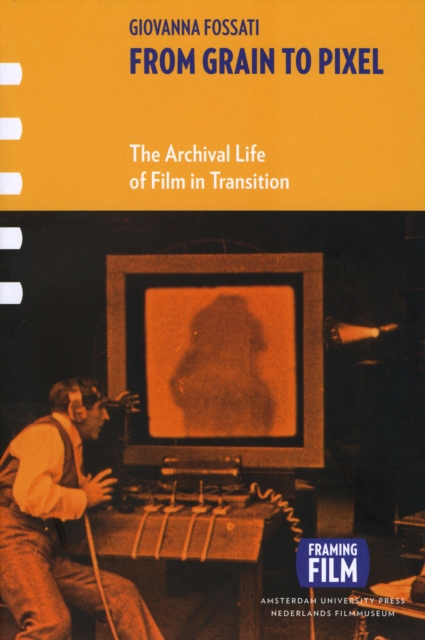
From grain to pixel
Film is in a state of rapid change, with the transition from analog to digital profoundly affecting not just filmmaking and distribution, but also the theoretical conceptualization of the medium film and the practice of film archiving. New forms of digital archives are being developed that make use of participatory media to provide a more open form of access than any traditional archive has offered before. Film archives are thus faced with new questions and challenges. From Grain to Pixel attempts to bridge the fields of film archiving and academic research, by addressing the discourse on film ontology and analysing how it affects the role of film archives. Fossati proposes a new theoretization of film archival practice as the starting point for a renewed dialogue between film scholars and film archivists.
Het bewegende beeld bevindt zich in een overgangsperiode waarin analoge (fotochemische) film geleidelijk vervangen wordt door digitale film. Deze overgang heeft niet alleen diepgaande invloed op filmproductie en -distributie, maar ook op de manier van archiveren van film en de theoretische conceptualisering van dit medium. Van digitale archieven worden steeds nieuwe vormen ontwikkeld. Deze archieven - digitale filmdatabases en YouTube bijvoorbeeld - maken gebruik van media die participatie van vele gebruikers mogelijk maken en worden zo toegankelijker dan ooit. Ondertussen is er nog onvoldoende dialoog tussen archivarissen en filmwetenschappers. From Grain to Pixel slaat een brug tussen archiveringspraktijken en wetenschappelijk onderzoek dat gebaseerd is op relevante debatten in film- en nieuwe mediastudies. Fossati stelt een nieuwe theorie op voor het archiveren en restaureren van film. Dit biedt mogelijkheden voor een hernieuwde dialoog tussen archivarissen en wetenschappers.
eBook
