
Catalogue Search | MBRL


Are you sure you want to remove the book from the shelf?

{{itemTitle}}
172
result(s) for
"Arianism"
Sort by:

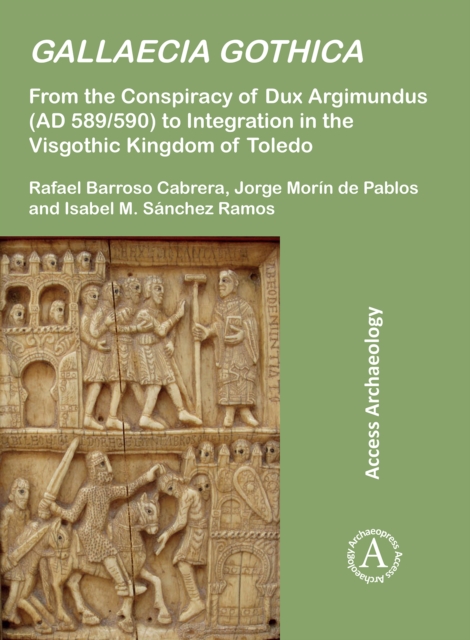
Gallaecia Gothica
Gallaecia Gothica offers a new interpretation of the Argimundus rebellion, one of the most difficult challenges of Reccared's reign. There are no specific details of how the conspiracy came about, but the throne was seriously threatened. The Chronicle of John of Biclaro underlined the gravity of this menace in his description of the punishment suffered by the rebel and his collaborators. His categorical condemnation of the attempted overthrow of the monarch is unlike that given to any other uprising narrated in the Chronicle, and it shows the importance that the abbot of Biclaro gave it in his narration.The fact that the Chronicle notes that Argimundus was not only a member of the Aula Regia but also a dux prouinciae (duke of a province), combined with the status of Gallaecia as a newly conquered province, suggests that this was not just a palace conspiracy, but a genuine provincial revolt which could have ruined the political settlement established by Leovigild and Reccared. However, it is difficult to prove Argimundus' ultimate aim: to replace Reccared on the Visigothic throne or, on the contrary, to restore the old Suevic kingdom in Gallaecia. This book uses numismatic and archaeological evidence seems to suggest the latter view.
eBook

L’arianisme dans le royaume wisigothique de Toulouse
Après l’installation des Wisigoths à Toulouse en 418, une situation nouvelle apparut : la minorité gothique était arienne, alors que la population locale était catholique. L’Empire reconnaissant aux Barbares ariens la possibilité de conserver leur confession, les deux populations coexisteront pacifiquement, sans toutefois se mélanger car les mariages mixtes étaient interdits. Les problèmes surgirent lorsque, avec la disparition de l’Empire, l’Église perdit son protecteur officiel. Doutant de la fidélité de l’épiscopat, Euric prit des mesures hostiles aux catholiques. Sur le plan religieux, les catholiques furent conduits à préciser leur foi, tandis que les ariens empruntèrent des éléments de leur liturgie aux orthodoxes, ainsi que l’organisation de leurs lieux de culte. Les conciles, après la conversion des Goths au catholicisme, auront à régler les questions canoniques de leur retour à l’orthodoxie. After the installation of the Visigoths in Toulouse in 418, a new situation emerged: the Gothic minority was Arian while the local population was Catholic. The Empire recognizing the Barbarians Arians the possibility of preserving their confession, the two populations will coexist peacefully, but not mix because mixed marriages were forbidden. The problems came when, with the disappearance of the Empire, the Church lost its official protector. Doubting the faithfulness of the episcopate, Euric took measures hostiles to the Catholics. On the religious level, Catholics specified their faith, while the Arians borrowed elements from their liturgy to the Orthodox, as well as the Organization of their churches. The Councils, after the conversion of the Goths to Catholicism, will have to settle the canonical questions of their return to orthodoxy.
Journal Article
Saint Ambrose of Milan 337 (340?)–397, Explanatio symboli—The Present Value of the Ambrosian Dogmatic Message
Explanatio symboli, a true Christian pedagogy lesson, is attributed to Saint Ambrose of Milan. It, was established 1700 years after the Synod of Nicaea, in which the first seven confessional articles of the Orthodox Creed were written. In the current religious context, it aims to resurrect the baptismal faith that was so manifest in the Milanese environment within the first few centuries after the persecutions came to an end. To the great bishop of the Century IV Occident, the Baptism and the doxological confession of the All-Holy Trinity, alongside the Trinitarian doxology, were empirical realities within ecclesial life, and were also associated with the experience of grace in the Trinitarian communion. This was imperative, especially in the context of defending the right-faith against the Arianism’s attacks, whose infiltration spread all the way to the Western borders of the Roman Empire. To Saint Ambrose, as to us living today, life in Christ—shaped by confessing the Trinitarian faith and through Baptism—is one that enlightens humanity to become Christo-morphic until the last moment of our life here, and this is the true existential meaning whose efficacity and reality lead us towards His Kingdom.
Journal Article

Peter the Venerable and Islam
For over four centuries the principal source of Christian European knowledge of Islam stemmed from a project sponsored by Peter the Venerable, ninth abbot of Cluny, in 1142. This consisted of Latin translations of five Arabic works, including the first translation of the Koran in a western language. Known as the Toledan Collection, it was eventually printed in 1543 with an introduction by Martin Luther. The abbot also completed a handbook of Islam beliefs and a major analytical and polemical work, Liber contra sectam Saracenorum; annotated editions of these texts are included in this book.
Originally published in 1964.
The Princeton Legacy Library uses the latest print-on-demand technology to again make available previously out-of-print books from the distinguished backlist of Princeton University Press. These editions preserve the original texts of these important books while presenting them in durable paperback and hardcover editions. The goal of the Princeton Legacy Library is to vastly increase access to the rich scholarly heritage found in the thousands of books published by Princeton University Press since its founding in 1905.
eBook

Arianism
This book surveys Arianism, a Christian creed of tremendous historical importance that once served as the faith of Roman emperors and the barbarians on the frontiers alike, while it simultaneously advances existing scholarship by integrating the approaches of history and theology with those drawn from the cognitive science of religion. This paradigm shift allows us to understand the initial support for the Arian creed and its eventual rejection by Roman emperors; to recognize the nature of intuitions of divinity amongst Germanic peoples before their conversion; to discern the way in which these were translated into Christian belief; and to differentiate the beliefs of Arius from those called Arians by their opponents.
eBook

‘A Thing Like God’: Re-Reading Gothic Philippians 2.6–8
The Gothic translation of Phil 2.6–8 differs from the Greek in three ways: it says that Christ did not think it robbery to be ‘like God’; it breaks the parallelism between the ‘form of God’ and ‘form of a slave’; and it states explicitly that Christ was obedient ‘to the Father’. Scholars have focused exclusively on the first element, crediting it to the Homoian ‘Arian’ prejudices of the translator, Wulfila, or to his opposition to modalist tendencies in pro-Nicene thought of the 340s. Neither interpretation is satisfactory, the first because the Gothic displays no generalised Homoian bias, the second on philological grounds. When the passage is viewed as a whole, an explanation can be found in the history of exegesis. Homoian churchmen, who followed a theology close to the elderly Wulfila’s, seem to have construed ἁρπαγμός (Gothic wulwa, English ‘robbery’) as res rapienda, in the typology developed by N.T. Wright. Christ did not ‘seize’ equality with God. Incompatible with this view, the Gothic is a better fit for res retinenda (Christ did not ‘hold fast’ his divine status). In an ancient analogue to modern ‘functional equivalence’, it is representing the meaning of the text, as agreed among Greek exegetes, on the translation’s surface. Just why Wulfila did this remains obscure: certainly to clarify the passage’s Christology, but possibly also to head off misinterpretation in his Gothic context. Either way, the Gothic text shows a more flexible approach to translation than scholarship, still focused on stereotyped ‘Arianism’ and lexical equivalence, has yet recognised.
Journal Article

“Sing Unto the Lord a New Song”: Musical Innovation at the Boundaries of Schism
This study examines the theological and liturgical significance of the biblical injunction to “sing a new song,” tracing its deployment across eras of Christian history as both a symbol of renewal and a tool of doctrinal contestation. Focusing on key moments of schism—the early Church’s response to Gnostic and Arian hymnody and Ambrose’s adoption of Eastern antiphonal singing, the article explores how musical form, meter, and performance practice became markers of orthodoxy and heresy long before Reformation-era musical reforms. Drawing on patristic commentary, heresiographical sources, and hymnological analysis, the study highlights how the popular style in various guises was alternately condemned and reclaimed. This suggests that Christian music has consistently evolved through interaction with popular and heterodox forms and that the “new song” in its exegetical form has functioned as a recurring strategy of theological self-definition. Ultimately, the paper argues that disputes over musical style mirror broader tensions between innovation and authority and that the history of hymnody offers a unique lens into the formation of Christian identity.
Journal Article

Reason and Religion in the English Revolution
This book provides a significant rereading of political and ecclesiastical developments during the English Revolution, by integrating them into broader European discussions about Christianity and civil society. Sarah Mortimer reveals the extent to which these discussions were shaped by the writing of the Socinians, an extremely influential group of heterodox writers. She provides the first treatment of Socinianism in England for over fifty years, demonstrating the interplay between theological ideas and political events in this period as well as the strong intellectual connections between England and Europe. Royalists used Socinian ideas to defend royal authority and the episcopal Church of England from both Parliamentarians and Thomas Hobbes. But Socinianism was also vigorously denounced and, after the Civil Wars, this attack on Socinianism was central to efforts to build a church under Cromwell and to provide toleration. The final chapters provide a new account of the religious settlement of the 1650s.
eBook

TWO LETTERS OF THE USURPER MAGNUS MAXIMUS (COLLECTIO AVELLANA 39 AND 40)
This article presents, for the first time in English, a translation of the two letters of the usurping emperor Magnus Maximus that are to be found within the Collectio Avellana (letters 39 and 40). The letters—from Maximus to the Emperor Valentinian II and from Maximus to Siricius, bishop of Rome—are each introduced with an extensive discussion of their subject matter, the circumstances of their composition, and their probable date. The article then considers possible reasons for these letters’ unusual survival; as letters of a usurping emperor, one would have expected them to be destroyed, and the article explores how we may understand their inclusion in the Collectio Avellana. Finally, the translations are given, with extensive commentary in their notes.
Journal Article