
Catalogue Search | MBRL


Are you sure you want to remove the book from the shelf?

{{itemTitle}}
2
result(s) for
"Aristotle Infuence."
Sort by:
The elements of Avicenna's physics : Greek sources and Arabic innovations
\"This study is the first comprehensive analysis of the physical theory of the Islamic philosopher Avicenna (d. 1037). It seeks to understand his contribution against the developments within the preceding Greek and Arabic intellectual milieus, and to appreciate his philosophy as such by emphasising his independence as a critical and systematic thinker. Exploring Avicenna's method of \"teaching and learning,\" it investigates the implications of his account of the natural body as a three-dimensionally extended composite of matter and form, and examines his views on nature as a principle of motion and his analysis of its relation to soul. Moreover, it demonstrates how Avicenna defends the Aristotelian conception of place against the strident criticism of his predecessors, among other things, by disproving the existence of void and space. Finally, it sheds new light on Avicenna's account of the essence and the existence of time. For the first time taking into account the entire range of Avicenna's major writings, this study fills a gap in our understanding both of the history of natural philosophy in general and of the philosophy of Avicenna in particular.\"-- Publisher's website.
BOOK
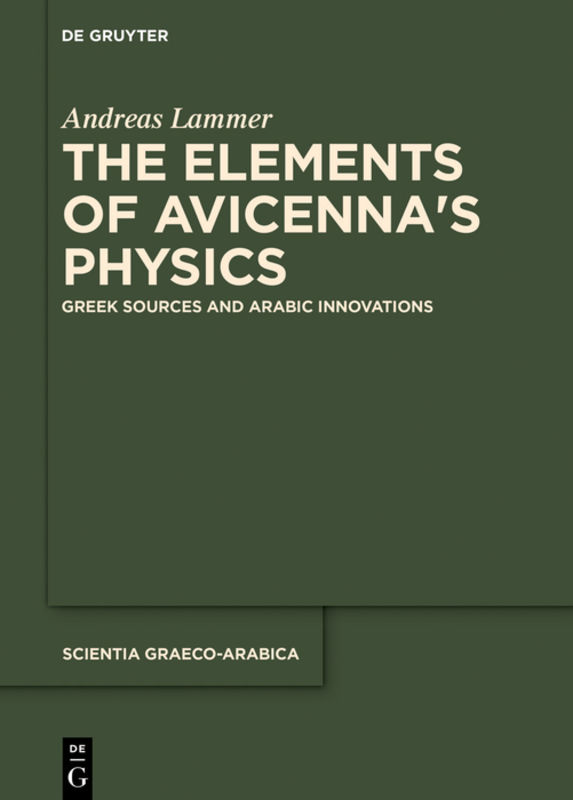
The elements of Avicenna's physics : Greek sources and Arabic innovations
The series is devoted to the study of scientific and philosophical texts from the Classical and the Islamic world handed down in Arabic. Through critical text editions and monographs, it provides access to ancient scientific inquiry as it developed in a continuous tradition from Antiquity to the modern period. All editions are accompanied by translations and philological and explanatory notes.
eBook