
Catalogue Search | MBRL


Are you sure you want to remove the book from the shelf?

{{itemTitle}}
616
result(s) for
"Arkitektur"
Sort by:


This is not a house
Takes a close look at spaces that reformulate the idea of what home means, in innovative houses in cities around the globe. Showcases recent projects that represent the vanguard of architects creating innovative spaces for living in the twenty-first century. Dan Rubinstein and the editors of the Amsterdam-based magazine have selected projects on five continents that will shape how we think of domestic life for a long time to come. Where the great experimenters of the last century were stripping away ornamentation and creating free-flowing spaces for the first time, today's pioneers are researching the potential of new materials and techniques to push the boundaries of environmental sustainability, as well as creating new forms and bold, sophisticated explorations in the adaptive reuse of spaces originally designed for any number of other purposes. This Is Not a House presents the latest built residential projects by such design luminaries as Sou Fujimoto, Plasma Studio, and Michael Maltzan, as well as emerging ones such as Johan Selbing, among others, in an array of locations across the globe, including New York, London, Los Angeles, and Tokyo.
Book


'The best guess for the future?' Teachers' adaptation to open and flexible learning environments in Finland
Finnish education has recently experienced reforms with respect to guidelines forming the curriculum framework for basic education and school architecture. Since 2016, all new schools incorporate open and flexible design, at least to some extent. The more open school design challenges the conventional organisation of space and pre-defined structures and interaction practices. This study investigates how teachers both adapt and are affected by new demands for pedagogy, team teaching and teacher-student relationships. Interview data of 21 teachers of six modern schools are reviewed through thematic analysis. The new school layouts provided some incongruence with the teachers' aims and their preferred practices. Although many teachers were dissatisfied with the new or remodelled space solution, they felt that their school had developed as a learning community, with improved collegiality, and good experiences of team teaching had increased. Shared vision, open discussion, commitment and enough time for preparation had helped in adaptation. Lacking arguments behind school transformation and the dismissal of ideas of school design hindered adaptation. This study suggests that teachers should have a greater voice in the school design process, and the needs of learners should be carefully considered, ensuring optimal physical and pedagogical context for effective and collaborative learning.
Journal Article

Mongrel rapture : the architecture of Ashton Raggatt McDougall
Mongrel Rapture is the first major monograph on Ashton Raggatt McDougall, one of the most significant architectural practices in Australia. ARM's architecture draws from a diverse territory of inspiration, including Michelangelo and Robert Venturi, computer programming and biblical verse. It has been celebrated--and occasionally execrated--by critics and the public alike, yet, despite the work's capacity to polarise, the practice has produced some of Australia's most significant buildings. These include the National Museum of Australia, Canberra (2001), Melbourne Recital Centre and Melbourne Theatre Company Southbank Theatre (2008), Perth Arena (2012) and the Barak Building at Swanston Square (2015), which puts the portrait of Wurundjeri Elder William Barak at the northern tip of Melbourne's civic axis. Mongrel Rapture is a book of many parts, including an extensive selection of architectural drawings, a rich photographic portfolio of key projects, and invited contributions from writers, critics and architects from around the world. It also includes a substantial body of texts on the practice itself, most importantly through a series of compelling texts by ARM directors Ian McDougall and Howard Raggatt. These are revealing and, at times, confronting. Independent contributors include Charles Jencks, Mark C Taylor, Leon van Schaik, Harriet Edquist, Conrad Hamann, Vivian Mitsogianni, John Macarthur and Naomi Stead. This exquisite volume, designed by renowned Australian graphic artist Stuart Geddes, is an illuminated manuscript every bit as provocative and puzzling as ARM's buildings. It contains dynamic QR codes that point to a wealth of exclusive digital material beyond the book's pages, including drawings of all of ARM's major public buildings, conceptual animations and audio material. Ranting, funny, and reflective in turn, Mongrel Rapture is many books in one binding. It radically rethinks what an architecture publication can be.
Book

The Aurelian Wall and the Refashioning of Imperial Rome, AD 271–855
This book explores the relationship between the city of Rome and the Aurelian Wall during the six centuries following its construction in the 270s AD, a period when the city changed and contracted almost beyond recognition, as it evolved from imperial capital into the spiritual center of Western Christendom. The Wall became the single most prominent feature in the urban landscape, a dominating presence which came bodily to incarnate the political, legal, administrative, and religious boundaries of urbs Roma, even as it reshaped both the physical contours of the city as a whole and the mental geographies of 'Rome' that prevailed at home and throughout the known world. With the passage of time, the circuit took on a life of its own as the embodiment of Rome's past greatness, a cultural and architectural legacy that dwarfed the quotidian realities of the post-imperial city as much as it shaped them.
eBook
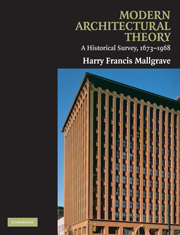
Modern Architectural Theory
Modern Architectural Theory is the first book to provide a comprehensive survey of architectural theory, primarily in Europe and the United States, during three centuries of development. In this synthetic overview, Harry Mallgrave examines architectural discourse within its social and political context. He explores the philosophical and conceptual evolution of its ideas, discusses the relation of theory to the practice of building, and, most importantly, considers the words of the architects themselves, as they contentiously shaped Western architecture. He also examines the compelling currents of French rationalist and British empiricist thought, radical reformation of the theory during the Enlightenment, the intellectual ambitions and historicist debates of the nineteenth century, and the distinctive varieties of modern theory in the twentieth century up to the profound social upheaval of the 1960s. Modern Architectural Theory challenges many assumptions about architectural modernism and uncovers many new dimensions of the debates about modernism.
eBook
Building Pedagogies. A historical study of teachers' spatial work in new school architecture
This article addresses schoolteachers' spatial work in the process of inhabiting and using a new school building. The study focuses on a historical case of a Danish open-plan school built in the early 1970s and shows how the teachers' spatial work engages with questions of the organisation of bodies, sound, furniture and teaching aids. The article uses Tim Ingold's notion of making - stressing the making of architecture, as well as pedagogy, as a continuous and never-ending process - and Karen Barad's theory of agential realism to explore the teachers' spatial work as part of the intra-actions of and mutual coming into being of school space, pedagogical ideas, teachers and pupils. Finally, the article analyses the transnational entanglements of the teachers' spatial work through a discussion of the open-plan school as an architectural and pedagogical model found across the globe.
Journal Article