
Catalogue Search | MBRL


Are you sure you want to remove the book from the shelf?

{{itemTitle}}
1,892
result(s) for
"Armed neutrality"
Sort by:

Defending Neutrality
Defending Neutrality analyses the broad spectrum of war preparation of a small neutral state, The Netherlands, before, during and after the First World War. It deals with the role of neutral states close to the front and with the internal technological, military and societal developments within that state to ensure its survival.
eBook

Small Powers in the Age of Total War, 1900-1940
In the period 1900-1940 the Netherlands, Belgium, Denmark, Norway and Switzerland reacted in divergent ways to the same foreign military threats. This volume argues that their internal politics and politico-military strategic culture are vital keys to understanding those differences.
eBook
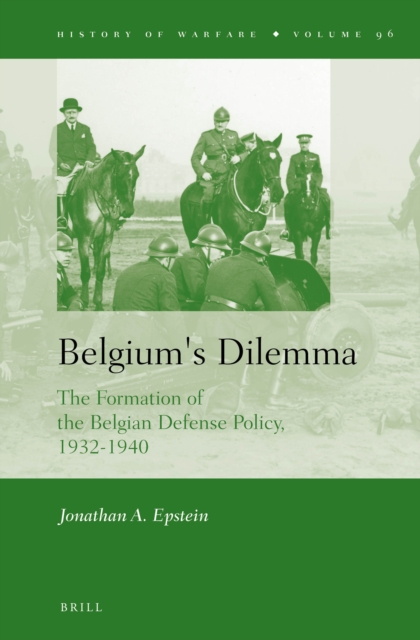
Belgium's Dilemma
Jonathan Andrew Epstein's Belgium's Dilemma: The Formation of Belgian Defense Policy, 1932-1940 is a study of the policy makers, debates, and decisions that impacted the Belgian army in the years before World War II.
eBook

In the interest of peace and quiet in Europe
The Netherlands is positioned amidst three major powers and controls the mouths of three main European rivers. Until the First World War, its choice for armed neutrality (1840-1940) seemed to be the most fitting answer to its security problem. After 1918, the Netherlands had difficulties adjusting to modern war, having decreased its defence budget substantially, and lacked a coherent political-military answer to the interwar strategic and operational challenges. Old notions of the Netherlands as a vital element of regional peace and as a country that could influence the behaviour of its large neighbours no longer fitted reality. Neutrality ceased to provide security to the country, thereby also endangering the stability in Western Europe to which the Dutch so wholeheartedly aspired.
Journal Article

NATO and American Security
The Berlin crisis, the Suez intervention, the Cyprus problem, and other differences among the NATO powers have tended to weaken the alliance in the face of constant Soviet pressure. Emphasizing the 1960's, a group of experts here examines the future of NATO and American security: military strategy for limited and large scale war, the problem of deterrence, nuclear sharing, surprise attack and disarmament, the special positions of England and Germany, and alternatives to NATO. The contributors are: Klaus Knorr, Roger Hilsman, C. E. Black, F. J. Yeager, G. W. Rathjens Jr., Malcolm Hoag, M. A. Kaplan, A. L. Burns, T. C. Schelling-, Denis Healey, G. A. Craig, and P. H. Nitze.
Originally published in 1959.
The Princeton Legacy Library uses the latest print-on-demand technology to again make available previously out-of-print books from the distinguished backlist of Princeton University Press. These editions preserve the original texts of these important books while presenting them in durable paperback and hardcover editions. The goal of the Princeton Legacy Library is to vastly increase access to the rich scholarly heritage found in the thousands of books published by Princeton University Press since its founding in 1905.
eBook

Strategy in the American War of Independence
\"This book examines the strategies pursued by the Colonies and the other combatants in the American War for Independence, placing the conflict in its proper global context. Many do not realize the extent to which the 1775 colonial rebellion against British rule escalated into a global conflict. Collectively, this volume examines the strategies pursued by the American Colonies, Great Britain, France, Spain, and Holland, and the League of Armed Neutrality, placing the military, naval, and diplomatic elements of the struggle in their proper global context. Moreover, assessing how each nation prosecuted their respective wars provides lessons for current students of strategic studies and military and naval history. This book will be of great interest to students of strategic studies, American history, Military History and political science in general. Donald Stoker is Professor of Strategy and Policy for the US Naval War College's Monterey Program in Monterey, California. He joined the Strategy and Policy faculty in 1999 and has taught both in Monterey and Newport. Kenneth J. Hagan, Professor Emeritus, the U.S. Naval Academy, is currently Professor of Strategy and Policy for the U.S. Naval War College's Monterey Program. Michael T. McMaster is a Professor at the U.S. Naval War College in Monterey. He is a retired U.S. Navy Commander.\"
eBook

Isolationism Reconfigured
This iconoclastic and fundamental work, Eric Nordlinger's last, advocates a new variant of isolationism, a \"national strategy\" confining U.S. military actions largely to North America and to neighboring sea-and air- lanes but encouraging international activism and engagement in nonsecurity realms. In Nordlinger's view, disengaging from security commitments on distant shores would liberate the United States to use its resources and decision-making powers to act more effectively abroad in matters of economic policy and human rights. A national strategy would then become a powerful new method of encouraging international ideals of democracy, and isolationism would be freed of its previous associations with appeasement, weakness, economic protectionism, and self-serving nationalism.
Nordlinger draws on the recent historical record to show that a national strategy would have lessened the perils of earlier decades, including those of the Cold War. While real dangers did exist during this period, engaged strategies, such as containment, too often exacerbated them. The United States could have effectively and far less expensively helped to deter Communist aggression in Europe and Asia by encouraging other nations to make larger investments in their own protection. Marshaling impressive empirical evidence in defense of a controversial position, this final work by a leading scholar of international affairs is essential reading for scholars, practitioners, and lay readers alike.
eBook

Fighting for a living
This book investigates the circumstances that have produced starkly different systems of recruiting and employing soldiers in different parts of the globe over the last years.
eBook

NEUTRAL ARMS TRANSFERS AND THE RUSSIAN INVASION OF UKRAINE
Since the beginning of the Russian invasion of Ukraine in February 2022, numerous Western States have supplied Ukraine with arms, munitions and war material, in ostensible breach of their obligations as neutral, non-participating States. States have failed to provide any legal explanation for such transfers, leaving the task to scholars and commentators to provide legal argumentation as to the compatibility of arms transfers to victims of aggression with neutral duties. This article analyses and seeks to evaluate these arguments in favour of ‘qualified neutrality’ and assess which of the proposed grounds, if any, are the most compelling.
Journal Article