
Catalogue Search | MBRL


Are you sure you want to remove the book from the shelf?

{{itemTitle}}
118
result(s) for
"Arranged marriage Fiction."
Sort by:

The marriage clock : a novel
\"Starting on the night of her 26th birthday, an Indian woman has just three months to find her true love or else, she has to allow her parents to arrange her marriage\"-- Provided by publisher.
Book

Shadowing Femi(ni)cide, Madness and the Politics of Female Control in Louisa May Alcott's \A Whisper in the Dark\
The term ‘femicide’ entered public discourse only in the late 1970s, when feminist critic Diana Russell used the term to bring attention to male violence and discrimination against women. This article intends to re-examine therepresentation of femicide through Louisa May Alcott’s short story “A Whisper in the Dark” (1865) in light of studies on femicide and female violence. Drawing from Russell’s definition of femicide, its theoretical approach and multipleredefinitions, the article proceeds by exploring Alcott’s depiction of femicide in the text. After a preliminary discussion, I critically examine Alcott’s short storyin light of studies on femicide by placing the text within American female Gothic fiction. Afterwards, I will demonstrate how femicide in the tale is based upon aninterplay of three main tropes: wrongful confinement, the threshold and madness, all of which are themes that Alcott develops with astonishing topicality and which underscores the importance of the tale as an example of female abuseand domestic violence, a phenomenon that has improved considerably all over the world in recent years. I conclude by showing how Alcott illustrates the politics of female control and offers an example of femicide long before the term was ever used.
Journal Article
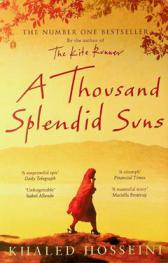
A thousand splendid suns
A story of deep friendship and family set in Afghanistan - It depicts the impact of the brutal regime of the Taliban on the life of the people, in particular the effect on Laila and Mariam whose friendship develops as they unite to survive in a harsh and unforgiving world.
Book

STERNER STUFF; SANSA STARK AND THE SYSTEM OF GOTHIC FANTASY
A short story is presented.
Journal Article

The fire queen
In exile after the death of Rajah Tarek and the invasion of the imperial city, Kalinda must fight and defeat three tournament opponents to ensure the help of Prince Ashwin against the warlords and to win Captain Deven Naik's release from prison.
Book

To me, I no man yet!
Samuel Selvon's A Brighter Sun (1952) and V S. Naipaul's A House for Mr. Biswas (1961) are two literary masterpieces that together depict various degrees of the Indo-Trinidadian man's sexuality and quest for manhood as being at the heart of human life. An epistemological craft that helps the reader construct an understanding of life in a British colony, A Brighter Sun reflects life in early 1940s Trinidad and has as its protagonist Tiger, a peasant with middle-class sensibility on the verge of discovering and shaping his sexuality and masculinity when he is married at age sixteen. According to Kenneth Ramchand: A Brighter Sun was the first brave attempt to deal, in fiction, with the crucial issue of the kind of relationships that may exist between Indians and Africans [and] Selvon employs a simple device to begin his story of African-Indian rapprochement: the newly married country Indians, Tiger and Urmilla set up house in Barataría next to the African couple Joe and Rita. Noted Caribbean gender activist and scholar Patricia Mohammed posits that, by indentureship's end in 1917, three competing masculinities existed: \"the dominant white patriarchy which controlled state power as it existed then; the 'creole' patriarchy of Africans and the mixed group, functioning in and emerging from the dominant white group; and the Indian patriarchy found among the Indian population\" (35).
Journal Article


FICTIONAL MINDS AND FEMALE SEXUALITY
Why have all the major novelistic innovations in representing consciousness been achieved through depicting the minds of female characters? This essay argues that eighteenth-century conduct books provided the cultural impetus and structural frame for a particular subjectivity--the self-examining heroine--that required the development of narrative techniques for rendering fictional minds. The essay traces the consciousness scene from the early novel to the twentieth century in order to demonstrate how the historical development of modes of thought representation has been synonymous with explorations of female sexual identity, played out most specifically in the relation between narrator and character fostered by free indirect discourse.
Journal Article

The Science Fiction of Roe v. Wade
This article argues that since the 1960s, science fiction's explorations of the human and the posthuman have been anchored in a very real legal question of their and our time--that of abortion. Unlike literary fiction, which has focused on representing realistic human emotions, science fiction's speculative character has allowed its authors to extend and examine the myriad cultural and legal analogies that established personhood in the years surrounding Roe v. Wade (1973). The most prominent early example of science fiction's engagement with abortion appears in the writings of Philip K. Dick, whose pro-life sentiments escalated as his career progressed.
Journal Article