
Catalogue Search | MBRL


Are you sure you want to remove the book from the shelf?

{{itemTitle}}
183
result(s) for
"Art, African Catalogs."
Sort by:


Investigating Art Exhibition Catalogue Design as a Creative Expression in Itself: Case of \Dry Bones Shall Rise Again\ Catalogue
This paper explores the evolving role of the art exhibition catalogue beyond its traditional function as a documentary tool or promotional material. Using qualitative approach, it argues that catalogues can transcend their utilitarian purposes to become autonomous creative artefacts, capable of standing alongside the artworks they document as expressions of intellectual and artistic engagement. Framing catalogue design as a form of creative research output, the study positions it within the growing academic discourse on practice-based research, where the creative process and its outcomes are both integral to scholarly inquiry. By focusing on the curatorial vision, conceptual depth and reflective content embedded within exhibition catalogues, this research advocates for their recognition as legitimate contributions to knowledge and practice in the fields of visual arts, design and communication. Using the case of Dry Bones Shall Rise Again, the study initiates a conversation on the inclusion of such catalogues in academic promotion criteria, especially in art and design faculties where practice-led contributions are often undervalued. The paper calls for institutions to broaden evaluation frameworks to include creative and curatorial productions as valid scholarly outputs. In doing so, it emphasizes the need for a more inclusive understanding of academic productivity, one that reflects the dynamic interplay between theory and practice and that values artistic expression as a form of research in its own right.
Journal Article


On Decimals, Catalogs, and Racial Imaginaries of Reading
Entering Howard University’s Moorland-Spingarn Research Center, one still passes through the “catalog room,” an antechamber filled with rows of card drawers. Inaugurated in 1930 by the librarian Dorothy Porter, this catalog of the “Negro Collection” served for much of the twentieth century as one of the only portals to African American print culture. This article reconstructs the creation of that catalog in order to chart the relation between infrastructure and racial imaginaries of reading. Porter contravened the routine misiling of blackness in prevailing information systems by rewriting Dewey decimals, creating new taxonomies for black print, and ielding research inquiries from across the African diaspora. She built public access to books “by and about the Negro” at a moment when most black readers were barred from libraries. In so doing, she fueled a broader sense of what a black archive—or what Porter called a “literary museum”—might afford.
Journal Article

Black refractions : highlights from the Studio Museum in Harlem
\"The artists featured in Black Refractions, including Kerry James Marshall, Faith Ringgold, Nari Ward, Norman Lewis, Wangechi Mutu, and Lorna Simpson, are drawn from the renowned collection of the Studio Museum in Harlem. Through exhibitions, public programs, artist residencies, and bold acquisitions, this pioneering institution has served as a nexus for artists of African descent locally, nationally, and internationally since its founding in 1968. Rather than aim to construct a single history of \"black art,\" Black Refractions emphasizes a plurality of narratives and approaches, traced through 125 works in all media from the 1930s to the present.\"--Amazon.com.
Book
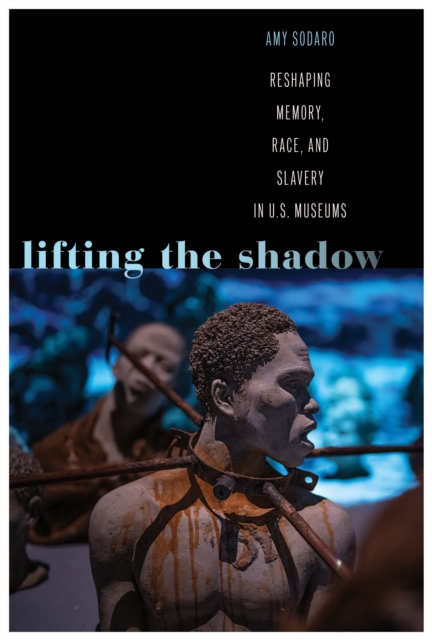
Lifting the Shadow
Lifting the Shadow: Reshaping Memory, Race, and Slavery in U.S.
Museums examines a small but significant wave of new U.S.
memorial museums that focus on slavery and its ongoing violent
legacies, including the Smithsonian National Museum of African
American History and Culture, Montgomery's Legacy Museum: From
Enslavement to Mass Incarceration, and Greenwood Rising, which
commemorates the 1921 Tulsa Race Massacre. These museums are
challenging historical narratives of slavery and race by placing
racial oppression at the center of American history and linking
historical slavery to contemporary racial injustice, but they have
opened in a period marked by growing racial tension, white
nationalism, and political division. Sodaro examines how the
violence of U.S. slavery and its lasting legacies is negotiated in
these museums, as well as their potential to contribute to the
development of a more critical historical memory of race in the
U.S. at this particularly volatile sociopolitical moment.
eBook

Luluwa : Central African art between heaven and earth
Living in the region between the Lubudi and Kasai rivers in south central Democratic Republic of the Congo, the Luluwa people are known for their elaborately carved male and female figure sculptures, masks, and decorative arts. Constantine Petridis draws on first-hand accounts of numerous explorers, missionaries, colonial servants, anthropologists, and art historians who visited the region between the 1880s and the 1970s, to comprehensively situate the Luluwa's ornate art in its original environment of production and use. Through a close study of published and unpublished sources as well as museum objects and archival photographs, this book sheds new light on the historical context of one of central Africa's most spectacular artistic legacies, whose creation presumably dates back to the second half of the 19th century.
Book

Stewards of the Nation's Art
Stewards of the Nation's Artexamines the internal tensions between Britain's four main public art galleries' administrative directors, the aristocrats dominating the boards of trustees, and those in the Treasury who controlled the funds as well as board appointments.
eBook


Art library collections at research universities: IDBEA in collection development
Academic research libraries that build and steward collections in support of art research are always developing and executing strategies for their physical and virtual spaces, preservation, and access. NYU Libraries’ Institute of Fine Arts Library welcomes readers of a wide range of expertise, subject focus, and languages and works to make the library collections easier to discover and use in more creative ways in the pursuit of research, teaching, and learning. This work raises the question, whom do librarians turn to when they are responsible for subject areas or languages they may not know? This article concerns collection development at NYU Libraries’ Institute of Fine Arts Library focusing on the African American and Black Diaspora, Asian, and Latin American & Caribbean art collections as distinct collections within a larger art library setting. In addition, it provides ways libraries can implement collection development policies that prioritize materials by underrepresented groups and offer community engagement with partners focused on inclusion, diversity, belonging, equity, and accessibility.
Journal Article