
Catalogue Search | MBRL


Are you sure you want to remove the book from the shelf?

{{itemTitle}}
500
result(s) for
"Art Study and teaching (Early childhood)"
Sort by:


Digital Technologies in Early Childhood Art
Through art children make sense of their experiences and the world around them.Drawing, painting, collage and modelling are open-ended and playful processes through which children engage in physical exploration, aesthetic decision-making, identity construction and social understanding.
eBook

Postdevelopmental approaches to childhood art
\"In childhood research, children's art-making has typically been viewed and understood through a lens of developmental psychology and the notion that children's art-making progresses through a linear series of stages continues to dominate how we design and implement art-making experiences for young children. Postdevelopmental Approaches to Childhood Art brings together the work of theorists from around the world who have presented postdevelopmental approaches to childhood art, thereby playing a vital part in unsettling the dominance of the developmental paradigm and offering worked examples of alternative models. Drawing on sociocultural theory, Deleuzian philosophy, posthumanism and postmodernism each chapter offers a theoretical basis that challenges developmentalism, as well as an application of that theoretical basis. The contributors also consider what this shift in our perspective means for the design and implementation of art-making experiences for young children.\"-- Provided by publisher.
Book

Drawing and painting : children and visual representation
Praise for the First Edition: `This is a fascinating book that clearly demonstrates the importance of such early artwork. It is richly provided with relevant photographs and each phase of development is clearly explained ... It really is a \"must read\" for anyone working with young children! - Montessori International, Vol. 10 No. 3 Autumn 2000 This book has been revised to reflect recent developments in early childhood education, in developmental psychology and in our understanding of children′s development in the arts. The author shows how this new model of children′s development in visual representation has important implications for education. This is a revised edition of Helping Children to Draw and Paint: Children and Visual Representation, originally published in 1994.
eBook

Digital technologies in early childhood art : enabling playful experiences
\"Through art children make sense of their experiences and the world around them. Drawing, painting, collage and modelling are open-ended and playful processes through which children engage in physical exploration, aesthetic decision-making, identity construction and social understanding. As digital technologies become increasingly prevalent in the lives of young children, there is a pressing need to understand how digital technologies shape important experiences in early childhood, including early childhood art. Mona Sakr shows the need to consider how particular dimensions of the art-making process are changed by the use of digital technologies and what can be done by parents, practitioners and designers to enable children to adopt playful and creative practices in their interactions with digital technologies. Incorporating different theoretical perspectives, including social semiotics and posthumanism, and drawing on various research studies, this book highlights how children engage with different facets of art-making with digital technologies including: remix and mash-up; distributed ownership; imagined audiences and changed sensory and social interactions.\"-- Provided by publisher.
Book
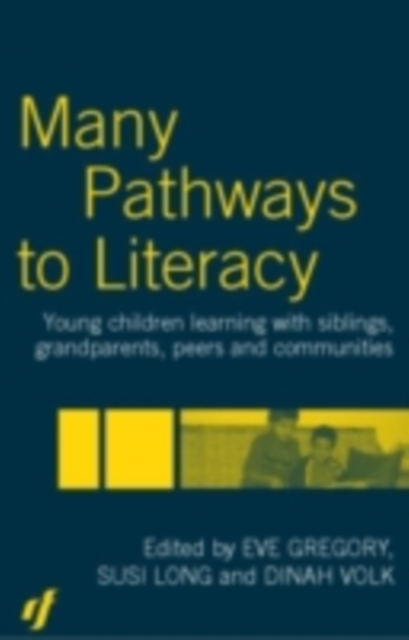
Many Pathways to Literacy
This unique and visionary text is a compilation of fascinating studies conducted in a variety of cross-cultural settings where children learn language and literacy with siblings, grandparents, peers and community members. Focusing on the knowledge and skills of children often invisible to educators, these illuminating studies highlight how children skilfully draw from their varied cultural and linguistic worlds to make sense of new experiences.
The vastly experienced team of contributors provide powerful demonstrations of the generative activity of young children and their mediating partners - family members, peers, and community members - as they syncretise languages, literacies and cultural practices from varied contexts.
Through studies grounded in home, school, community school, nursery and church settings, we see how children create for themselves radical forms of teaching and learning in ways that are not typically recognised, understood or valued in schools.
This book will be invaluable reading for teachers, teacher educators, researchers and policy-makers who seek to understand the many pathways to literacy and use that knowledge to affect real change in schools.
eBook


Art and Creativity in Reggio Emilia
This book explores the contribution of and art and creativity to early education, and examines the role of the atelier (an arts workshop in a school) and atelierista (an educator with an arts background) in the pioneering pre-schools of Reggio Emilia. It does so through the unique experience of Vea Vecchi, one of the first atelieristas to be appointed in Reggio Emilia in 1970.
Part memoir, part conversation and part reflection, the book provides a unique insider perspective on the pedagogical work of this extraordinary local project, which continues to be a source of inspiration to early childhood practitioners and policy makers worldwide.
Vea’s writing, full of beautiful examples, draws the reader in as she explains the history of the atelier and the evolving role of the atelierista. Key themes of the book include:
• processes of learning and knowledge construction
• the theory of the hundred languages of childhood and the role of poetic languages
• the importance of organisation, ways of working and tools, in particular pedagogical documentation
• the vital contribution of the physical environment
• the relationship between the atelier, the atelierista, the school and its teachers
This enlightening book is essential reading for students, practitioners, policy makers and researchers in early childhood education, and also for all those in other fields of education interested in the relationship between the arts and learning.
Series Editors' Introduction: Invitation to the Dance 1. Introduction 2. Aesthetics/Poetics 3. A General Overview 4. The Bicycle Metaphor 5. The Long View of Organisation 6. An Ethic Community 7. Environments 8. Professional Marvellers 9. Visible Learning 10. We Take Up the Walk Again 11. The Loris Malaguzzi International Centre 12. Blue Flowers, Bitter Leaves
Vea Vecchi worked as an atelierista at the Diana municipal preschool in Reggio Emilia for over thirty years, doing pedagogical research and documentation in the area of children’s many languages. She now acts as a consultant to 'Reggio Children'.
eBook

Communities of practice : art, play, and aesthetics in early childhood
Reflecting contemporary theory and research in early art education, this volume offers a comprehensive introduction to new ways of thinking about the place of art, play, and aesthetics in the lives and education of young children. Enlivened by narratives and illustrations, 16 authors offer perspectives on the lived experience of being a child and discovering the excitement of making meaning and form in the process of art, play, and aesthetic inquiry.
Book

STEM, STEAM and Makerspaces in Early Childhood: A Scoping Review
STEM has emerged as a key area of importance for children, highlighting the value and relevance of integrated understandings of science, technology, engineering and mathematics in both educational contexts and everyday life. The need for innovation and creativity is also recognised, which emphasizes the important role the arts can play as STEM is extended into STEAM. This scoping review investigated what is known about STEM, STEAM and makerspace experiences and opportunities for children aged birth to eight. The review found that early childhood experience with STEM, STEAM and makerspaces is an emerging field of research. Findings suggest that STEAM holds more relevance to learning and experiences in the early childhood years, and perhaps across the lifespan. The review also highlights the need to shift the starting point to the earliest of years and create greater intentionality in STEAM experiences with infants, toddlers and preschool aged children, recognizing the relevance of STEAM and maker mindsets in the lives of young children. Additionally, the scoping review identified the value of informal and community contexts as a means to invite broader participation. Such opportunities provide scope to challenge inequity in opportunity and to overcome intergenerational aversion towards STEM/STEAM-related learning. Further research is needed to understand the professional learning needs of early childhood educators and facilitators of STEAM and makerspace experiences.
Journal Article