
Catalogue Search | MBRL


Are you sure you want to remove the book from the shelf?

{{itemTitle}}
1,324
result(s) for
"Art Turkey History."
Sort by:

A cultural history of the Ottomans : the imperial elite and its artefacts
The Ottoman Empire was more than a center of military and economic activity; it was a vivid and flourishing cultural realm. The artefacts and objects remaining from all corners of this vast empire tell us a great deal about the everyday concerns of the Ottomans. In this book, Faroqhi, a leading historian on the Ottoman Empire, has selected the most revealing, surprising and striking examples of the artefacts which illuminate the lesser-known cultural and artistic world of the Ottomans. Each image reproduced in full color is deftly linked to the latest historiography, and the social, political and economic implications of her selections are never forgotten. In Faroqhi's hands, the objects become ways to learn more about trade, gender and socio-political status. They open an enticing window onto the variety and color of everyday life; from the Sultan's court, to the peasantry and slavery. Amongst its luxuriant faiences and etchings, its sofras and carpets, \"A Cultural History of the Ottomans\" is essential reading for all students of the Ottoman Empire and its material culture.\"
BOOK
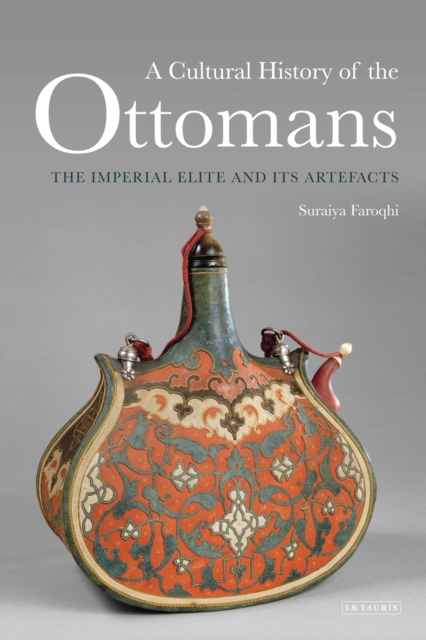
A Cultural History of the Ottomans
Far from simply being a centre of military and economic activity, the Ottoman Empire represented a vivid and flourishing cultural realm. The artefacts and objects that remain from all corners of this vast empire illustrate the real and everyday concerns of its subjects and elites and, with this in mind, Suraiya Faroqhi, one of the most distinguished Ottomanists of her generation, has selected 40 of the most revealing, surprising and striking. Each image - reproduced in full colour - is deftly linked to the latest historiography, and the social, political and economic implications of her selections are never forgotten. In Faroqhi’s hands, the objects become ways to learn more about trade, gender and socio-political status and open an enticing window onto the variety and colour of everyday life, from the Sultan’s court, to the peasantry and slavery. Amongst its faiences and etchings and its sofras and carpets, A Cultural History of the Ottomans is essential reading for all those interested in the Ottoman Empire and its material culture. Faroqhi here provides the definitive insight into the luxuriant and varied artefacts of Ottoman world.
eBook

How happy to call oneself a Turk : provincial newspapers and the negotiation of a Muslim national identity
The modern nation-state of Turkey was established in 1923, but when and how did its citizens begin to identify themselves as Turks? Mustafa Kemal Atatrk, Turkeys founding president, is almost universally credited with creating a Turkish national identity through his revolutionary program to secularize the former heartland of the Ottoman Empire. Yet, despite Turkeys status as the lone secular state in the Muslim Middle East, religion remains a powerful force in Turkish society, and the country today is governed by a democratically elected political party with a distinctly religious (Islamist) orientation. In this history, Gavin D. Brockett takes a fresh look at the formation of Turkish national identity, focusing on the relationship between Islam and nationalism and the process through which a religious national identity emerged. Challenging the orthodoxy that Atatrk and the political elite imposed a sense of national identity from the top down, Brockett examines the social and political debates in provincial newspapers from around the country. He shows that the unprecedented expansion of print media in Turkey between 1945 and 1954, which followed the end of strict, single-party authoritarian government, created a forum in which ordinary people could inject popular religious identities into the new Turkish nationalism. Brockett makes a convincing case that it was this fruitful negotiation between secular nationalism and Islamrather than the imposition of secularism alonethat created the modern Turkish national identity.
eBook


Opposition and Legitimacy in the Ottoman Empire
This book looks at opposition to the Ottoman government in the second half of the nineteenth century, examining a number of key political conspiracies and how these relate to an existing political culture. In his detailed analysis of these conspiracies, the author offers a new perspective on an important and well researched period of Ottoman history.
A close reading of police records on five conspiracies offers the opportunity to analyse this opposition in great detail, giving special attention to the different groups of political actors in these conspiracies that often did not come from the established political elites. Florian Riedler investigates how their background of class and education, but also their individual life experiences influenced their aims and strategies, their political styles as well as their ways of thinking on political legitimacy. In contrast, the reaction of the authorities to these conspiracies reveals the official understanding of Ottoman legitimacy.
The picture that emerges of the political culture of opposition during the second half of the nineteenth century offers a unique contribution to our understanding of the great changes in the political system of the Ottoman Empire at the time. As such, it will be of great interest to scholars of Middle Eastern history, political history, and the Ottoman Empire.
Florian Riedler is a historian specialising in Ottoman history of the nineteenth century. His current research interests are social and urban history of the Eastern Mediterranean, particularly Istanbul, as well as the history of migration in the Ottoman Empire.
1. Introduction: Political Culture of Conspiracy 2. A Sheikh and an Officer: The Society of Martyrs and the Kuleli Incident 3. New and Old Forms of Opposition: The Young Ottomans and the Vocation Group 4. How To Exchange Sultans: The Successful Coup Against Abdülaziz 5. War and Refugees: Ali Suavi and the Çırağan Incident 6. Bourgeois Conspirators: The Skalieri-Aziz Committee 7. Conclusion: The Tanzimat and Beyond
eBook

Istanbul exchanges : Ottomans, Orientalists, and nineteenth-century visual culture
\"A vibrant artistic milieu emerged in the late-nineteenth century Istanbul that was extremely heterogeneous, including Ottoman, Ottoman-Armenian, French, Italian, British, Polish and Ottoman-Greek artists. Roberts analyzes the ways artistic output intersected with the broader political agenda of a modernizing Ottoman state. She draws on extensive original research, bringing together sources in Turkey, England, France, Italy, Armenia, Poland and Denmark. Five chapters each address a particular issue related to transcultural exchange across the east-west divide that is focused on a particular case study of art, artistic patronage, and art exhibitions in nineteenth-century Istanbul\"--Provided by publisher.
Book

The Young Turks' crime against humanity : the Armenian genocide and ethnic cleansing in the Ottoman Empire
Introducing evidence from more than 600 secret Ottoman documents, this book demonstrates in unprecedented detail that the Armenian Genocide and the expulsion of Greeks from the late Ottoman Empire resulted from an official effort to rid the empire of its Christian subjects.
eBook


The Environmental Legacy of War on the Hungarian-Ottoman Frontier, c. 1540-1690
This book is the first monographic attempt to follow the environmental changes that took place in the frontier zone of the Ottoman Empire and the Kingdom of Hungary in the sixteenth and seventeenth centuries. On the one hand, it looks at how the Ottoman–Hungarian wars affected the landscapes of the Carpathian Basin – specifically, the frontier zone. On the other hand, it examines how the environment was used in the military tactics of the opposing realms. By taking into consideration both perspectives, this book intends to pursue the dynamic interplay between war, environment, and local society in the early modern period.
eBook