
Catalogue Search | MBRL


Are you sure you want to remove the book from the shelf?

{{itemTitle}}
90
result(s) for
"Art and society -- California -- Los Angeles"
Sort by:


Art and the City
No longer represented only by Hollywood and the commercial fashion industry, Los Angeles in recent years has received international media attention as one of the world's new art centers. From the appearance of local artists in major European exhibitions to widely reported multimillion-dollar museum endowments, Los Angeles has entered the world cultural stage.
Art and the City: Civic Imagination and Cultural Authority in Los Angelesplaces this celebrated arrival in the richer context of art controversies and political contests over modern art and art spaces in the twentieth century. The Ferus Gallery's pop-infused \"L.A. Look\" and \"finish-fetish,\" now synonymous with Los Angeles's postwar modernist aesthetics, emerged from a dispersed art community that struggled in the 1950s to find a toehold in a local scene reeling from the censure of the McCarthy era. The Watts Towers have long faced neglect despite their international fame, while Venice Beach, Barnsdall Park, Griffith Park, and Olvera Street proved highly contentious sites of urban cultural expression.
Challenging historical accounts that situate the city's origins as an art center in the 1960s,Art and the Cityargues that debates over modernism among artists and civic leaders alike made art a charged political site as early as the 1910s. The legacy of those early battles reverberated throughout the century. Because of a rich tradition of arts education and the presence of Hollywood, Los Angeles historically hosted a talented population of contemporary artists. However, because of the snug relationship between urban aesthetics and capital investment that underscored the booster goals of the civic arts movement, modern artists were pushed out of public exhibition spaces until after World War II.Art and the Cityuncovers the historic struggles for cultural expression and creative space that are hidden behind the city's booster mythology.
eBook


Land of Smoke and Mirrors
Unlike the more forthrightly mythic origins of other urban centers-think Rome via Romulus and Remus or Mexico City via the god Huitzilopochtli-Los Angeles emerged from a smoke-and-mirrors process that is simultaneously literal and figurative, real and imagined, material and metaphorical, physical and textual. Through penetrating analysis and personal engagement, Vincent Brook uncovers the many portraits of this ever-enticing, ever-ambivalent, and increasingly multicultural megalopolis. Divided into sections that probe Los Angeles's checkered history and reflect on Hollywood's own self-reflections, the book shows how the city, despite considerable remaining challenges, is finally blowing away some of the smoke of its not always proud past and rhetorically adjusting its rear-view mirrors.
Part I is a review of the city's history through the early 1900s, focusing on the seminal 1884 novelRamonaand its immediate effect, but also exploring its ongoing impact through interviews with present-day Tongva Indians, attendance at the 88th annualRamonapageant, and analysis of its feature film adaptations.
Brook deals with Hollywood as geographical site, film production center, and frame of mind in Part II. He charts the events leading up to Hollywood's emergence as the world's movie capital and explores subsequent developments of the film industry from its golden age through the so-called New Hollywood, citing such self-reflexive films asSunset Blvd.,
Singin' in the Rain, andThe Truman Show.
Part III considers LA noir, a subset of film noir that emerged alongside the classical noir cycle in the 1940s and 1950s and continues today. The city's status as a privileged noir site is analyzed in relation to its history and through discussions of such key LA noir novels and films asDouble Indemnity,Chinatown, andCrash.
In Part IV, Brook examines multicultural Los Angeles. Using media texts as signposts, he maps the history and contemporary situation of the city's major ethno-racial and other minority groups, looking at such films asMi Familia(Latinos),Boyz N the Hood(African Americans),Charlotte Sometimes(Asians),Falling Down(Whites), andThe Kids Are All Right(LGBT).
eBook

Creating the future : art and Los Angeles in the 1970s
Examines the premise that the progress of art in Los Angeles ceased during the 1970s--after the decline of the Ferus Gallery, the scattering of its stable of artists (Robert Irwin, Ed Kienholz, Ed Moses, Ed Rusha and others), and the economic struggles throughout the decade--and didn't resume until sometime around 1984 when Mark Tansey, Alison Saar, Judy Fiskin, Carrie Mae Weems, David Salle, Manuel Ocampo, among others became stars in an exploding art market. However, this is far from the reality of the L.A. art scene in the 1970s. The passing of those fashionable 1960s-era icons, in fact, allowed the development of a chaotic array of outlandish and independent voices, marginalized communities, and energetic, sometimes bizarre visions that thrived during the stagnant 1970s. Fallon's narrative describes and celebrates, through twelve thematically arranged chapters, the wide range of intriguing artists and the world--not just the objects--they created.
Book
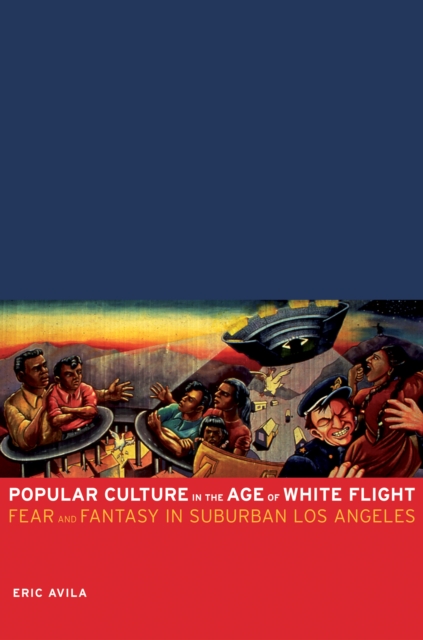
Popular culture in the age of white flight
Los Angeles pulsed with economic vitality and demographic growth in the decades following World War II. This vividly detailed cultural history of L.A. from 1940 to 1970 traces the rise of a new suburban consciousness adopted by a generation of migrants who abandoned older American cities for Southern California's booming urban region. Eric Avila explores expressions of this new \"white identity\" in popular culture with provocative discussions of Hollywood and film noir, Dodger Stadium, Disneyland, and L.A.'s renowned freeways. These institutions not only mirrored this new culture of suburban whiteness and helped shape it, but also, as Avila argues, reveal the profound relationship between the increasingly fragmented urban landscape of Los Angeles and the rise of a new political outlook that rejected the tenets of New Deal liberalism and anticipated the emergence of the New Right. Avila examines disparate manifestations of popular culture in architecture, art, music, and more to illustrate the unfolding urban dynamics of postwar Los Angeles. He also synthesizes important currents of new research in urban history, cultural studies, and critical race theory, weaving a textured narrative about the interplay of space, cultural representation, and identity amid the westward shift of capital and culture in postwar America.
eBook

The culture broker
Franklin Murphy? It's not a name that is widely known; even during his lifetime the public knew little of him. But for nearly thirty years, Murphy was the dominant figure in the cultural development of Los Angeles. Behind the scenes, Murphy used his role as confidant, family friend, and advisor to the founders and scions of some of America's greatest fortunes—Ahmanson, Rockefeller, Ford, Mellon, and Annenberg—to direct the largesse of the wealthy into cultural institutions of his choosing. In this first full biography of Franklin D. Murphy (1916-994), Margaret Leslie Davis delivers the compelling story of how Murphy, as chancellor of UCLA and later as chief executive of the Times Mirror media empire, was able to influence academia, the media, and cultural foundations to reshape a fundamentally provincial city. The Culture Broker brings to light the influence of L.A.'s powerful families and chronicles the mixed motives behind large public endeavors. Channeling more than one billion dollars into the city's arts and educational infrastructure, Franklin Murphy elevated Los Angeles to a vibrant world-class city positioned for its role in the new era of global trade and cross-cultural arts.
eBook

Zapotecs on the Move
Through interviews with three generations of Yalálag Zapotecs (\"Yaláltecos\") in Los Angeles and Yalálag, Oaxaca, this book examines the impact of international migration on this community. It traces five decades of migration to Los Angeles in order to delineate migration patterns, community formation in Los Angeles, and the emergence of transnational identities of the first and second generations of Yalálag Zapotecs in the United States, exploring why these immigrants and their descendents now think of themselves as Mexican, Mexican Indian immigrants, Oaxaqueños, and Latinos-identities they did not claim in Mexico.Based on multi-site fieldwork conducted over a five-year period, Adriana Cruz-Manjarrez analyzes how and why Yalálag Zapotec identity and culture have been reconfigured in the United States, using such cultural practices as music, dance, and religious rituals as a lens to bring this dynamic process into focus. By illustrating the sociocultural, economic, and political practices that link immigrants in Los Angeles to those left behind, the book documents how transnational migration has reflected, shaped, and transformed these practices in both their place of origin and immigration.
eBook

Urban Tomographies
Tomography is a method of exploring a phenomenon through a large number of examples or perspectives. In medical tomography, such as a CAT scan, two-dimensional slices or images of a three-dimensional organ are used to envision the organ itself. Urban tomography applies the same approach to the study of city life. To appreciate different aspects of a community, from infrastructure to work to worship, urban planning expert Martin H. Krieger scans the myriad sights and sounds of contemporary Los Angeles. He examines these slices of life in Urban Tomographies.The book begins by introducing tomographic methods and the principles behind them, which are taken from phenomenological philosophy. It draws from the examples of Lee Friedlander and Walker Evans, as well as Denis Diderot, Charles Marville, and Eugène Atget, who documented the many facets of Paris life in three crucial periods. Rather than focus on singular, extraordinary figures and events as do most documentarians, Krieger looks instead at the typical, presenting multiple specific images that call attention to people and activities usually rendered invisible by commonality. He took tens of thousands of photographs of industrial sites, markets, electrical distributing stations, and storefront churches throughout Los Angeles. He also recorded the city's ambient sounds, from the calls of a tamale vendor to the buzz of a workshop saw. Krieger considers these samples from the urban sensorium in this innovative volume, resulting in a thoughtful illumination of the interplay of people with and within the built environment. With numerous maps and photographs, as well as Krieger's unique insights, Urban Tomographies provides an unusually representative and rounded view of the city.
eBook

Stardust monuments : the saving and selling of Hollywood
Hollywood is placeless, timeless, and iconic, a key fabricator and forger of American cultural myths and stories. How, then, will the history of Hollywood be written?
Stardust Monuments spotlights the enduring efforts to memorialize and canonize the history and meaning of Hollywood and American film culture. In this engaging analysis, Alison Trope explores the tensions between art and commerce as they intersect in a range of nonprofit and for-profit institutions and products.
An insightful tour of Hollywood’s past, present, and future, Stardust Monuments examines the establishment of film libraries and museums beginning in the mid 1930s, the many failed attempts to open a Hollywood museum ranging from the 1960s to today, and the more successful recent corporate efforts to use Hollywood’s past in theme restaurants and parks, classic movie channels, and DVD boxed sets.
This fascinating narrative details the ongoing struggle to champion and codify Hollywood’s legacy, a struggle engaged in by Hollywood stars and corporate executives, as well as memorabilia collectors and users of IMDb.
eBook