
Catalogue Search | MBRL


Are you sure you want to remove the book from the shelf?

{{itemTitle}}
738
result(s) for
"Art and society History 18th century."
Sort by:

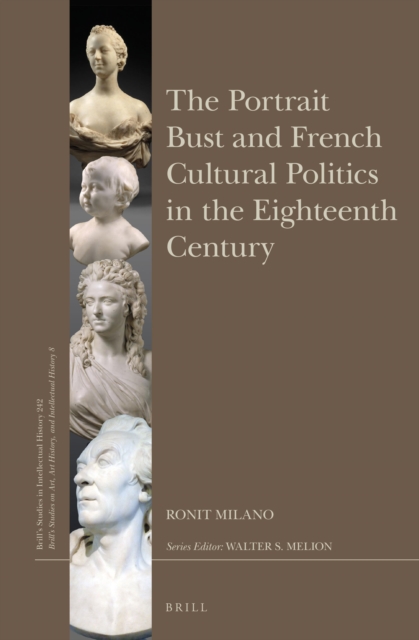
The Portrait Bust and French Cultural Politics in the Eighteenth Century
In The Portrait Bust and French Cultural Politics in the Eighteenth Century, Ronit Milano probes the aesthetic and intellectual charge of a remarkably concise art form, and its role in the construction of modern identity, during a seismic moment in French history.
eBook


Eighteenth-Century Art Worlds
While the connected, international character of today's art world is well known, the eighteenth century too had a global art world. Eighteenth-Century Art Worlds is the first book to attempt a map of the global art world of the eighteenth century. Fourteen essays from a distinguished group of scholars explore both cross-cultural connections and local specificities of art production and consumption in Africa, the Americas, Asia, and Europe. The result is an account of a series of interconnected and asymmetrical art worlds that were well developed in the eighteenth century. Capturing the full material diversity of eighteenth-century art, this book considers painting and sculpture alongside far more numerous prints and decorative objects. Analyzing the role of place in the history of eighteenth-century art, it bridges the disciplines of art history and cultural geography, and draws attention away from any one place as a privileged art-historical site, while highlighting places such as Manila, Beijing, Mexico City, and London as significant points on globalized map of the eighteenth-century art world. Eighteenth-Century Art Worlds combines a broad global perspective on the history of art with careful attention to how global artistic concerns intersect with local ones, offering a framework for future studies in global art history.
eBook

Landscape and landscape painting in revolutionary France : liberty's embrace
\"The French Revolution had a marked impact on the ways in which citizens saw the newly-liberated spaces in which they now lived. Painting, gardening, cinematic displays of landscape, travel guides, public festivals, tales of space flight and devil-abduction each shaped citizens' understanding of space. Through an exploration of landscape painting over some forty years, Steven Adams examines the work of artists, critics and contemporary observers who have largely escaped art historical attention to show the importance of landscape as a means of crystallising national identity in a period of unprecedented political and social change\"-- Provided by publisher.
Book

Citizen Spectator
In this richly illustrated study, the first book-length exploration
of illusionistic art in the early United States, Wendy Bellion
investigates Americans' experiences with material forms of visual
deception and argues that encounters with illusory art shaped their
understanding of knowledge, representation, and subjectivity
between 1790 and 1825. Focusing on the work of the well-known Peale
family and their Philadelphia Museum, as well as other
Philadelphians, Bellion explores the range of illusions encountered
in public spaces, from trompe l'oeil paintings and drawings at art
exhibitions to ephemeral displays of phantasmagoria, \"Invisible
Ladies,\" and other spectacles of deception.
Bellion reconstructs the elite and vernacular sites where such art
and objects appeared and argues that early national exhibitions
doubled as spaces of citizen formation. Within a post-Revolutionary
culture troubled by the social and political consequences of
deception, keen perception signified able citizenship. Setting
illusions into dialogue with Enlightenment cultures of science,
print, politics, and the senses, Citizen Spectator
demonstrates that pictorial and optical illusions functioned to
cultivate but also to confound discernment. Bellion reveals the
equivocal nature of illusion during the early republic, mapping its
changing forms and functions, and uncovers surprising links between
early American art, culture, and citizenship.
eBook

Military Enlightenment : war and culture in the French Empire from Louis XIV to Napoleon
\"Combines the study of literary works, treatises of moral philosophy, and archival military writings to show the ways that the military sphere both generated and applied French Enlightenment ideas with regard to the phenomenon of war, the human body and emotions, social equality, and human rights\"-- Author's Web site.
Book

The Art of Professing in Bourbon Mexico
In the eighteenth century, New Spaniards (colonial Mexicans) so lauded their nuns that they developed a local tradition of visually opulent portraits, called monjas coronadas or “crowned nuns,” that picture their subjects in regal trappings at the moment of their religious profession and in death. This study identifies these portraits as markers of a vibrant and changing society that fused together indigenous and Euro-Christian traditions and ritual practices to construct a new and complex religious identity that was unique to New Spain.To discover why crowned-nun portraits, and especially the profession portrait, were in such demand in New Spain, this book offers a pioneering interpretation of these works as significant visual contributions to a local counter-colonial discourse. James M. Córdova demonstrates that the portraits were a response to the Spanish crown’s project to modify and modernize colonial society—a series of reforms instituted by the Bourbon monarchs that threatened many nuns’ religious identities in New Spain. His analysis of the portraits’ rhetorical devices, which visually combined Euro-Christian and Mesoamerican notions of the sacred, shows how they promoted local religious and cultural values as well as client-patron relations, all of which were under scrutiny by the colonial Church. Combining visual evidence from images of the “crowned nun” with a discussion of the nuns’ actual roles in society, Córdova reveals that nuns found their greatest agency as Christ’s brides, a title through which they could, and did, challenge the Church’s authority when they found it intolerable.
eBook

The painter's fire : a forgotten history of the artists who championed the American Revolution
\"The Painter's Fire follows an unusual cohort of London-based artists-men and women, Black and white-who promoted the Patriot cause during the Revolutionary War, risking their livelihoods and reputations to defy the British Empire. Their experiences, Zara Anishanslin shows, testified to both the promise and the limits of liberty in the founding era\"-- Provided by publisher.
BOOK

The Part and the Whole in Early American Literature, Print Culture, and Art
The essays in this pathbreaking collection consider the significance of varied early American fragmentary genres and practices-from diaries and poetry, to almanacs and commonplace books, to sermons and lists, to Indigenous ruins and other material shards and fragments-often overlooked by critics in a scholarly privileging of the \"whole.\" Contributors from literary studies, book history, and visual culture discuss a host of canonical and non-canonical figures, from Edward Taylor and Washington Irving to Mary Rowlandson and Sarah Kemble Knight, offering insight into the many intellectual, ideological, and material variations of \"form\" that populated the early American cultural landscape. As these essays reveal, the casting of the fragmentary as aesthetically eccentric or incomplete was a way of reckoning with concerns about the related fragmentation of nation, society, and self. For a contemporary audience, they offer new ways to think about the inevitable gaps and absences in our cultural and historical archive.
eBook