
Catalogue Search | MBRL


Are you sure you want to remove the book from the shelf?

{{itemTitle}}
111
result(s) for
"Art patronage -- United States"
Sort by:

Tremaine houses : one family's patronage of domestic architecture in midcentury America
\"This volume examines the patronage of modern architecture that the Tremaine family sustained for nearly four decades in the mid-twentieth century\"--Provided by publisher.
Book

Black Culture, Inc : how ethnic community support pays for corporate America
\"A surprising and fascinating look at how Black culture has been leveraged by corporate America, this book addresses some of today's most pressing public debates around allyship and diversity. Open the brochure for the Alvin Ailey American Dance Theater, and you'll see logos for corporations like American Express. Visit the website for the Apollo Theater and you'll notice acknowledgments to corporations like Coca Cola and Citibank. The Martin Luther King, Jr. Memorial and the National Museum of African American History and Culture, owe their very existence to large corporate donations from companies like General Motors. And while we can easily make sense of the need for such funding to keep cultural spaces afloat, less obvious are the reasons that corporations give to them. In Black Culture, Inc. Patricia A. Banks interrogates the notion that such giving is completely altruistic, and argues for a deeper understanding of the hidden trans
eBook

Understanding the Arts and Creative Sector in the United States
The arts and creative sector is one of the nation's broadest, most important, and least understood social and economic assets, encompassing both nonprofit arts and cultural organizations, for-profit creative companies, such as advertising agencies, film producers, and commercial publishers, and community-based artistic activities. The thirteen essays in this timely book demonstrate why interest in the arts and creative sector has accelerated in recent years, and the myriad ways that the arts are crucial to the social and national agenda and the critical issues and policies that relate to their practice. Leading experts in the field show, for example, how arts and cultural policies are used to enhance urban revitalization, to encourage civic engagement, to foster new forms of historic preservation, to define national identity, to advance economic development, and to regulate international trade in cultural goods and services.Illuminating key issues and reflecting the rapid growth of the field of arts and cultural policy, this book will be of interest to students at both the undergraduate and graduate levels, to arts educators and management professionals, government agency and foundation officials, and researchers and academics in the cultural policy field.
eBook
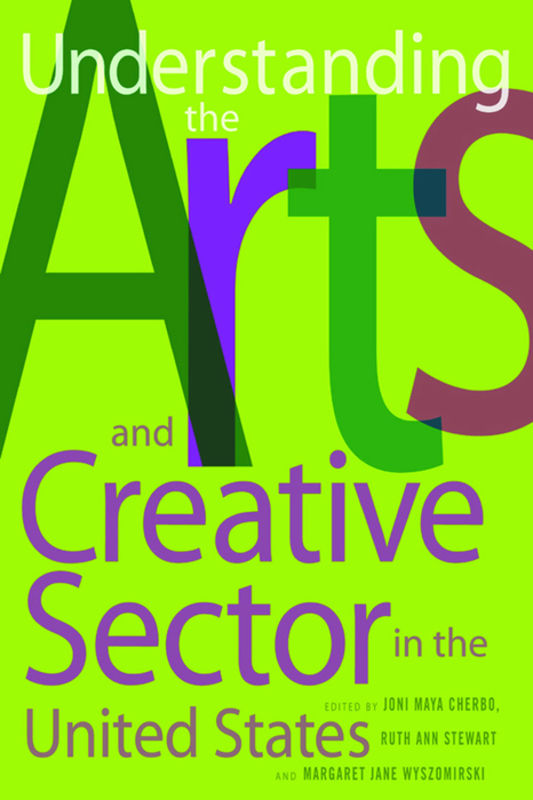
Understanding the Arts and Creative Sector in the United States
The arts and creative sector is one of the nation's broadest, most important, and least understood social and economic assets, encompassing both nonprofit arts and cultural organizations, for-profit creative companies, such as advertising agencies, film producers, and commercial publishers, and community-based artistic activities. The thirteen essays in this timely book demonstrate why interest in the arts and creative sector has accelerated in recent years, and the myriad ways that the arts are crucial to the social and national agenda and the critical issues and policies that relate to their practice. Leading experts in the field show, for example, how arts and cultural policies are used to enhance urban revitalization, to encourage civic engagement, to foster new forms of historic preservation, to define national identity, to advance economic development, and to regulate international trade in cultural goods and services. Illuminating key issues and reflecting the rapid growth of the field of arts and cultural policy, this book will be of interest to students at both the undergraduate and graduate levels, to arts educators and management professionals, government agency and foundation officials, and researchers and academics in the cultural policy field.
eBook

Arts and Culture in the Metropolis
The nonprofit arts currently face an environment that challenges the way the arts have grown and raises the prospect of future consolidation. Cognizant of these problems, William Penn Foundation and the Greater Philadelphia Cultural Alliance asked RAND to examine the condition of Philadelphia's arts and culture sector and recommend actions to ensure its sustainability. The authors identify the sources and characteristics of this new environment and describe the ways local arts communities are responding to the challenges confronting them. In the course of their analysis of eleven metropolitan regions, including Baltimore, Boston, Charlotte, Chicago, Cleveland, Denver, Detroit, Minneapolis, Philadelphia, Phoenix, and Pittsburgh, they introduce two novel ways of examining the local arts sector. First, they focus on the relationship among the three components of communities' arts ecology: their arts infrastructures; the support systems upon which the arts depend; and the sociodemographic, economic, and the political environment in which they operate. Second, they create a new framework for describing and evaluating the range of support services that communities provide to their arts sectors. They then use this framework to analyze the components of Philadelphia's arts ecology and assess its specific strengths and weaknesses.
eBook

The Evolution of Taste in American Collecting
The Evolution of Taste in American Collecting is a new critical translation of René Brimo's classic study of eighteenth- and nineteenth-century patronage and art collecting in the United States. Originally published in French in 1938, Brimo's foundational text is a detailed examination of collecting in America from colonial times to the end of World War I, when American collectors came to dominate the European art market. This work helped shape the then-fledgling field of American art history by explaining larger cultural transformations as manifested in the collecting habits of American elites. It remains the most substantive account of the history of collecting in the United States. In his introduction, Kenneth Haltman provides a biographical study of the author and his social and intellectual milieu in France and the United States. He also explores how Brimo's work formed a turning point and initiated a new area of academic study: the history of art collecting. Making accessible a text that has until now only been available in French, Haltman's elegant translation of The Evolution of Taste in American Collecting sheds new critical light on the essential work of this extraordinary but overlooked scholar.
eBook

Avant-Garde in the Cornfields
A close examination of an iconic small town that gives boundless insights into architecture, landscape, preservation, and philanthropy
Avant-Garde in the Cornfields is an in-depth study of New Harmony, Indiana, a unique town in the American Midwest renowned as the site of two successive Utopian settlements during the nineteenth century: the Harmonists and the Owenites. During the Cold War years of the twentieth century, New Harmony became a spiritual \"living community\" and attracted a wide variety of creative artists and architects who left behind landmarks that are now world famous.
This engrossing and well-documented book explores the architecture, topography, and preservation of New Harmony during both periods and addresses troubling questions about the origin, production, and meaning of the town's modern structures, landscapes, and gardens. It analyzes how these were preserved, recognizing the funding that has made New Harmony so vital, and details the elaborate ways in which the town remains an ongoing experiment in defining the role of patronage in historic preservation.
An important reappraisal of postwar American architecture from a rural perspective,Avant-Garde in the Cornfields presents provocative ideas about how history is interpreted through design and historic preservation-and about how the extraordinary past and present of New Harmony continue to thrive today.
Contributors: William R. Crout, Harvard U; Stephen Fox, Rice U; Christine Gorby, Pennsylvania State U; Cammie McAtee, Harvard U; Nancy Mangum McCaslin; Kenneth A. Schuette Jr., Purdue U; Ralph Schwarz; Paul Tillich.
eBook

Stirring Up Seattle
In the 1950s, the city of Seattle began a transformation from an insular, provincial outpost to a vibrant and cosmopolitan cultural center. As veteran Seattle journalist R. M. Campbell illustrates in Stirring Up Seattle: Allied Arts in the Civic Landscape, this transformation was catalyzed in part by the efforts of a group of civic arts boosters originally known as The Beer and Culture Society. This merry band of lawyers, architects, writers, designers, and university professors, eventually known as Allied Arts of Seattle, lobbied for public funding for the arts, helped avert the demolition of Pike Place Market, and were involved in a wide range of crusades and campaigns in support of historic preservation, cultural institutions, and urban livability.
eBook

Identity Instrumentalized: Pattern Recognition as an Epistemology of Surveillance, 1960–66
The emergence of new surveillance practices is not solely a matter of technological and political developments. It is also intertwined with the production of scientific knowledge. This article traces how scientists in the 1960s developed some of the earliest computerized facial recognition techniques while covertly sponsored by a U.S. intelligence agency. The article situates their project within approaches from the technical field of pattern recognition. It demonstrates how the scientists, especially amid unsteady patronage relationships, reinforced a key assumption: that recognizing identity could be reduced to classifying specific features within a set of existing examples. As their ambitions grew over six years, the scientists transformed human identity into a scientific object tailored to their recognition techniques. How this transformation occurred foregrounds the epistemic underpinnings of surveillance technologies.
Journal Article

The Difficult Art of Giving
The Difficult Art of Giving rethinks standard economic histories of the literary marketplace. Traditionally, American literary histories maintain that the post-Civil War period marked the transition from a system of elite patronage and genteel amateurism to what is described as the free literary market and an era of self-supporting professionalism. These histories assert that the market helped to democratize literary production and consumption, enabling writers to sustain themselves without the need for private sponsorship. By contrast, Francesca Sawaya demonstrates the continuing importance of patronage and the new significance of corporate-based philanthropy for cultural production in the United States in the postbellum and modern periods.Focusing on Henry James, William Dean Howells, Mark Twain, Charles Chesnutt, and Theodore Dreiser, Sawaya explores the notions of a free market in cultural goods and the autonomy of the author. Building on debates in the history of the emotions, the history and sociology of philanthropy, feminist theory, and the new economic criticism, Sawaya examines these major writers' careers as well as their rich and complex representations of the economic world. Their work, she argues, demonstrates that patronage and corporate-based philanthropy helped construct the putatively free market in literature. The book thereby highlights the social and economic interventions that shape markets, challenging old and contemporary forms of free market fundamentalism.
eBook