
Catalogue Search | MBRL


Are you sure you want to remove the book from the shelf?

{{itemTitle}}
5
result(s) for
"Art thefts United States History 20th century."
Sort by:

The practice run : how a failed art heist provided a blueprint for the world's largest art robbery
On St Patrick's Day, 1990, one of the largest art thefts in the world took place - the heist of Boston's Isabella Stewart Gardner Museum in which thirteen works of art, worth over half a billion dollars, were stolen by two thieves posing as policemen. Had there been a prior practice run for this theft? Ten years earlier, during the Christmas season, two thieves who posed as delivery men were thwarted in their attempt of a near-identical robbery at The Hyde Collection in Glens Falls, New York - an art museum modeled after a one in Boston. This book investigates the planning and execution of both heists.
BOOK

Punishment's place: the local concentration of mass incarceration
The crime rate is measured by the Uniform Crime Reports (ucr) \"index\" offenses (aggravated assault, forcible rape, murder, robbery, arson, burglary, larceny-theft, and motor vehicle theft) per 100,000 persons in Chicago. Concentrated incarceration may have the unintended consequence of increasing crime rates through its negative impact on the labor market and social-capital prospects of former prisoners.20 What is more, evidence shows that neighborhood context plays a major role in the recidivism rates of ex-prisoners.21 The integration of prisoner release programs and efforts to build community capacity are important steps for policy.22 Along with policy reform, efforts to destigmatize and achieve justice for communities are crucial to overcoming the vicious cycle of crime production, victimization, incapacitation, and disadvantage.
Journal Article
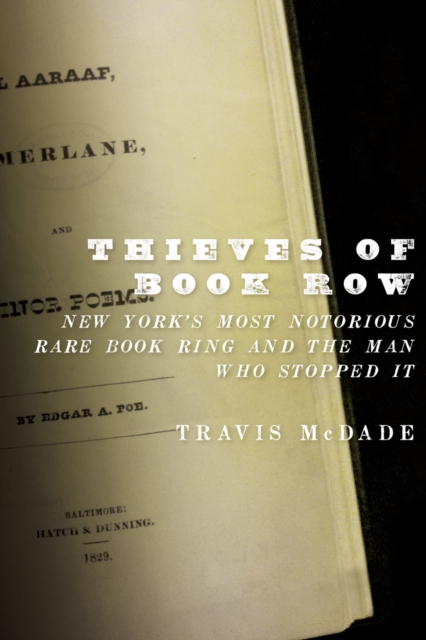
Thieves of Book Row
In Thieves of Book Row, Travis McDade tells the gripping tale of the worst book-theft ring in American history, and the intrepid detective who brought it down. Both a fast-paced, true-life thriller, Thieves of Book Row provides a fascinating look at the history of crime and literary culture.
eBook

\Wouldn't a Boy Do?\ Placing Early-Twentieth-Century Male Youth Sex Work into Histories of Sexuality
[...] reform and policing activities regarding male youth sex work were much more inconsistent than were actions regarding female prostitution, commercialized amusements, and more anticipated forms of boy delinquency such as theft and truancy. Over time overtly commercialized same-sex encounters, particularly involving boys, came to represent this effect's worst manifestation.43 Both in passing mention within the reports and more extensively in the background materials and field notes supporting them, male youth sex work became a regularized component of the broad array of activities and locations that fell under the broad umbrella of \"vice\" that had the concept of prostitution as its organizing principle.
Journal Article

Culture War: The Case Against Repatriating Museum Artifacts
Claims on the national identity of antiquities are at the root of many states' cultural property laws, which in the last few decades have been used by governments to reclaim objects from museums and other collections abroad. Despite UNESCO's declaration that \"no culture is a hermetically sealed entity,\" governments are increasingly making claims of ownership of cultural property on the basis of self-proclaimed and fixed state-based identities. In an era of globalization that is nonetheless marked by resurgent nationalism and sectarianism, antiquities and their history should not be used to stoke such narrow identities. Instead, they should express the guiding principles of the world's great museums: pluralism, diversity, and the idea that culture shouldn't stop at borders-and nor, for that matter, should the cosmopolitan ideals represented by encyclopedic museums. Rather than acquiesce to frivolous, if stubborn, calls for repatriation, often accompanied by threats of cultural embargoes, encyclopedic museums should encourage the development of mutually beneficial relationships with museums everywhere in the world that share their cosmopolitan vision.
Magazine Article