
Catalogue Search | MBRL


Are you sure you want to remove the book from the shelf?

{{itemTitle}}
145,533
result(s) for
"Art theory"
Sort by:

The art of controversy : political cartoons and their enduring power
\"A lavishly illustrated, witty, and learned look at the awesome power of the political cartoon throughout history to enrage, provoke,
Book

Fleshing out surfaces
Fleshing out surfaces is the first English-language book on skin and flesh tones in art. It considers flesh and skin in art theory, image making and medical discourse in seventeenth to nineteenth-century France. Describing a gradual shift between the early modern and the modern period, it argues that what artists made when imitating human nakedness was not always the same. Initially understood in terms of the body's substance, of flesh tones and body colour, it became increasingly a matter of skin, skin colour and surfaces. Each chapter is dedicated to a different notion of skin and its colour, from flesh tones via a membrane imbued with nervous energy to hermetic borderline. Looking in particular at works by Fragonard, David, Girodet, Benoist and Ingres, the focus is on portraits, as facial skin is a special arena for testing painterly skills and a site where the body and the image become equally expressive.
eBook

Jungian art therapy : a guide to dreams, images, and analytical psychology
Jungian Art Therapy aims to provide a clear introductory manual for art therapists on how to navigate Jung's model of working with the psyche. This exciting new text circumambulates Jung's map of the mind so as to reinforce the theoretical foundations of analytical psychology while simultaneously defining key concepts to help orient practitioners, students, and teachers alike. The book provides several methods, which illustrate how to work with the numerous images originating from the unconscious and glean understanding from them. Throughout the text readers will enjoy clinical vignettes to support each chapter and illuminate important lessons--back cover.
Book
The Object As a Process
How does artistic practice lead to the production of knowledge?How does, in turn, artistic knowledge relate to its material base?How does contingent materiality guide the artist towards finding form and developing a statement?.
eBook
The truth is always grey : a history of modernist painting
\"Frances Guerin argues that painters select grey to respond to a key question of modernist art: What is painting? Presenting an impressive range of canonical paintings across centuries, this book is a treatise on color that allows us to see something entirely new in familiar paintings and encourages our appreciation for the innovation and dynamism of the color grey\"-- Provided by publisher.
Book

In the Blink of an Ear
An ear-opening reassessment of sonic art from World War II to the present Marcel Duchamp famously championed a \"non-retinal\" visual art, rejecting judgments of taste and beauty.
eBook

Another light : Gericault's romanticism and other essays
\"In this richly illustrated book, Michael Fried-one of the most esteemed and influential art critics and art historians working today-has gathered eight major essays written between 1993 and 2013, on topics ranging from Jacques-Louis David, Thâeodore Gâericault, and Caspar David Friedrich through Gustave Caillebotte and Roger Fry to recent films by Douglas Gordon and Thomas Demand. Gustave Courbet and Edouard Manet, too, are distinct presences along with, in the background, the great art critic Denis Diderot and, in the case of Friedrich, the philosopher Immanuel Kant. As always in Fried's writing, the emphasis falls equally on observation and argument: never have these artists (and one critic, Fry) been subjected to so searching a gaze, and never has the meaning of their respective enterprises been laid bare with comparable clarity and force. Another hallmark of Fried's work is its extraordinary originality, and that too is fully in evidence throughout this remarkable book, which will add to his reputation as one of the indispensable thinkers of our time\"-- Provided by publisher.
Book

Solvent form
This book is about the destruction of art, both in terms of objects that have been destroyed – lost in fires, floods or vandalism – and the general concept of art operating through object and form. Through re-examinations of such events as the Momart warehouse fire in 2004 and the activities of art thief Stéphane Breitwieser, the book proposes an idea of solvent form hinging on the dual meaning in the words solvent and solvency, whereby art, while attempting to make secure or fixed, simultaneously undoes and destroys through its inception. Ultimately, the book questions what is it that may be perceived in the destruction of art and how we understand it, and further how it might be linked to a more general failure.
eBook

Surrealist ghostliness
\"In this study of surrealism and ghostliness, Katharine Conley provides a new, unifying theory of surrealist art and thought based on history and the paradigm of puns and anamorphosis. In Surrealist Ghostliness, Conley discusses surrealism as a movement haunted by the experience of World War I and the repressed ghost of spiritualism. From the perspective of surrealist automatism, this double haunting produced a unifying paradigm of textual and visual puns that both pervades surrealist thought and art and commemorates the surrealists' response to the Freudian unconscious. Extending the gothic imagination inherited from the eighteenth century, the surrealists inaugurated the psychological century with an exploration of ghostliness through doubles, puns, and anamorphosis, revealing through visual activation the underlying coexistence of realities as opposed as life and death.Surrealist Ghostliness explores examples of surrealist ghostliness in film, photography, painting, sculpture, and installation art from the 1920s through the 1990s by artists from Europe and North America from the center to the periphery of the surrealist movement. Works by Man Ray, Claude Cahun, Brassai; and Salvador Dali;, Lee Miller, Dorothea Tanning, Francesca Woodman, Pierre Alechinsky, and Susan Hiller illuminate the surrealist ghostliness that pervades the twentieth-century arts and compellingly unifies the century's most influential yet disparate avant-garde movement\"-- Provided by publisher.
Book
Dimensions of Aesthetic Encounters
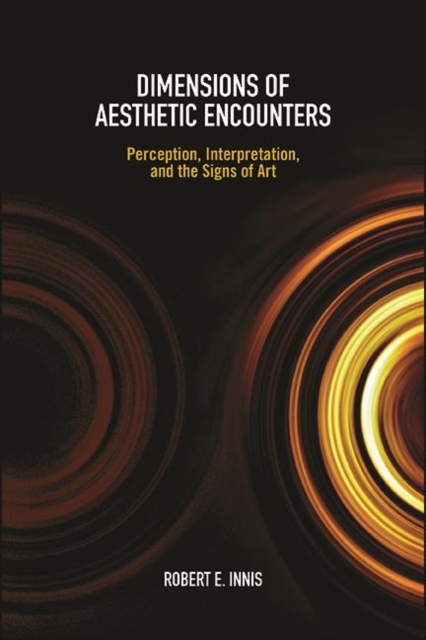
We encounter in our lives things and situations that elicit from us special forms of attention. They affect and inform us in various ways, drawing us in and holding us in their grasp or turning us away. Works of art of all sorts, and nature in its myriad manifestations, exemplify these luring and repelling qualities and potencies. Dimensions of Aesthetic Encounters explores central perceptual, interpretative, and semiotic dimensions of these encounters, combining a wide range of examples and intellectual resources from pragmatist, hermeneutical, and semiotic frameworks. Practicing a kind of \"method of rotation\" Robert E. Innis breaks down barriers in aesthetic theory and shows their complementary powers. Recurring themes link each chapter, throwing a powerful light on aesthetic encounters by foregrounding such pivotal notions as play, fundedness and the role of memory, the defining quality of an artwork, energies of objects, potencies, rhythm, form, presentational abstraction, medium, symbolization, intuition, role of the body, and the non-argumentative nature of art.
eBook