
Catalogue Search | MBRL


Are you sure you want to remove the book from the shelf?

{{itemTitle}}
286
result(s) for
"Arthurian romances."
Sort by:

Sovereign Fantasies
During and after the Hundred Years War, English rulers struggled with a host of dynastic difficulties, including problems of royal succession, volatile relations with their French cousins, and the consolidation of their colonial ambitions toward the areas of Wales and Scotland. Patricia Ingham brings these precarious historical positions to bear on readings of Arthurian literature in Sovereign Fantasies, a provocative work deeply engaged with postcolonial and gender theory.Ingham argues that late medieval English Arthurian romance has broad cultural ambitions, offering a fantasy of insular union as an \"imagined community\" of British sovereignty. The Arthurian legends offer a means to explore England's historical indebtedness to and intimacies with Celtic culture, allowing nobles to repudiate their dynastic ties to France and claim themselves heirs to an insular heritage. Yet these traditions also provided a means to critique English conquest, elaborating the problems of centralized sovereignty and the suffering produced by chivalric culture. Texts such as Sir Gawain and the Green Knight, the Alliterative Morte Arthure, and Caxton's edition of Malory's Morte Darthur provide what she terms a \"sovereign fantasy\" for Britain. That is, Arthurian romance offers a cultural means to explore broad political contestations over British identity and heritage while also detailing the poignant complications and losses that belonging to such a community poses to particular regions and subjects. These contestations and complications emerge in exactly those aspects of the tales usually read as fantasy-for example, in the narratives of Arthur's losses, in the prophecies of his return, and in tales that dwell on death, exotic strangeness, uncanny magic, gender, and sexuality.Ingham's study suggests the nuances of the insular identity that is emphasized in this body of literature. Sovereign Fantasies shows the significance, rather than the irrelevance, of medieval dynastic motifs to projects of national unification, arguing that medieval studies can contribute to our understanding of national formations in part by marking the losses produced by union.
eBook


A Connecticut Yankee in King Arthur's court
A Connecticut Yankee is Mark Twain's most ambitious work, a tour de force with a science-fiction plot told in the racy slang of a Hartford workingman, sparkling with literary hijinks as well as social and political satire. Mark Twain characterized his novel as \"one vast sardonic laugh at the trivialities, the servilities of our poor human race.\" The Yankee, suddenly transported from his native nineteenth-century America to the sleepy sixth-century Britain of King Arthur and the Round Table, vows brashly to \"boss the whole country inside of three weeks.\" And so he does. Emerging as \"The Boss,\" he embarks on an ambitious plan to modernize Camelot—with unexpected results.
eBook

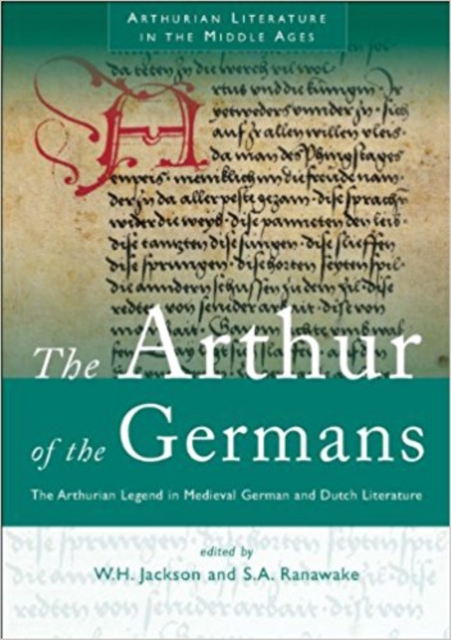
The Arthur of the Germans
From the twelfth century onwards the legends of King Arthur and his knights, including the Tristan legend, spread across Europe, producing a vast range of adaptations and new stories. German and Dutch literature were of central importance in this expansion of Arthurian material from the 12th to 16th century. This title deals with this topic.
eBook

Le Morte D'Arthur : King Arthur and the legends of the Round Table
Presents the epic story of King Arthur, the wizard Merlin, his Knights of the Round Table, the sword Excalibur, and his tragic and poetic death, in a prose translation of the classic legend, featuring an introduction by acclaimed poet Robert Graves.
Book
