
Catalogue Search | MBRL


Are you sure you want to remove the book from the shelf?

{{itemTitle}}
170
result(s) for
"Articles of Confederation"
Sort by:

U.S. Constitution & other important American documents : the text plus a translation anyone can understand
The complete texts of the Constitution, the Articles of Confederation, the Declaration of Independence, and the Gettysburg Address on the left-hand page, side-by-side with an easy-to-understand translation on the right. Also includes line-by-line translation that puts the documents into everyday language, helpful commentary on each of the four documents, a chart comparing the Articles of Confederation to the U.S. Constitution, brief descriptions of twenty landmark Supreme Court cases, fun facts about the U.S. Constitution, and a glossary of key terms.
Book
America's Founding Documents
Soon after the start of the American Revolutionary War in 1775, the Thirteen Colonies proclaimed their independence from British rule and became the United States of America.The written word proved vital in shaping America's new identity, laying the groundwork for societal principles and political doctrine alike.
eBook

The Constitution, Invasion, Immigration, and the War Powers of States
By express and implied reservation, the Constitution permits states to wage defensive war and take other military action in response to invasion, insurrection, and transnational criminal gangs. This article examines the under-researched area of state war powers and how they interact with federal military and other foreign affairs powers. It also recovers the meaning of the Constitution’s term “invasion” and demonstrates that several judicial decisions have construed that term far too narrowly. The article ends with reflections on justiciability and remedies in state war power cases.
Journal Article

Bounding Power
Realism, the dominant theory of international relations, particularly regarding security, seems compelling in part because of its claim to embody so much of Western political thought from the ancient Greeks to the present. Its main challenger, liberalism, looks to Kant and nineteenth-century economists. Despite their many insights, neither realism nor liberalism gives us adequate tools to grapple with security globalization, the liberal ascent, and the American role in their development. In reality, both realism and liberalism and their main insights were largely invented by republicans writing about republics.
The main ideas of realism and liberalism are but fragments of republican security theory, whose primary claim is that security entails the simultaneous avoidance of the extremes of anarchy and hierarchy, and that the size of the space within which this is necessary has expanded due to technological change.
In Daniel Deudney's reading, there is one main security tradition and its fragmentary descendants. This theory began in classical antiquity, and its pivotal early modern and Enlightenment culmination was the founding of the United States. Moving into the industrial and nuclear eras, this line of thinking becomes the basis for the claim that mutually restraining world government is now necessary for security and that political liberty cannot survive without new types of global unions.
Unique in scope, depth, and timeliness,Bounding Poweroffers an international political theory for our fractious and perilous global village.
eBook

Charles Beard and the Constitution
\"One could almost use the word momentous, or the word epoch-making though epoch-ending might be more to the point ... I don't see how anyone henceforth can repeat the old cliches which Beard put into circulation forty years ago.\"—Frederick B. Tolles, Swarthmore College.
\"American historians, particularly those who have given lectures or written books based on the Beard thesis, ignore Brown's book at their peril.\"—American Historical Review.
Originally published in 1956.
The Princeton Legacy Library uses the latest print-on-demand technology to again make available previously out-of-print books from the distinguished backlist of Princeton University Press. These editions preserve the original texts of these important books while presenting them in durable paperback and hardcover editions. The goal of the Princeton Legacy Library is to vastly increase access to the rich scholarly heritage found in the thousands of books published by Princeton University Press since its founding in 1905.
eBook
The Annapolis Convention: Prelude to the Constitution
\"The Annapolis Convention was a gathering of concerned representatives from the various states in order to discuss ways to compensate for various difficulties that Americans were experiencing as a result of perceived weaknesses in the Articles of Confederation. In particular, the Articles' requirement that all decisions be unanimous was causing some states great difficulties with regard to finance and trade.\" (Social Studies for Kids) Read more about the Annapolis Convention.
Web Resource
America's Founding Documents
\"Want to create a country? What are its laws? What rights do the people have? How does the government work? The founders of the United States had to answer all those questions. To do that, they developed documents. These formed the guidelines of the young country. Some remained the same for over 200 years. Others changed. The United States began with the Declaration of Independence. That document stated the purpose of America: to be free from Great Britain. It also set out rights of the American people.\" (News-O-Matic) Read about America’s founding documents.
Web Resource
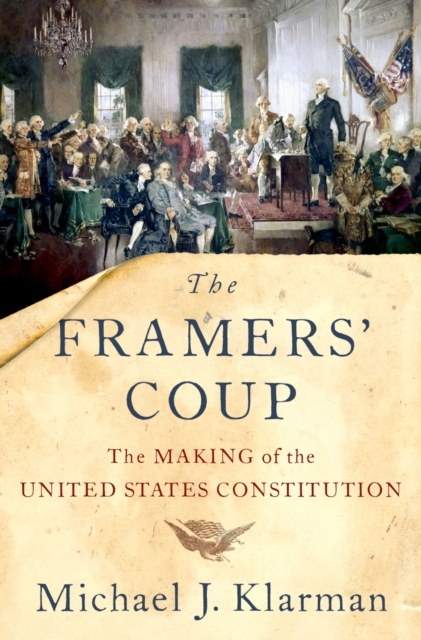
The framers' coup : the making of the United States Constitution
Americans revere their Constitution. However, most of us are unaware how tumultuous and improbable the drafting and ratification processes were. Based on prodigious research and told largely through the voices of the participants, Michael Klarman's The Framers' Coup narrates how the Framers' clashing interests shaped the Constitution--and American history itself.
eBook
The Political Theory of The Federalist
In The Political Theory of \"The Federalist,\" David F. Epstein offers a guide to the fundamental principles of American government as they were understood by the framers of the Constitution. Epstein here demonstrates the remarkable depth and clarity of The Federalist's argument, reveals its specifically political (not merely economic) view of human nature, and describes how and why the American regime combines liberal and republican values.
\"While it is a model of scholarly care and clarity, this study deserves an audience outside the academy. . . . David F. Epstein's book is a fine demonstration of just how much a close reading can accomplish, free of any flights of theory or fancy references.\"—New Republic
\"Epstein's strength lies in two aspects of his own approach. One is that he reads the text with uncommon closeness and sensitivity; the other is an extensive knowledge of the European political thought which itself forms an indispensable background to the minds of the authors.\"—Times Literary Supplement
eBook