
Catalogue Search | MBRL


Are you sure you want to remove the book from the shelf?

{{itemTitle}}
2,567
result(s) for
"Artificial intelligence Educational applications."
Sort by:


AI with intention : principles and action steps for teachers and school leaders
Make sure your tech initiatives put students first with this robust guide for teachers and school leaders from award-winning educator Tony Frontier.
eBook

Artificial intelligence in education : 19th International Conference, AIED 2018, London, UK, June 27-30, 2018, Proceedings
This two volume set LNAI 10947 and LNAI 10948 constitutes the proceedings of the 19th International Conference on Artificial Intelligence in Education, AIED 2018, held in London, UK, in June 2018. The 45 full papers presented in this book together with 76 poster papers, 11 young researchers tracks, 14 industry papers and 10 workshop papers were carefully reviewed and selected from 192 submissions. The conference provides opportunities for the cross-fertilization of approaches, techniques and ideas from the many fields that comprise AIED, including computer science, cognitive and learning sciences, education, game design, psychology, sociology, linguistics as well as many domain-specific areas.
Book

The Educational Intelligent Economy: Big Data, Artificial Intelligence, Machine Learning and the Internet of Things in Education
This book examines, from a comparative perspective, the impact of the movement from the so-called knowledge-based economy towards the Intelligent Economy, which is premised upon the application of knowledge. This volume links the advent of this new technological revolution to the world of governance and policy formulation in education.
eBook


Teaching AI : exploring new frontiers for learning
Get the tools, resources and insights you need to explore artificial intelligence in the classroom and explore what students need to know about living in a world with AI.
For many, artificial intelligence, or AI, may seem like science fiction, or inherently overwhelming. The reality is that AI is already being applied in industry and, for many of us, in our daily lives as well. A better understanding of AI can help you make informed decisions in the classroom that will impact the future of your students.
Drawing from a broad variety of expert voices from countries including Australia, Japan, and South Africa, as well as educators from around the world and underrepresented student voices, this book explores some of the ways AI can improve education. These include educating learners about AI, teaching them about living in a world where they will be surrounded by AI and helping educators understand how they can use AI to augment human ability.
Each chapter offers activities and questions to help you deepen your understanding, try out new concepts and reflect on the information presented. Links to media artifacts from trusted sources will help make your learning experience more dynamic while also providing additional resources to use in your classroom.
This book:
* Offers a unique approach to the topic, with chapter opening scenes, case studies, and featured student voices.
* Discusses a variety of ways to teach students about AI, through design thinking, project-based learning and STEM connections.
* Includes lesson ideas, activities and tools for exploring AI with your students.
* Includes references to films and other media you can use in class to start discussions on AI or inspire design thinking and STEM projects.
In Teaching AI, you'll learn what AI is, how it works and how to use it to better prepare students in a world with increased human-computer interaction.
Audience: K-12 educators, tech coordinators, teacher educators
eBook


Teaching with AI : a practical guide to a new era of human learning
How AI is revolutionizing the future of learning and how educators can adapt to this new era of human thinking.
Artificial Intelligence (AI) is revolutionizing the way we learn, work, and think. Its integration into classrooms and workplaces is already underway, impacting and challenging ideas about creativity, authorship, and education. In this groundbreaking and practical guide, teachers will discover how to harness and manage AI as a powerful teaching tool. José Antonio Bowen and C. Edward Watson present emerging and powerful research on the seismic changes AI is already creating in schools and the workplace, providing invaluable insights into what AI can accomplish in the classroom and beyond.
By learning how to use new AI tools and resources, educators will gain the confidence to navigate the challenges and seize the opportunities presented by AI. From interactive learning techniques to advanced assignment and assessment strategies, this comprehensive guide offers practical suggestions for integrating AI effectively into teaching and learning environments. Bowen and Watson tackle crucial questions related to academic integrity, cheating, and other emerging issues.
In the age of AI, critical thinking skills, information literacy, and a liberal arts education are more important than ever. As AI continues to reshape the nature of work and human thinking, educators can equip students with the skills they need to thrive in a rapidly evolving world. This book serves as a compass, guiding educators through the uncharted territory of AI-powered education and the future of teaching and learning.
eBook
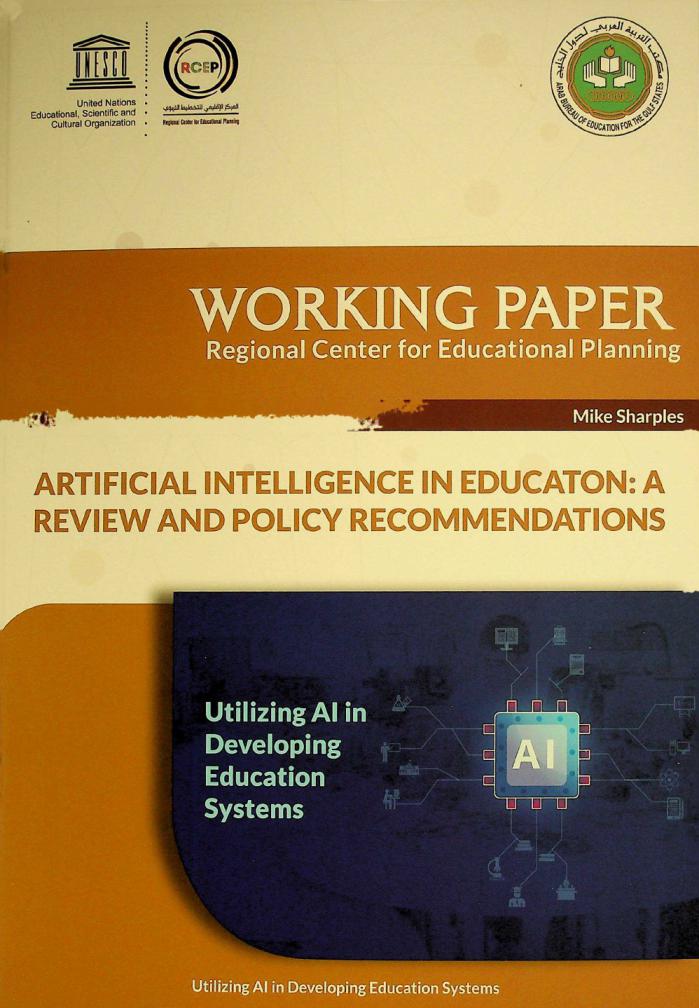

Artificial intelligence in education
The field of Artificial Intelligence in Education has continued to broaden and now includes research and researchers from many areas of technology and social science. This study opens opportunities for the cross-fertilization of information and ideas from researchers in the many fields that make up this interdisciplinary research area, including artificial intelligence, other areas of computer science, cognitive science, education, learning sciences, educational technology, psychology, philosophy, sociology, anthropology, linguistics, and the many domain-specific areas for which Artificial Intelligence in Education systems have been designed and built. An explicit goal is to appeal to those researchers who share the perspective that true progress in learning technology requires both deep insight into technology and also deep insight into learners, learning, and the context of learning. The theme reflects this basic duality.
eBook