
Catalogue Search | MBRL


Are you sure you want to remove the book from the shelf?

{{itemTitle}}
2,622
result(s) for
"Artificial intelligence Security measures."
Sort by:


Artificial Intelligence and Global Security
Artificial Intelligence and Global Security: Future Trends, Threats and Considerations brings a much-needed perspective on the impact of the integration of Artificial Intelligence (AI) technologies in military affairs. Experts forecast that AI will shape future military operations in ways that will revolutionize warfare.
eBook

Artificial intelligence safety and security
This book includes chapters from leading AI Safety researchers, addressing different aspects of the AI control problem as it relates to the development of safe and secure artificial intelligence. The book would be the first to address challenges of constructing safe and secure artificially intelligent systems. No similar book currently exists that concentrates on technical aspects of this research from the computer science point of view. Competing books are aimed at general/non-professional audiences from a philosophical point of view-- Provided by publisher.
Book

The role of artificial intelligence and machine learning in wireless networks security: principle, practice and challenges
Security is one of the biggest challenges concerning networks and communications. The problem becomes aggravated with the proliferation of wireless devices. Artificial Intelligence (AI) has emerged as a promising solution and a volume of literature exists on the methodological studies of AI to resolve the security challenge. In this survey, we present a taxonomy of security threats and review distinct aspects and the potential of AI to resolve the challenge. To the best of our knowledge, this is the first comprehensive survey to review the AI solutions for all possible security types and threats. We also present the lessons learned from the existing AI techniques and contributions of up-to-date literature, future directions of AI in security, open issues that need to be investigated further through AI, and discuss how AI can be more effectively used to overcome the upcoming advanced security threats.
Journal Article

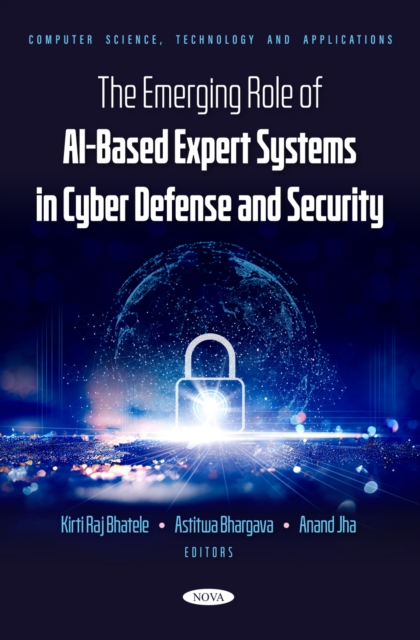
The Emerging Role of AI-Based Expert Systems in Cyber Defense and Security
The world, especially developing countries, is going through digital transformation. Digital transformation of businesses, cities, manufacturing sector, service sector, government offices and procedures, vehicles (Internet enabled vehicles), and Industry 4.0 are taking place at a distinguished pace and have many rewards. Digital transformation helps to address many social, techno-financial, and governance issues, but it also carries many challenges like increased volume of cyber-attacks, privacy concerns, security threats, digital identity threat, phishing frauds, operational security, and many other vulnerabilities. Aforesaid challenges have become a common phenomenon in today's interconnected world. It is the time when cyber-security must be stationed as a central issue and be established as a management issue besides a technological issue. The COVID-19 pandemic has accelerated the digital transformation. Work from home (remote working) and learn from home (online learning) are the new normal of life. The repercussions set by the COVID-19 pandemic will outlast the post-pandemic era. AI can help human society to resolve modern issues of cyber security. AI can be used by organizations to mitigate risks and increase revenue by detecting cyber threats and fraud at an early stage. Although keeping up with new viruses and malware updates is becoming more difficult, cyber security using artificial intelligence technologies will facilitate the detection and response to threats and malware by using previous cyber-attack data to determine the best course of action. AI may often be better and more effective than humans in detecting malicious malware. The faster the data breach was identified and contained, the lower the costs. This book will fill the gaps between artificial intelligence and its usage in cyber security and defense.
eBook

Taming Silicon Valley : how we can ensure that AI works for us
\"An expert on AI safety explains what we must do now to minimize the serious harms and threats that AI poses while realizing its benefits for society\"-- Provided by publisher.
BOOK

Integrating Artificial Intelligence and Machine Learning with Blockchain Security
Due to its transparency and dependability in secure online transactions, blockchain technology has grown in prominence in recent years. Several industries, including those of finance, healthcare, energy and utilities, manufacturing, retail marketing, entertainment and media, supply chains, e-commerce, and e-business, among others, use blockchain technology.In order to enable intelligent decision-making to prevent security assaults, particularly in permission-less blockchain platforms, artificial intelligence (AI) techniques and machine learning (ML) algorithms are used. By exploring the numerous use cases and security methods used in each of them, this book offers insight on the application of AI and ML in blockchain security principles. The book argues that it is crucial to include artificial intelligence and machine learning techniques in blockchain technology in order to increase security.
eBook


Generative AI and LLMs for Critical Infrastructure Protection: Evaluation Benchmarks, Agentic AI, Challenges, and Opportunities
Critical National Infrastructures (CNIs)—including energy grids, water systems, transportation networks, and communication frameworks—are essential to modern society yet face escalating cybersecurity threats. This review paper comprehensively analyzes AI-driven approaches for Critical Infrastructure Protection (CIP). We begin by examining the reliability of CNIs and introduce established benchmarks for evaluating Large Language Models (LLMs) within cybersecurity contexts. Next, we explore core cybersecurity issues, focusing on trust, privacy, resilience, and securability in these vital systems. Building on this foundation, we assess the role of Generative AI and LLMs in enhancing CIP and present insights on applying Agentic AI for proactive defense mechanisms. Finally, we outline future directions to guide the integration of advanced AI methodologies into protecting critical infrastructures. Our paper provides a strategic roadmap for researchers and practitioners committed to fortifying national infrastructures against emerging cyber threats through this synthesis of current challenges, benchmarking strategies, and innovative AI applications.
Journal Article