
Catalogue Search | MBRL


Are you sure you want to remove the book from the shelf?

{{itemTitle}}
184
result(s) for
"Artisans Europe History."
Sort by:

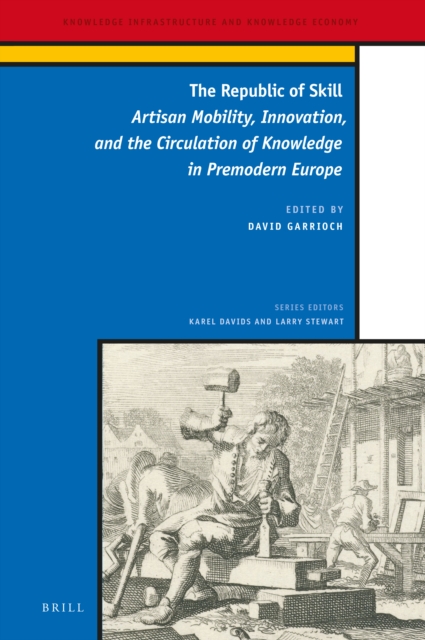
The republic of skill : artisan mobility, innovation, and the circulation of knowledge in premodern Europe
Mobile artisans, male and female, were responsible for many innovations and new consumer products. This book asks why, and shows the importance of collective traditions of migration, of the experience of mobility, and of the encounter with new places.
eBook


From craftsmen to capitalists
Politically adrift, alienated from Weimar society, and fearful of competition from industrial elites and the working class alike, the independent artisans of interwar Germany were a particularly receptive audience for National Socialist ideology. As Hitler consolidated power, they emerged as an important Nazi constituency, drawn by the party's rejection of both capitalism and Bolshevism. Yet, in the years after 1945, the artisan class became one of the pillars of postwar stability, thoroughly integrated into German society.From Craftsmen to Capitalists gives the first account of this astonishing transformation, exploring how skilled tradesmen recast their historical traditions and forged alliances with former antagonists to help realize German democratization and recovery.
eBook

Islamesque : the forgotten craftsmen who built Europe's medieval monuments
Who really built Europe's finest Romanesque monuments? At a time when Christendom lacked such expertise, Muslim craftsmen had advanced understanding of geometry and complex ornamentation. They dominated high-end construction in Islamic Spain, Sicily and North Africa, spreading knowledge and techniques across Western Europe. Challenging Euro-centric assumptions, Diana Darke uncovers the profound influence of the Islamic world in 'Christian' Europe, and argues that 'Romanesque' architecture, a nineteenth-century art historians' fiction, should be recognised for what it truly is: Islamesque.
BOOK

The role of human capital and innovation in economic development
The effect of human capital on growth involves multiple channels. On the one hand, an increase in human capital directly affects economic growth by enhancing labor productivity in production. On the other hand, human capital is an important input into R&D and therefore increases labor productivity indirectly by accelerating technological change. In addition, different types of human capital such as basic and higher education or trainingon-the-job might play different roles in both production and innovation activities. We merge individual data on valuable patents granted in Prussia in the late nineteenth-century with county-level data on literacy, craftsmanship, secondary schooling, and income tax revenues to explore the complex relationship between various types of human capital, innovation, and income. We find that the Second Industrial Revolution can be seen as a transition period when it comes to the role of human capital. As in the preceding First Industrial Revolution, “useful knowledge” embodied in master craftsmen was related to innovation, especially of independent inventors. As in the subsequent twentieth century, the quality of basic education was associated with both workers’ productivity and firms’R&D processes. In a final step, we show that literacy had also a negative effect on fertility which increased with innovation. In general, our findings support the notion that the accumulation of basic human capital was crucial for the transition to modern economic growth.
Journal Article

Endogenous Parliaments: The Domestic and International Roots of Long-Term Economic Growth and Executive Constraints in Europe
Institutional constraints on executive behavior are commonly understood to be crucial constitutional features that limit state expropriation, protect property rights, and promote economic development. Combining new data describing the presence of parliamentary constraints for the entire European continent with data on city sizes, we build upon theories of endogenous economic growth to demonstrate that paths of both economic and political development over the long span of European history from 1200 to 1900 are the consequence of a common process of urban agglomeration. In doing so, we provide evidence that both outcomes—the existence of constraining institutions and growth—are driven by initial conditions that fostered technical know-how embodied in urban-dwelling artisans who, in turn, were able to force institutional limits on rulers’ actions. Hence, instead of reflecting a true underlying cause of development, parliamentary constraints are themselves outcomes determined by an endogenous process of growth.
Journal Article

Occupational Choice and the Spirit of Capitalism
The British Industrial Revolution triggered a socioeconomic transformation whereby the landowning aristocracy was replaced by industrial capitalists rising from the middle classes as the economically dominant group. We propose a theory of preference formation under financial market imperfections that can account for this pattern. Parents shape their children's preferences in response to economic incentives. Middle-class families in occupations requiring effort, skill, and experience develop patience and a work ethic, whereas upper-class families relying on rental income cultivate a refined taste for leisure. These class-specific attitudes, which are rooted in the nature of preindustrial professions, become key determinants of success once industrialization transforms the economic landscape.
Journal Article

The Political Economy of Status Competition: Sumptuary Laws in Preindustrial Europe
Sumptuary laws that regulated clothing based on social status were an important part of the political economy of premodern states. We introduce a model that captures the notion that consumption by ordinary citizens poses a status threat to ruling elites. Our model predicts a non-monotonic effect of income—sumptuary legislation initially increases with income, but then falls as income increases further. The initial rise is more likely for states with less extractive institutions, whose ruling elites face a greater status threat from the rising commercial class. We test these predictions using a new dataset of country and city-level sumptuary laws. It is unfortunately an established fact that both men and womenfolk have, in utterly irresponsible manner, driven extravagance in dress and new styles to such shameful and wanton extremes that the different classes are barely to be known apart.
—Nuremberg Ordnance of 1657, Quoted in Hunt (1996)
Journal Article

Trading Zones in Early Modern Europe
This essay adopts the concept of trading zones first developed for the history of science by Peter Galison and redefines it for the early modern period. The term “trading zones” is used to mean arenas in which substantive and reciprocal communication occurred between individuals who were artisanally trained and learned (university-trained) individuals. Such trading zones proliferated in the sixteenth century. They tended to arise in certain kinds of places and not in others, but their existence must be determined empirically. The author’s work on trading zones differs from the ideas of Edgar Zilsel, who emphasized the influence of artisans on the scientific revolution. In contrast, in this essay, the mutual influence of artisans and the learned on each other is stressed, and translation is used as a modality that was important to communication within trading zones.
Journal Article