
Catalogue Search | MBRL


Are you sure you want to remove the book from the shelf?

{{itemTitle}}
173
result(s) for
"Artistes Histoire."
Sort by:

The artist as curator : an anthology
Immer wieder haben Kèunstler den weit gefassten Begriff der \"Ausstellung\" im Sinne eines kritischen Mediums gedeutet und konventionelle Formen des Ausstellungsmachens neu gedacht. Die Anthologie stellt wegweisende Beispiele solcher Ausstellungsprojekte einschlieاlich seltener Zeugnisse und Illustrationen vor. Neben einer Einfèuhrung und den 20 erstmals in Mousse abgedruckten Texten umfasst sie auch ein Nachwort von Hans Ulrich Obrist sowie zwei zusèatzliche, hier erstmals publizierte Essays.
Book

Maritime Musicians and Performers on Early Modern English Voyages
Maritime Musicians and Performers on Early Modern English Voyages aims to tell the full story of early English shipboard performers, who have been historically absent from conversations about English navigation, maritime culture, and economic expansion. Often described reductively in voyaging accounts as having one function, in fact maritime performers served many communicative tasks. Their lives were not only complex, but often contradictory. Though not high-ranking officers, neither were they lower-ranking mariners or sailors. They were influenced by a range of competing cultural practices, having spent time playing on both land and sea, and their roles required them to mediate parties using music, dance, and theatre as powerful forms of nonverbal communication. Their performances transcended and breached boundaries of language, rank, race, religion, and nationality, thereby upsetting conventional practices, improving shipboard and international relations, and ensuring the success of their voyages.
eBook

Art, annotated : your expert guide to 500 of the world's greatest works of art
Combining reproductions of each work of art with precise annotations and visual analysis, it is an expertly curated selection of the finest paintings, sculptures, and prints in history. Immerse yourself in this book spanning 3,000 years of art.
BOOK

Glorify the Empire
In the 1930s and '40s, Japanese rulers in Manchukuo enlisted writers and artists to promote imperial Japan's modernization program. Ironically, the cultural producers chosen to spread the imperialist message were previously left-wing politically. In Glorify the Empire, Annika A. Culver explores how these once anti-imperialist intellectuals produced avant-garde works celebrating the modernity of a fascist state and reflecting a complicated picture of complicity with, and ambivalence toward, Japan's utopian project. A groundbreaking work, this book magnifies the intersection between politics and art in a rarely examined period of Japanese history.
eBook

The story of art without men
\"How many women artists do you know? Who makes art history? Did women even work as artists before the twentieth century? And what is the Baroque anyway? Guided by Katy Hessel, art historian and founder of @thegreatwomenartists, discover the glittering paintings by Sofonisba Anguissola of the Renaissance, the radical work of Harriet Powers in the nineteenth-century United States and the artist who really invented the 'readymade.' Explore the Dutch Golden Age, the astonishing work of postwar artists in Latin America, and the women defining art in the 2020s. Have your sense of art history overturned and your eyes opened to many artforms often ignored or dismissed. From the Cornish coast to Manhattan, Nigeria to Japan, this is the history of art as it's never been told before\"--Provided by publisher.
Book

Extraordinary Aesthetes
The fin de siècle not only designated the end of the Victorian epoch but also marked a significant turn towards modernism. Extraordinary Aesthetes critically examines literary and visual artists from England, Ireland, and Scotland whose careers in poetry, fiction, and illustration flourished during the concluding years of the nineteenth century.
This collection draws special attention to the exceptional contributions that artists, poets, and novelists made to the cultural world of the late 1880s and 1890s. The essays illuminate a range of established, increasingly acknowledged, and lesser-known figures whose contributions to this brief but remarkably intense cultural period warrant close attention. Such figures include the critically neglected Mabel Dearmer, whose stunning illustrations appear in Evelyn Sharp’s radical fairy tales for children. Equally noteworthy is the uncompromising short fiction of Ella D’Arcy, who played a pivotal role in editing the most famous journal of the 1890s, The Yellow Book . The discussion extends to a range of legendary writers, including Max Beerbohm, Oscar Wilde, and W.B. Yeats, whose works are placed in dialogue with authors who gained prominence during this period. Bringing women’s writing to the fore, Extraordinary Aesthetes rebalances the achievements of artists and writers during the rapidly transforming cultural world of the fin de siècle.
eBook

The art of Thai comics : a century of strips and stripes
Comics flourished following the publication of the first Thai comics strip in 1907. Artists borrowed elements from European and American publications, such as Punch magazine, and created uniquely Thai mash-ups. In the 1930s, one artist combined E. C. Segar's Popeye with the codes of local 'likay' theatre, while another used the neoclassical realism introduced by Italian painters appointed at the Siamese court to give eerie form to the folklore pantheon of Thai ghosts. During the Cold War era, horror tales, anti-communist propaganda and socially engaged graphic novels bore witness to the country's darker years. Then, in the 1990s, Thai comics struggled to compete with the sudden influx of unlicensed manga from Japan that led to a disregard for local efforts and its current 'forgotten' status. After a hiatus, Thai comics made a comeback in the late '90s with a quirky, alternative scene that deserves wider international recognition. Beautifully designed and bursting with stories - from 20th-century interpretations of age-old Buddhist legends to tales of modern-day millennial angst - 'The Art of Thai Comics' opens an enlightening and visually spectacular window onto the country's history, culture and creativity. In doing so, it reinstates Thai comics into the wider story of global comics art.
BOOK
Religion and Prison Art in Ming China (1368-1644)
Approaching the prison as a creative environment and imprisoned officials as creative subjects in Ming China (1368-1644), Ying Zhang introduces important themes at the intersection of premodern Chinese religion, poetry, and visual and material culture.
eBook

Glorify the empire : Japanese avant-garde propaganda in Manchukuo
\"In the 1930s and '40s, Japanese political architects of the Manchukuo project in occupied northeast China realized the importance of using various cultural media to promote a modernization program in the region, as well as its expansion into other parts of Asia. Ironically, the writers and artists chosen to spread this imperialist message had left-wing political roots in Japan, where their work strongly favoured modernist, even avant-garde, styles of expression. In Glorify the Empire, Annika Culver explores how these once anti-imperialist intellectuals produced modernist works celebrating the modernity of a fascist state and reflecting a complicated picture of complicity with, and ambivalence towards, Japan's utopian project. During the war, literary and artistic representations of Manchuria accelerated, and the Japanese-led culture in Manchukuo served as a template for occupied areas in Southeast Asia. A groundbreaking work, Glorify the Empire magnifies the intersection between politics and art in a rarely examined period in Japanese history.\"--Publisher's website.
Book
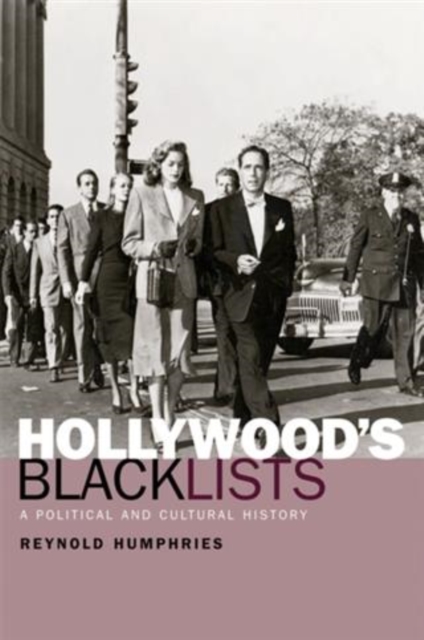
Hollywood's Blacklists
'Hollywood's Blacklists' is a history of the political and cultural factors relevant to understanding the whys and hows of the various investigations of the alleged communist infiltration of Hollywood in the 1950s.
eBook