
Catalogue Search | MBRL


Are you sure you want to remove the book from the shelf?

{{itemTitle}}
27
result(s) for
"Artistic experimentation"
Sort by:

Doméstico y salvaje: Humberto Rigalli y la experimentación artística en el umbral público-privado
La obra de Humberto Rigalli (1918-2016) tensiona las fronteras espaciales y disciplinares que definen el arte legitimado, al hacer del espacio doméstico un espacio de experimentación y enunciación estética y política. Lejos de una expresión ingenua o marginal, su obra se sitúa en una zona de ambigüedad entre arte y no arte, público y privado, profesionalismo y afectividad, desafiando las categorías consagradas del sistema artístico. Este artículo propone una lectura situada de su trabajo a partir de los marcos conceptuales de arte otro y arte salvaje y amaneramiento. Propone también la noción de ecología doméstica para dar cuenta de los condicionamientos de su espacio de producción. Incorpora, finalmente, una caracterización del pensamiento profético, para explicar su dimensión política no programática. Estas categorías contribuyen a pensar el espacio del hogar como lugar de experimentación y enunciación estética y política. A través del análisis de obras como Apogeo y muerte de Artigas y Árbol cantegril, el artículo examina cómo Rigalli convierte lo doméstico en un umbral de enunciación crítica que articula invención técnica, narración simbólica y gesto profético. Se aborda también el problema de la institucionalización del arte otro, a partir del deterioro de Árbol cantegril tras su ingreso en el museo. Finalmente, se plantea que el valor de la obra de Rigalli no reside en su adecuación a las formas legitimadas del arte, sino en su potencia de interpelación simbólica, su persistencia experimental y su vocación de inscribir el hacer artístico en la vida cotidiana. La obra de Humberto Rigalli (1918-2016) tensiona las fronteras espaciales y disciplinares que definen el arte legitimado, al hacer del espacio doméstico un espacio de experimentación y enunciación estética y política. Lejos de una expresión ingenua o marginal, su obra se sitúa en una zona de ambigüedad entre arte y no arte, público y privado, profesionalismo y afectividad, desafiando las categorías consagradas del sistema artístico. Este artículo propone una lectura situada de su trabajo a partir de los marcos conceptuales de arte otro y arte salvaje y amaneramiento. Propone también la noción de ecología doméstica para dar cuenta de los condicionamientos de su espacio de producción. Incorpora, finalmente, una caracterización del pensamiento profético, para explicar su dimensión política no programática. Estas categorías contribuyen a pensar el espacio del hogar como lugar de experimentación y enunciación estética y política. A través del análisis de obras como Apogeo y muerte de Artigas y Árbol cantegril, el artículo examina cómo Rigalli convierte lo doméstico en un umbral de enunciación crítica que articula invención técnica, narración simbólica y gesto profético. Se aborda también el problema de la institucionalización del arte otro, a partir del deterioro de Árbol cantegril tras su ingreso en el museo. Finalmente, se plantea que el valor de la obra de Rigalli no reside en su adecuación a las formas legitimadas del arte, sino en su potencia de interpelación simbólica, su persistencia experimental y su vocación de inscribir el hacer artístico en la vida cotidiana. La obra de Humberto Rigalli (1918-2016) tensiona las fronteras espaciales y disciplinares que definen el arte legitimado, al hacer del espacio doméstico un espacio de experimentación y enunciación estética y política. Lejos de una expresión ingenua o marginal, su obra se sitúa en una zona de ambigüedad entre arte y no arte, público y privado, profesionalismo y afectividad, desafiando las categorías consagradas del sistema artístico. Este artículo propone una lectura situada de su trabajo a partir de los marcos conceptuales de arte otro y arte salvaje y amaneramiento. Propone también la noción de ecología doméstica para dar cuenta de los condicionamientos de su espacio de producción. Incorpora, finalmente, una caracterización del pensamiento profético, para explicar su dimensión política no programática. Estas categorías contribuyen a pensar el espacio del hogar como lugar de experimentación y enunciación estética y política. A través del análisis de obras como Apogeo y muerte de Artigas y Árbol cantegril, el artículo examina cómo Rigalli convierte lo doméstico en un umbral de enunciación crítica que articula invención técnica, narración simbólica y gesto profético. Se aborda también el problema de la institucionalización del arte otro, a partir del deterioro de Árbol cantegril tras su ingreso en el museo. Finalmente, se plantea que el valor de la obra de Rigalli no reside en su adecuación a las formas legitimadas del arte, sino en su potencia de interpelación simbólica, su persistencia experimental y su vocación de inscribir el hacer artístico en la vida cotidiana.
Journal Article
Skin in the Game
Skin in the Game follows on from the acclaimed fieldwork diary, The Metabolic Museum.In this new book, Clémentine Deliss expands on how artists understand risk and contention both in their work and with regard to historical collections.
eBook

Vulnerabilidad narrativa: un laboratorio de experimentación artística y narrativa con excombatientes en proceso de de reintegración en Colombia
Some narratives of ex-combatants from the Colombian armed conflict reveal precariousness as a cause for enlisting in armed groups and also the obstacles to reintegrating into civilian life. Recognizing this vulnerability demands social and academic efforts to understand our violent past and create possibilities for transformation. In this context, this article presents a Critical methodology focusing on vulnerability, which the Research Group on Critical Studies developed and implemented through a laboratory of artistic and narrative experimentation with ex-combatants in the reintegration process in Medellín (Colombia). From this experience, we propose the categories of narrative vulnerability, biographical-performative laboratory, and biographical-performative gesture, as an extension of the notions of Judith Butler, Christine Delory-Momberger and Georges Didi-Huberman. Among the findings of this methodological design are the need to build new narrative frameworks and the call to non-violence made by ex-combatants who survived and participated in the war. Resumen. Algunas narraciones de excombatientes del conflicto armado colombiano revelan la precariedad como causa para alistarse en los grupos armados y los obstáculos para reintegrarse a la vida civil. Reconocer esta vulnerabilidad demanda esfuerzos sociales y académicos por comprender nuestro pasado violento y plantear posibilidades de transformación. En este contexto, este artículo presenta la metodología crítica con enfoque en vulnerabilidad, que desarrollamos e implementamos desde el Grupo de Investigación sobre Estudios Críticos con excombatientes en proceso de reintegración en Medellín (Colombia), mediante un laboratorio de experimentación artística y narrativa. Desde esta experiencia, planteamos las categorías de vulnerabilidad narrativa, laboratorio biográfico-performativo y gesto biográfico-performativo, como una ampliación de las nociones de Judith Butler, Christine Delory-Momberger y Georges Didi-Huberman. Entre los hallazgos de este diseño metodológico están la necesidad de construir nuevos marcos narrativos y el llamado a la no violencia que hacen los excombatientes que participaron en la guerra y sobrevivieron.
Journal Article

Protest Song in East and West Germany since the 1960s
The modern German political song is a hybrid of high and low culture. With its roots in the birth of mass culture in the 1920s, it employs communicative strategies of popular song. Yet its tendencies toward philosophical, poetic, and musical sophistication reveal intellectual aspirations. This volume looks at the influence of revolutionary artistic traditions in the lyrics and music of the 'Liedermacher' of east and west Germany: the rediscovery of the revolutionary songs of 1848 by the 1960s West German folk revival, the use of the profane \"carnivalesque\" street-ballad tradition by Wolf Biermann and the GDR duo Wenzel & Mensching, the influence of 1920s artistic experimentation on 'Liedermacher' such as Konstantin Wecker, and the legacy of Hanns Eisler's revolutionary song theory. The book also provides an insider perspective on the countercultural scenes of the two Germanys, examining the conditions in which political songs were written and performed. In view of the decline of the political song form since the fall of communism, the book ends with a look at German avant-garde techno's attempt to create a music that challenges conventional cultural perceptions and attitudes. CONTRIBUTORS: DAVID ROBB, ECKARD HOLLER, ANNETTE BLÜHDORN, PETER THOMPSON. David Robb is Senior Lecturer in German Studies at the Queen's University of Belfast.
eBook

Introduction
In a review article in the Athenaeum in 1919 T. S. Eliot posed the question ‘Was there a Scottish literature?’, rapidly concluding that there was not, since Scotland had neither a single language nor a sufficiently unfragmented literary history to entitle it to claim what he called a distinctive ‘Scotch literature’.¹ If Eliot were alive today, his question might well be ‘Was there a Scottish modernism?’; and many academic scholars and critics – Scottish as well as non-Scottish – would probably join him in doubting that there was any such thing. A perusal of critical studies of modernism in the past twenty
Book Chapter

Creativity : theories and themes : research, development, and practice
An integrative introduction to the theories and themes in research on creativity, this book is both a reference work and text for courses in this burgeoning area of research. The book begins with a discussion of the theories of creativity (Person, Product, Process, Place), the general question of whether creativity is influenced by nature or nurture, what research has indicated of the personality and style of creative individuals from a personality analysis standpoint, how social context affects creativity, and then coverage of issues like gender differences, whether creativity can be enhanced, if creativity is related to poor mental or physical health, etc. The book contains boxes covering special interest items including one page biographies of famous creative individuals and activities for a group or individual to test and/or encourage creativity, as well as references to internet sites relating to creativity.
eBook

The theatrical orchestra
The Theatrical Orchestra analyses experimental performances by British music ensembles in the twenty-first century. Orchestras are reconceiving how concerts are programmed and presented, how musicians perform, where performance can occur, and the role of the audience in the co-creation of the live event. They are embracing theatricality, thereby realising music more fully as a multi-sensory performance art. This book explains how and why orchestras are thinking theatrically about performance, and uses the work of British music ensembles as exemplars. It analyses performances by Aurora Orchestra, London Contemporary Orchestra, London Sinfonietta, Manchester Collective, Multi-Story Orchestra, Paraorchestra, Scottish Ensemble, and Southbank Sinfonia. The book bridges musicology and theatre studies to analyse the theatrical orchestra on the concert stage and beyond, addressing such topics as visuality, storytelling, physical performance, site-engaged performance, and immersive performance.
eBook

Amateur, professional and proto-practices: a contribution to 'the proficiency debate'
With increasing disciplinary interest in amateur practice, and growing geographical use of artistic practice as a research method, ideas of proficiency are increasingly coming under scrutiny. In this paper, I explore and unsettle different classifications of proficiency in relation to empirical data from practice-based research with art practitioners. I focus on the role and nature of experimentation within artistic practices across different levels of proficiency, and suggest that this leads to increasingly individualised practices over time, which can be characterised by features from outside the conventions of a field (proto-practices) irrespective of formal attributions of proficiency. I suggest an alternative understanding of proficiency that characterises the practice rather than the practitioner in terms of experimental style rather than skill, which has theoretical and methodological implications for geographical research into both amateur and artistic practices.
Journal Article

HDR and image abstraction framework for dirt free line drawing to convey the shapes from blatant range images
Due to the evolution of computer vision and non-photorealistic rendering (NPR) techniques, enhancements of image features from blatant range images are possible. Conveying the shape from blatant range images are a crucial part of surveillance systems, content-aware analysis, image abstraction and line drawing. In view of this, the work presents a combinational high dynamic range (HDR) and image abstraction framework that can deliver the most effective dirt-free line drawing output to convey the shapes from blatant range images. The proposed framework manipulates the visual features from under/overexposed 2D blatant range images by retaining the prominent tonal information, dominant structural features and suppressing the superfluous details. Significant image properties and quality assessment metrics are effectively enhanced based on the statistical parameters computed and by empirically defined conditions at every stage of the framework. The framework exploits image and objective spatial data to create the dirt-free line drawing in order to recognize amplified elements of the enhanced structure by making use of the Harris key-feature detector algorithm. A sequence of HDR tone mapping operators and NPR image filters are comprehensively integrated through rigorous experimental analysis. Hence, this work empirically retains the prominent tonal and structural features in the frontal region and diminishes the background features in given input images. The work is implemented in MatLab-2020 with a 6.6 teraflops/s high-performance super computation ambience and Tesla P100 graphical processing unit. Efficacy of the presented framework has been validated by executing extensive experimentation on the benchmark datasets such as Ruixing Wang dataset, Flickr repository images and many other interesting datasets are collected. The obtained results are compared with other comparable existing work cited in the literary-works. Furthermore, human visualization perceptual analysis opinion process is also used to evaluate the proposed framework. Significant image abstraction and dirt free line drawing detentions, design challenges, applications and potential work in the domain of non-photorealistic rendering are also envisaged in this paper.
Journal Article
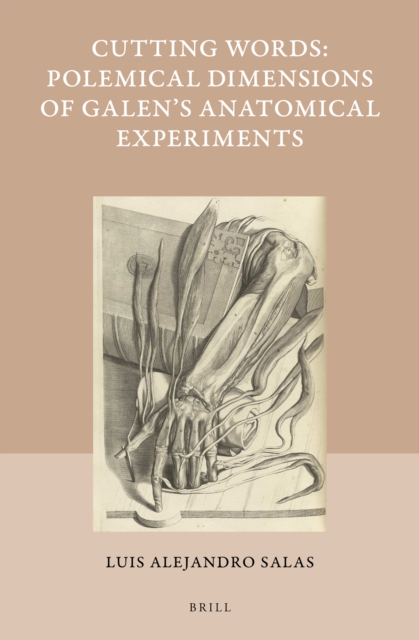
Cutting Words - Polemical Dimensions of Galen's Anatomical Experiments
Luis Alejandro Salas' book, Cutting Words: Polemical Dimensions of Galen's Anatomical Experiments, examines Galen's experimental writing. In four case studies, it argues that Galen exploits writing as a surrogate for live performance and, in some cases, an improvement upon it.
eBook