
Catalogue Search | MBRL


Are you sure you want to remove the book from the shelf?

{{itemTitle}}
9,375
result(s) for
"Arts, Dutch"
Sort by:

Dutch art in a global age
\"The seventeenth century has long been considered a \"golden age\" for Dutch art, fueled by the Dutch Republic's growth as an economic world power. Nourished by an innovative stock market and burgeoning global trade network, this vibrant economy not only provided artists with a rich context in which to make their art, but also directly influenced the art itself--in its subject matter, materials, meaning, and interpretation. The genre scenes and still lifes that today seem quintessentially Dutch actually project a global vision, and often address the positive and the negative of economic and global expansion. Drawing on the world-renowned collection of Dutch paintings, works on paper, decorative arts, and illustrated books at the Museum of Fine Arts, Boston, this book offers a fresh look at seventeenth-century Dutch art, accompanied by authoritative essays that ask readers to consider the global context in which this work was made.\" -- Publisher's website.
Book

Rembrandt, Vermeer, and the Gift in Seventeenth-Century Dutch Art
Rembrandt, Vermeer, and the Gift in Seventeenth-Century Dutch Art offers a new perspective on the art of the Dutch Golden Age by exploring the interaction between the gift's symbolic economy of reciprocity and obligation and the artistic culture of early modern Holland. Gifts of art were pervasive in seventeenth-century Europe, and many Dutch artists, like their counterparts elsewhere, embraced gift giving to cultivate relations with patrons, art lovers, and other members of their social networks. Rembrandt also created distinctive works to function within a context of gift exchange, and both Rembrandt and Vermeer engaged the ethics of the gift to identify their creative labor as motivated by what contemporaries called a \"love of art,\" not materialistic gain. In the merchant republic's vibrant market for art, networks of gift relations and the anti-economic rhetoric of the gift mingled with the growing dimension of commerce, revealing a unique chapter in the interconnected history of gift giving and art making.
eBook

Reconstruction and resumption in indirect A'-dependencies : on the syntax of prolepsis and relativization in (Swiss) German and beyond
\"This monograph investigates A'-dependencies in Standard German, Alemannic and Dutch where the dislocated constituent is indirectly, i.e. not transformationally, related to the position where it is interpreted. The study focuses on relative clauses and shows that an important part of the relativization system in these languages, long relativization, involves a hitherto ignored construction termed resumptive prolepsis. This construction is characterized by base-generation of the operator in the matrix middle-field and a resumptive pronoun in the position of the variable. It is shown that it involves short A'-movement in the matrix clause, empty operator movement in the complement clause and an ellipsis operation that links the two operators. While the link is directly visible in German and Dutch, Swiss German provides a more abstract version of resumptive prolepsis. Through a detailed examination of reconstruction effects and the properties of resumption in these constructions, the book provides new evidence for the role of ellipsis in A'-movement and for a base-generation analysis of resumption. More generally, it makes an important contribution to the modeling of long-distance dependencies and the study of A'-syntax.\"-- Provided by publisher.
Book

Trade, Globalization, and Dutch Art and Architecture
We all look to our past to define our present, but we don’t always realize that our view of the past is shaped by subsequent events. It’s easy to forget that the Dutch dominated the world’s oceans and trade in the seventeenth century when our cultural imagination conjures up tulips and wooden shoes instead of spices and slavery. This book examines the Dutch so-called “Golden Age” though its artistic and architectural legacy, recapturing the global dimensions of this period by looking beyond familiar artworks to consider exotic collectibles and trade goods, and the ways in which far-flung colonial cities were made to look and feel like home. Using the tools of art history to approach questions about memory, history, and how cultures define themselves, this book demonstrates the centrality of material and visual culture to understanding history and cultural identity.
eBook


Talking Prices
How do dealers price contemporary art in a world where objective criteria seem absent?Talking Pricesis the first book to examine this question from a sociological perspective. On the basis of a wide range of qualitative and quantitative data, including interviews with art dealers in New York and Amsterdam, Olav Velthuis shows how contemporary art galleries juggle the contradictory logics of art and economics. In doing so, they rely on a highly ritualized business repertoire. For instance, a sharp distinction between a gallery's museumlike front space and its businesslike back space safeguards the separation of art from commerce.
Velthuis shows that prices, far from being abstract numbers, convey rich meanings to trading partners that extend well beyond the works of art. A high price may indicate not only the quality of a work but also the identity of collectors who bought it before the artist's reputation was established. Such meanings are far from unequivocal. For some, a high price may be a symbol of status; for others, it is a symbol of fraud.
Whereas sociological thought has long viewed prices as reducing qualities to quantities, this pathbreaking and engagingly written book reveals the rich world behind these numerical values. Art dealers distinguish different types of prices and attach moral significance to them. Thus the price mechanism constitutes a symbolic system akin to language.
eBook

Crowning glories : Netherlandish realism and the French imagination during the reign of Louis XIV
\"Crowning Glories integrates Louis XIV's propaganda campaigns, the transmission of Northern art into France, and the rise of empiricism in the eighteenth century--three historical touchstones--to examine what it would have meant for France's elite to experience the arts in France simultaneously with Netherlandish realist painting. In an expansive study of cultural life under the Sun King, Harriet Stone considers the monarchy's elaborate palace decors, the court's official records, and the classical theatre alongside Northern images of daily life in private homes, urban markets, and country fields. Stone argues that Netherlandish art assumes an unobtrusive yet, for the history of ideas, surprisingly dramatic role within the flourishing of the arts, both visual and textual, in France during Louis XIV's reign. Netherlandish realist art represented thinking about knowledge that challenged the monarchy's hold on the French imagination, and its efforts to impose the king's portrait as an ideal and proof of his authority. As objects appreciated for their aesthetic and market value, Northern realist paintings assumed an uncontroversial place in French royal and elite collections. Flemish and Dutch still lifes, genre paintings, and cityscapes, however, were not merely accoutrements of power, acquisitions made by those with influence and money. Crowning Glories reveals how the empirical orientation of Netherlandish realism exposed French court society to a radically different mode of thought, one that would gain full expression in the Encyclopâedie of Diderot and d'Alembert.\"-- Provided by publisher.
BOOK

Rembrandt, Vermeer, and the Gift in Seventeenth-Century Dutch Art
This book offers a new perspective on the art of the Dutch Golden Age by exploring the interaction between the gift's symbolic economy of reciprocity and ligation and the artistic culture of early modern Holland.
eBook

Insect artifice : nature and art in the Dutch Revolt
\"This pathbreaking and stunningly illustrated book recovers the intersections between natural history, politics, art, and philosophy in the late sixteenth-century Low Countries. Insect Artifice explores the moment when the seismic forces of the Dutch Revolt wreaked havoc on the region's creative and intellectual community, compelling its members to seek solace in intimate exchanges of art and knowledge. At its center is a neglected treasure of the late Renaissance: the Four Elements manuscripts of Joris Hoefnagel (1542-1600), a learned Netherlandish merchant, miniaturist, and itinerant draftsman who turned to the study of nature in this era of political and spiritual upheaval. Presented here for the first time are more than eighty pages in color facsimile of Hoefnagel's encyclopedic masterwork, which showcase both the splendor and eccentricity of its meticulously painted animals, insects, and botanical specimens. Marisa Anne Bass unfolds the circumstances that drove the creation of the Four Elements by delving into Hoefnagel's writings and larger oeuvre, the works of his friends, and the rich world of classical learning and empirical inquiry in which he participated. Bass reveals how Hoefnagel and his colleagues engaged with natural philosophy as a means to reflect on their experiences of war and exile, and found refuge from the threats of iconoclasm and inquisition in the manuscript medium itself. This is a book about how destruction and violence can lead to cultural renewal, and about the transformation of Netherlandish identity on the eve of the Dutch Golden Age.\" -- Dust jacket
Book
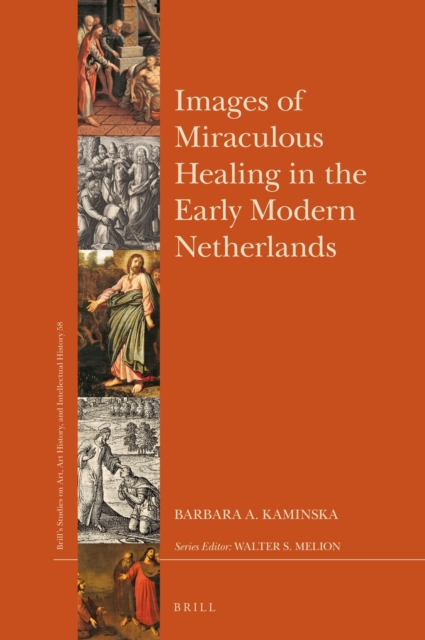
Images of Miraculous Healing in the Early Modern Netherlands
Barbara Kaminska argues that visual imagery was central to premodern disability discourses and shows how interpretations of miracle stories served to justify expectations toward the impaired and the poor.
eBook