
Catalogue Search | MBRL


Are you sure you want to remove the book from the shelf?

{{itemTitle}}
30,074
result(s) for
"Arts Mathematics."
Sort by:

100 essential things you didn't know you didn't know about math and the arts
\"At first glance, the worlds of math and the arts might not seem like comfortable neighbors. But as mathematician John D. Barrow points out, they have a strong and natural affinity--after all, math is the study of all patterns, and the world of the arts is rich with pattern. Barrow whisks us through 100 thought-provoking and often whimsical intersections between math and many arts, from the golden ratios of Mondrian's rectangles and the curious fractal-like nature of Pollock's drip paintings to ballerinas' gravity-defying leaps and the next generation of monkeys on typewriters tackling Shakespeare\"--Dust jacket flap.
Book

Connections between mathematics, the arts and architecture
The purpose of this book is to analyse the interdisciplinary aspects of mathematics and geometry in reference to nature, art, and architecture. In Chapter 1, we introduce symmetry and its different meanings. Symmetry is a notion, which has been applied in the arts and architecture to find harmony and beauty. It joins aesthetics and practice, science and economy, mathematics and philosophy. In this chapter, we also analyze the influence of Vitruvius and the concept of old symmetry, received by the Renaissance. It is also interesting to note how in contemporary architecture there is often the presence of the \"break\" of symmetry (for example in the Frank O Gehry's works). Chapter 2 explains how proportions, and in particular, the golden section, has introduced aesthetic canons that have strongly influenced many artists like Polycletus, and architects, from Ictinus to Le Corbusier. In Chapter 3, we discover how curves and spirals find their application in artistic works, for example in Mycenaean jewellery, and architectural works, from the Baroque of Francesco Borromini to the Land Art of Smithson. Chapter 4 presents the importance and influence that Platonic solids and polyhedrons have had on philosophy and art through different historical periods and different cultures. For instance, we look at how Platonic solids are connected to the theory of Empedocles' elements and Hippocrates' theory of humors. Chapter 5 describes surfaces, discovering how different cultures have used them in different manners, including Roman aqueducts, iron bridges, and finally arriving on modern structures that base their forms on hyperboloids and paraboloids. In Chapter 6, we introduce fractal geometry, as a geometry that tries to explain nature's irregular shapes, trying to overcome the limitations imposed by \"old\" Euclidean geometry. We also analyse how fractal geometry has influenced architecture in this century.
eBook

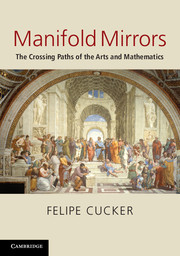
Manifold Mirrors
Most works of art, whether illustrative, musical or literary, are created subject to a set of constraints. In many (but not all) cases, these constraints have a mathematical nature, for example, the geometric transformations governing the canons of J. S. Bach, the various projection systems used in classical painting, the catalog of symmetries found in Islamic art, or the rules concerning poetic structure. This fascinating book describes geometric frameworks underlying this constraint-based creation. The author provides both a development in geometry and a description of how these frameworks fit the creative process within several art practices. He furthermore discusses the perceptual effects derived from the presence of particular geometric characteristics. The book began life as a liberal arts course and it is certainly suitable as a textbook. However, anyone interested in the power and ubiquity of mathematics will enjoy this revealing insight into the relationship between mathematics and the arts.
eBook

Blueprints : how mathematics shapes creativity
An award-winning mathematician and Oxford professor looks to the arts to uncover the key mathematical structures that underpin both nature and human creativity.
BOOK
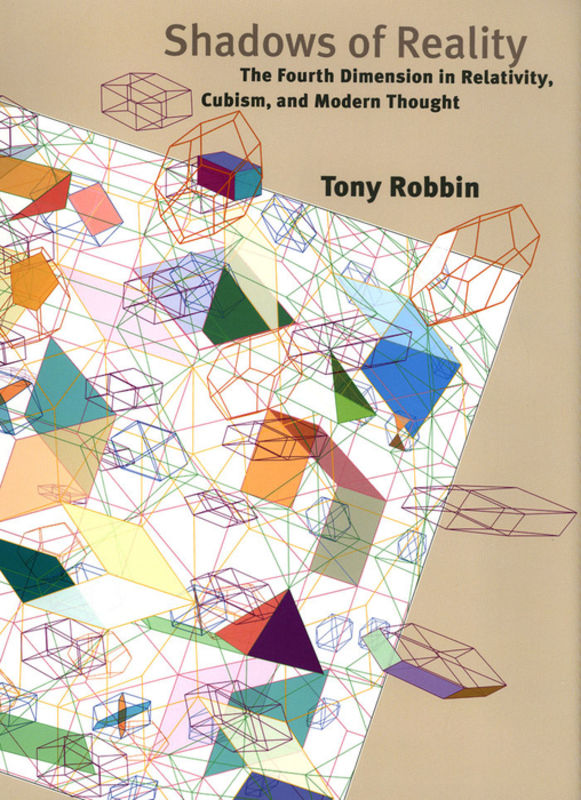
Shadows of Reality
In this insightful book, which is a revisionist math history as well as a revisionist art history, Tony Robbin, well known for his innovative computer visualizations of hyperspace, investigates different models of the fourth dimension and how these are applied in art and physics. Robbin explores the distinction between the slicing, or Flatland, model and the projection, or shadow, model. He compares the history of these two models and their uses and misuses in popular discussions. Robbin breaks new ground with his original argument that Picasso used the projection model to invent cubism, and that Minkowski had four-dimensional projective geometry in mind when he structured special relativity. The discussion is brought to the present with an exposition of the projection model in the most creative ideas about space in contemporary mathematics such as twisters, quasicrystals, and quantum topology. Robbin clarifies these esoteric concepts with understandable drawings and diagrams.Robbin proposes that the powerful role of projective geometry in the development of current mathematical ideas has been long overlooked and that our attachment to the slicing model is essentially a conceptual block that hinders progress in understanding contemporary models of spacetime. He offers a fascinating review of how projective ideas are the source of some of today's most exciting developments in art, math, physics, and computer visualization.
eBook

The proof stage : how theater reveals the human truth of mathematics
\"The proof stage is the story of the unexpected collaborations and resonances between theater and mathematics and how they have evolved since the turn of the twentieth century. Toward the end of the 1800s, unsettling discoveries about alternate geometries and the mathematical infinite began to reveal that, despite its reputation for absolute certainty, mathematical truth is not immutable. At the same time, new, experimental forms of theater were rapidly developing-some inspired by these very upheavals in mathematics. Both disciplines were, and are, characterized by a quest for truth and a shared ability to investigate their respective limitations. Stephen Abbott provides the first systematic, book-length treatment of the interactions between mathematics and theater that have occurred over the last 120 years. Drawing on the author's fifteen years of experience researching and teaching a course on the subject, the book examines how the two disciplines reveal novel insights about one another. Stages of Uncertainty follows the path of playwrights that engaged mathematics such as Alfred Jarry, Stanislav Witkeiwicz, Samuel Beckett, Bertolt Brecht, Felix Durrenmatt, Tom Stoppard, Micheal Frayn, and Simon McBurney. Intertwined with this history is the history of mathematics; along the way, Abbott describes the development of quantum mechanics, chaos theory, incompleteness, and alternative geometries that occurred as these plays were being written. The main arguments are that these two domains have deep resonances, including shared notions of uncertainty, self-reference, recursion, and orientation, and that theater has engaged deeply and innovatively with math for many years. Abbott reveals a unique portrait of mathematics, one that is unexpected and deeply human\"-- Provided by publisher.
Book

Poiesis and Enchantment in Topological Matter
In this challenging but exhilarating work, Sha Xin Wei argues for an approach to materiality inspired by continuous mathematics and process philosophy. Investigating the implications of such an approach to media and matter in the concrete setting of installation- or event-based art and technology, Sha maps a genealogy of topological media -- that is, of an articulation of continuous matter that relinquishes a priori objects, subjects, and egos and yet constitutes value and novelty. Doing so, he explores the ethico-aesthetic consequences of topologically creating performative events and computational media. Sha's interdisciplinary investigation is informed by thinkers ranging from Heraclitus to Alfred North Whitehead to Gilbert Simondon to Alain Badiou to Donna Haraway to Gilles Deleuze and Félix Guattari. Sha traces the critical turn from representation to performance, citing a series of installation-events envisioned and built over the past decade. His analysis offers a fresh way to conceive and articulate interactive materials of new media, one inspired by continuity, field, and philosophy of process. Sha explores the implications of this for philosophy and social studies of technology and science relevant to the creation of research and art. Weaving together philosophy, aesthetics, critical theory, mathematics, and media studies, he shows how thinking about the world in terms of continuity and process can be informed by computational technologies, and what such thinking implies for emerging art and technology.
eBook

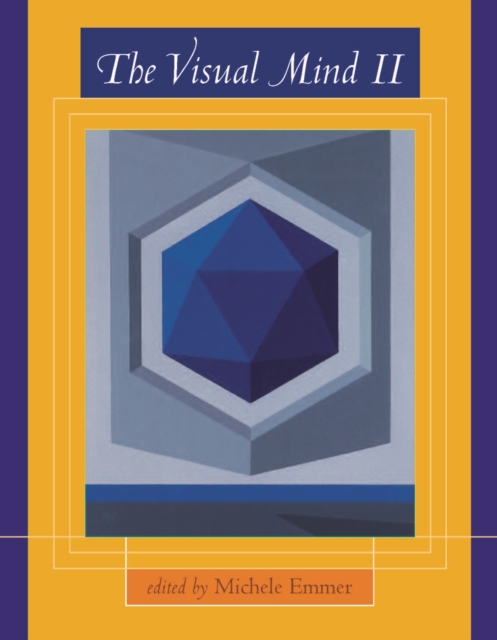
The Visual Mind II
Essays on mathematics and art as visual expression.Mathematical forms rendered visually can give aesthetic pleasure; certain works of art-Max Bill's Moebius band sculpture, for example-can seem to be mathematics made visible. This collection of essays by artists and mathematicians continues the discussion of the connections between art and mathematics begun in the widely read first volume of The Visual Mind in 1993.Mathematicians throughout history have created shapes, forms, and relationships, and some of these can be expressed visually. Computer technology allows us to visualize mathematical forms and relationships in new detail using, among other techniques, 3D modeling and animation. The Visual Mind proposes to compare the visual ideas of artists and mathematicians-not to collect abstract thoughts on a general theme, but to allow one point of view to encounter another. The contributors, who include art historian Linda Dalrymple Henderson and filmmaker Peter Greenaway, examine mathematics and aesthetics; geometry and art; mathematics and art; geometry, computer graphics, and art; and visualization and cinema. They discuss such topics as aesthetics for computers, the Guggenheim Museum in Bilbao, cubism and relativity in twentieth-century art, the aesthetic value of optimal geometry, and mathematics and cinema.
eBook