
Catalogue Search | MBRL


Are you sure you want to remove the book from the shelf?

{{itemTitle}}
1,554
result(s) for
"Asia -- Foreign economic relations -- Developing countries"
Sort by:
The future of South-South economic relations
In recent years, it has become apparent that South-South economic relations are increasing, and will continue to do so. There will be more trade agreements and more trade, more economic alliances and more political alliances with economic goals, more investment flows and an increasing acknowledgement that the Global South has more to offer than it has in the past. These new economic relations have great potential, both for harm and for good. In the absence of directed policies and intentional actors, imbalances of power and growing gaps in development will persist. With the right policies in place, however, these relationships could forge a new global order with greater economic and political equality. Covering a wide range of topics, including regional trade integration in Africa, the environmental impact of increased South-South trade, the changing patterns of South-South investment, and the effect of conflict on trade in South Asia, this ground-breaking volume presents an analysis of South-South economic relations, and how they might impact and be impacted by the rest of the world
eBook

China into Africa: Trade, Aid, and Influence
Discusses the evolving symbiosis between Africa and China and specifies its likely implications. Among the specific topics tackled here are China's interest in African oil, military and security relations, the influx and goals of Chinese aid to sub-Saharan Africa, human rights issues, and China's overall strategy in the region
eBook

Strengthening China's and India's trade and investment ties to the Middle East and North Africa
China and India's spectacular economic rise over the last two decades has accelerated their trade and investment flows with the Middle East and North Africa (MENA), particularly with the oil-producing countries. And while these flows are still small, China and India's presence in the region is on the rise. This report focuses on the following questions: what have been evolution and the impact of MENA's trade and investment relations with China and India? what actions can be taken to maximize the benefits from these relations and to enhance MENA's international integration? The main findings indicate that the region as a whole has benefited from the rise of China and India in terms of better terms of trade, significant increases in oil and gas exports, and cheaper imports. However, producers of industrial goods have been negatively-and in a few cases severely-affected by competition with the two Asian countries in both third and domestic markets. While China and India are investing more in MENA, they are contributing very little to job creation or to the transfer and diffusion of technology. Faster growth in the two Asian countries-and the associated higher demand for energy-will increase revenues from oil and the difficult choices associated with their management. For the labor-abundant, non oil-producing countries, competition with China and India will increase. But the lack of competitive manufacturing industries and services, the insufficient attention given in the past to building technological capabilities and promoting openness and entrepreneurship are constraining their ability to respond to competition. They need to accelerate productivity to tackle unemployment, especially among youth. This may require the broader institutional changes seen in China and India-suggesting the importance of a pragmatic reform agenda that can accelerate
productivity, trade, and investment in the region.
eBook
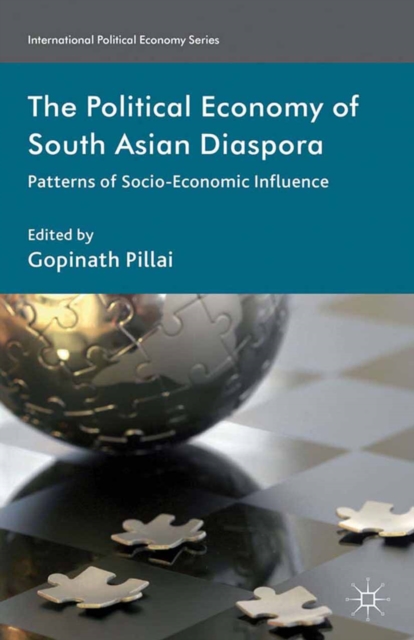
The political economy of South Asian diaspora : patterns of socio-economic influence
01
02
The South Asian diaspora is a diverse group who settled in different parts of the world, often concentrated in developed countries. There is an emerging trend of re-engagement of the diaspora in the South Asian region. Entrepreneurs in Japan and Singapore as well as the Malaysian Indian diaspora are involved in South India making the region a lucrative space for capital, talent and ideas. This volume expands into diasporic communities such as the Nepali community in Singapore and their contribution to their home economy through remittances. Beyond economics, the contributors explore how transnational politics overlap with religious ideologies amongst Pakistanis in United Kingdom and the Sathya Sai Baba movement which contributes to diasporic identity building in host countries. They also explore media and culture: in the last decade Bollywood films have portrayed life in the diaspora, and have featured the diaspora and Non Resident Indians (NRI) as fully formed stock characters and protagonists. The process of diaspora re-engagement has tremendous development implications for South Asian countries, both individually and for their regional integration.
02
02
The South Asian diaspora is a diverse group who settled in different parts of the world, often concentrated in developed countries. This volume explores how transnational politics overlap with religious ideologies, media and culture amongst the disapora, contributing to diasporic identity building in host countries.
13
02
Gopinath Pillai has been Ambassador-at-Large since August 2008. He was Singapore's Non-Resident Ambassador to Iran between 1990 and 2008. He has also served as Singapore's High Commissioner to Pakistan. Ambassador Pillai has been Chairman of the Management Board of the Institute of South Asian Studies, National University of Singapore, since its inception in 2004. As Chairman, he spearheaded the first South Asian Diaspora Conference in 2011 and chairs the second diaspora conference to be held in November 2013.
04
02
Introduction; Gopinath Pillai PART I: ECONOMICS 1. Looking East and Beyond: Indian IT Diaspora in Japan; Anthony P. D'Costa 2. Bangladeshi Diaspora Entrepreneurs in Japan; Md Mizanur Rahman and Lian Kwen Fee 3. From Sentries to Skilled Migrants: the transitory residence of the Nepali community in Singapore; Hema Kiruppalini 4. Migrant Remittance Supported Micro Enterprises in South Asia; Shahadat Khan 5. Diaspora Route to Professional Success in the Indian Context: A Perspective; Ravi Mantha and Meng Weng Wong PART II: RELIGION 6. Religion, Politics and Islam in the South Asian Diaspora; Pnina Werbner 7. Social Movements in the Diasporic Context: the Sathya Sai Baba Movement; Ajaya K. Sahoo and Melissa Kelly PART III: MEDIA 8. Transnational Subject/Transnational Audience: the NRI trope and Diasporic Aesthetic in Diasporic Romance Films; Sarah Joshi 9. Transnational Collaboration and Media Industry in South India: Case of Malaysian-Indian Diaspora; Shanthini Pillai Conclusion; Gopinath Pillai
eBook

Aid, China, and Growth
This article introduces a new dataset of official financing from China to 138 developing countries between 2000 and 2014. It investigates whether Chinese development finance affects economic growth in recipient countries. The results demonstrate that Chinese development finance boosts short-term economic growth. An additional project increases growth by between 0.41 and 1.49 percentage points 2 years after commitment, on average. While this study does not find that significant financial support from China impairs the overall effectiveness of aid from Western donors, aid from the United States tends to be more effective in countries that receive no substantial support from China.
Journal Article

Global value chains in a post-Washington Consensus world
Contemporary globalization has been marked by significant shifts in the organization and governance of global industries. In the 1970s and 1980s, one such shift was characterized by the emergence of buyer-driven and producer-driven commodity chains. In the early 2000s, a more differentiated typology of governance structures was introduced, which focused on new types of coordination in global value chains (GVCs). Today the organization of the global economy is entering another phase, with transformations that are reshaping the governance structures of both GVCs and global capitalism at various levels: (1) the end of the Washington Consensus and the rise of contending centers of economic and political power; (2) a combination of geographic consolidation and value chain concentration in the global supply base, which, in some cases, is shifting bargaining power from lead firms in GVCs to large suppliers in developing economies; (3) new patterns of strategic coordination among value chain actors; (4) a shift in the end markets of many GVCs accelerated by the economic crisis of 2008-09, which is redefining regional geographies of investment and trade; and (5) a diffusion of the GVC approach to major international donor agencies, which is prompting a reformulation of established development paradigms.
Journal Article

Vulnerability to poverty : theory, measurement and determinants, with case studies from Thailand and Vietnam
With the current global crisis, high levels of volatility in trade, capital flows, commodity prices, aid, and the looming threat of climate change, this book brings together high-quality research and presents conceptual issues and empirical results to analyze the determinants of the vulnerability to poverty in developing countries.
eBook

Exploring the relationship between development aid and FDI from developed countries in developing countries: empirical insights from Japanese firm-level data
Development aid is recognized in the fields of international relations and development economics as an important geopolitical tool for supporting the outward FDI of developed countries in developing countries. However, little attention has been given to the role of firm heterogeneity, a central concept in IB, in the aid–FDI relationship. This study helps address this gap by bringing the aid–FDI nexus to the level of the firm. We argue that both infrastructure and non-infrastructure aid encourage private home firms’ FDI entries, even when unrelated to aid project execution. We propose that developed-country firms that are less able to manage host-country challenges or have access to the home state should be more sensitive to both types of aid. Analyzing data from 1451 private Japanese firms in 76 developing countries (1991–2002), we find that both types of aid raise the FDI entry likelihood. However, the firm-level contingencies are confirmed only for the infrastructure aid–FDI nexus. Non-infrastructure aid seems to mitigate market and political uncertainties that home firms are less capable of tackling on their own. This study complements research in IB that focuses on Chinese infrastructure aid and emphasizes infrastructure-related FDI and political expansion motives of SOEs in the aid–FDI nexus.
Journal Article

Rogue aid? An empirical analysis of China's aid allocation
Foreign aid from China is often characterized as \"rogue aid\" that is guided by selfish interests alone. We collect data on Chinese project aid, food aid, medical staff and total aid money to developing countries, covering the 1956-2006 period, to empirically test to what extent self-interests shape China's aid allocation. While political considerations shape China's allocation of aid, China does not pay substantially more attention to politics compared to Western donors. What is more, China's aid allocation seems to be widely independent of recipients' endowment with natural resources and institutional characteristics. Overall, denoting Chinese aid as \"rogue aid\" seems unjustified. L'aide étrangère de la Chine est souvent caractérisée comme une « aide canaille » guidée par les seuls intérêts du donneur. On a collecté des données sur l'aide de la Chine pour des projets, de la nourriture, du personnel médical, ainsi que l'aide monétaire totale aux pays en développement pour la période 1956-2006, afin de tester empiriquement jusqu'à quel point les intérêts égoïstes de la Chine ont conformé l'aide de la Chine. Bien que des considérations politiques conforment l'allocation de l'aide de la Chine, la Chine ne porte pas une attention substantiellement plus grande aux considérations politiques que les donateurs de l'Ouest. De plus, l'allocation de l'aide de la Chine semble grandement indépendante de la dotation en facteurs ou des caractéristiques institutionnelles des pays récipiendaires. En gros, caractériser l'aide de la Chine comme « aide canaille » semble injustifié.
Journal Article
State-owned MNCs and host country expropriation risk: The role of home state soft power and economic gunboat diplomacy
Expropriation risk has a binding effect on foreign direct investment (FDI). However, state-owned multinational corporations may counter the monopoly power of the host state by leveraging the political influence of their home government. The magnitude of this counter force, we argue, may vary, depending on the strength of political relations between the home and host state, and the level of economic dependence of the host country on the home market. We find supporting evidence of our hypotheses using Chinese firm-level FDI information between 2003 and 2010.
Journal Article