
Catalogue Search | MBRL


Are you sure you want to remove the book from the shelf?

{{itemTitle}}
20
result(s) for
"Asia Mount Everest."
Sort by:

High crimes
People die every year on Mount Everest. This year will be murder. Zan Jensen, on the run from her past, has landed in Kathmandu, where she works as a climbing guide for rich tourists. On the side, she and her partner, Haskell, moonlight as high-altitude graverobbers: extorting money from the families of the many dead bodies they find littering the peaks of the Himalayas to bring them down and send them home. When a body at the summit of Mount Everest shows up with a jackpot of state secrets embedded in its skin, they're put in the crosshairs of a government agency bent on recovering the body and eliminating any witnesses. It's a race to the top of the world, where Zan will fight to find salvation in the deadliest place on Earth. Collecting the two-time Eisner-nominated comic by Christopher Sebela (CROWDED, SHANGHAI RED, WE(L)COME BACK) and artist Ibrahim Moustafa (JAEGER, MOTHER PANIC, JAMES BOND), High Crimes is a high-altitude noir that's been called the perfect thriller, with big stakes, damaged characters, dark pasts, and just the right ratio of humor-to-corpses. (Chelsea Cain, NYT bestselling author of the Archie Sheridan-Gretchen Lowell series.).
Book
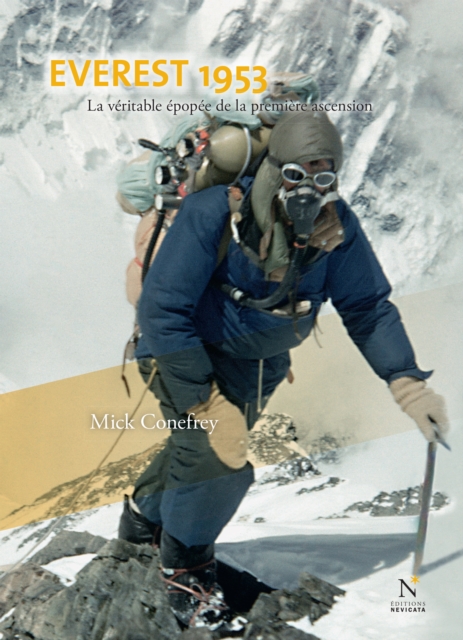
Everest 1953
Les coulisses de la victoire sur l'Everest racontees pour la premiere fois a l'appui d'archives inedites.29 mai 1953. Edmund Hillary et Tenzing Norgay sont les premiers hommes a fouler le sommet de l'Everest, la plus haute montagne au monde. 60 ans plus tard, voici le premier recit complet sur cet exploit historique, fruit de recherches approfondies de l'auteur, qui a eu acces a de nombreuses archives inedites et passionnantes dont celles de membres de l'expedition, du gouvernement britannique ou de la prestigieuse Royal Geographical Society. Et d'apprendre qu'une expedition qui est entree dans les manuels d'histoire comme un modele d'organisation fut secouee de nombreuses crises, sur la montagne mais aussi en dehors. Pressions politiques, enjeux diplomatiques, guerre mediatique, ambitions personnelles, controverses etouffees : l'expedition de 1953 est non seulement une histoire humaine de courage et d'aventure, mais un condense des interets et luttes d'un monde effervescent en cette annee du couronnement de la reine Elizabeth II. Mick Conefrey eclaire d'une lumiere inedite le courage, l'imagination et le talent hors normes dont ont du faire preuve chaque membre de l'expedition pour aboutir au succes. Un recit palpitant, fourmillant d'anecdotes et d'informations, repondant a de nombreuses questions, dont la celebre \"qui de Hillary ou de Tenzing a foule le premier le sommet ?\".CE QU'EN PENSE LA CRITIQUE :\"Un regal ! Un recit humain, drole et meticuleusement recherche.\" - The Independent\"Fascinant et poignant. La reference definitive sur cette temeraire ascension.\" - Daily Mail\"J'ai souvent ete emu au cours de ma lecture. Cette histoire est celle du courage et, malheureusement, d'un monde aujourd'hui disparu.\" - The GuardianA PROPOS DE L'AUTEUR :Mick Conefrey habite a Oxford, en Angleterre. Il est l'auteur de nombreux livres et documentaires d'aventure et de montagne, dont plusieurs en collaboration avec la BBC.
eBook

Where Is Mount Everest?
Introduces Mount Everest, the tallest peak in the world, describing its ancient beginnings, the first human settlers, and historic climbs.
Book

Timing of midcrustal metamorphism, melting, and deformation in the Mount Everest region of southern Tibet revealed by U(-Th)-Pb geochronology
U(-Th)-Pb dating of zircon, monazite, and xenotime from metamorphic and igneous rocks at two outcrops along a north-south transect in the Mount Everest region of southern Tibet provide new constraints on the timing and duration of thermal events associated with channel flow and the ductile extrusion of the Greater Himalayan Series (GHS). At the southernmost outcrop in the Kangshung Valley, Th-Pb ages from monazite indicate that prograde metamorphism associated with crustal thickening following the India-Asia collision occurred at least as early as 38.9±0.9 Ma. A subsequent sillimanite-grade metamorphic event at 28.0±1.2 Ma was followed by two phases of leucogranite emplacement at 20.8±0.8 and 16.7±0.4 Ma. At Thongmön, ∼40 km to the northeast of the Kangshung Valley, prograde metamorphism was occurring at ∼25.4 Ma and lasted until 16.1±0.1 Ma, reaching ∼740°C and 5 kbar at 22.4±0.2 Ma. Immediately following metamorphism, two phases of leucogranite were emplaced at 15.2±0.2 and 12.6±0.2 Ma, with an intervening phase of ductile deformation. These data combined with ages from the Rongbuk glacier and Ama Drime range, north and east of Everest and the North Himalayan Mabja dome 100-140 km to the northeast, suggest that GHS metamorphism lasted ∼20 m.yr. and that migmatization and south-directed channel flow peaked around ∼23-20 Ma and ended by ∼16 Ma. The youngest leucogranites crosscut all ductile fabrics related to the Miocene channel flow.
Journal Article


The Benkar fault zone; an orogen-scale cross fault in the eastern Nepal Himalaya
The Benkar Fault Zone (BFZ) is a recently recognized, NNE-striking, brittle to ductile, cross fault that cuts across the dominant metamorphic fabric of the Greater Himalayan Sequence (GHS) and the Lesser Himalayan Sequence (LHS) in eastern Nepal. 40Ar/39Ar-muscovite cooling ages along a transect across the BFZ in the GHS indicate movement younger than 12 Ma. To understand the mode of genesis, and seismo-tectonic implications of the BFZ, we mapped this fault from the Everest region in the upper Khumbu valley toward the south, across the Main Central Thrust, into the LHS and the Greater Himalayan Nappe. We recognize a series of cross faults segments, which we interpret the BFZ system. The currently mapped section of the BFZ is >100 km long, and its width is up to 4 km in the LHS. The BFZ is semi-ductile in the GHS region but is brittle in the south, where it is expressed as gouge zones, tectonically brecciated zones, sharp fault planes, and segments of nonpenetrative brittle deformation zones. From petrographic and kinematic analysis, we interpret largely a right-lateral, extensional sense of shear. Our work did not continue into the Sub-Himalaya, but the BFZ may continue through this zone into the foreland as documented in other Himalayan cross faults. While several genetic models have been proposed for cross faults in the Himalaya and other convergent orogens, we suggest that the BFZ may be related to extensional structures in Tibet. Understanding cross faults is not only important for the tectonic history of the Himalaya but due to the co-location of cross faults and seismogenic boundaries, there may be a causal relationship. Cross faults also follow many of the north-south river segments of the Himalaya and weakened fault rocks on the valley walls may enhance the landslide hazard in these areas.
Journal Article

The white road
Desperate to attract subscribers to his fledgling website, ex-adrenaline junkie Simon Newman undertakes two life-risking ventures, one in the notorious Cwm Pot caves and another scaling Everest, that force him to test the limits of his morality and wits in order to survive.
Book

The structural geometry, metamorphic and magmatic evolution of the Everest Massif, High Himalaya of Nepal-South Tibet
This paper presents a new geological map together with cross-sections and lateral sections of the Everest massif. We combine field relations, structural geology, petrology, thermobarometry and geochronology to interpret the tectonic evolution of the Everest Himalaya. Lithospheric convergence of India and Asia since collision at c. 50 Ma. resulted in horizontal shortening, crustal thickening and regional metamorphism in the Himalaya and beneath southern Tibet. High temperatures (>620°C) during sillimanite grade metamorphism were maintained for 15 million years from 32 to 16.9±0.5 Ma along the top of the Greater Himalayan slab. This implies that crustal thickening must also have been active during this time, which in turn suggests high topography during the Oligocene-early Miocene. Two low-angle normal faults cut the Everest massif at the top of the Greater Himalayan slab. The earlier, lower Lhotse detachment bounds the upper limit of massive leucogranite sills and sillimanite-cordierite gneisses, and has been locally folded. Ductile motion along the top of the Greater Himalayan slab was active from 18 to 16.9 Ma. The upper Qomolangma detachment is exposed in the summit pyramid of Everest and dips north at angles of less than 15°. Brittle faulting along the Qomolangma detachment, which cuts all leucogranites in the footwall, was post-16 Ma. Footwall sillimanite gneisses and leucogranites are exposed along the Kharta valley up to 57 km north of the Qomolangma detachment exposure near the summit of Everest. The amount of extrusion of footwall gneisses and leucogranites must have been around 200 km southwards, from an origin at shallow levels (12-18 km depth) beneath Tibet, supporting models of ductile extrusion of the Greater Himalayan slab. The Everest-Lhotse-Nuptse massif contains a massive ballooning sill of garnet+muscovite+tourmaline leucogranite up to 3000 m thick, which reaches 7800 m on the Kangshung face of Everest and on the south face of Nuptse, and is mainly responsible for the extreme altitude of both mountains. The middle crust beneath southern Tibet is inferred to be a weak, ductile-deforming zone of high heat and low friction separating a brittle deforming upper crust above from a strong (?granulite facies) lower crust with a rheologically strong upper mantle. Field evidence, thermobarometry and U-Pb geochronological data from the Everest Himalaya support the general shear extrusive flow of a mid-crustal channel from beneath the Tibetan plateau. The ending of high temperature metamorphism in the Himalaya and of ductile shearing along both the Main Central Thrust and the South Tibetan Detachment normal faults roughly coincides with initiation of strike-slip faulting and east-west extension in south Tibet (<18 Ma).
Journal Article

Strain, deformation temperatures and vorticity of flow at the top of the Greater Himalayan Slab, Everest Massif, Tibet
This paper presents quantitative data on strain, deformation temperatures and vorticity of flow at the top of the Greater Himalayan Slab. The data were collected from the Tibetan side of the Everest Massif where two low-angle normal faults bound the upper surface of the Greater Himalayan Slab, the earlier and structurally lower Lhotse Detachment and the later and structurally higher Qomolangma Detachment. Greenschist- to sillimanite-grade quartz-rich metasedimentary rocks exposed in the Rongbuk to North Col region of the Everest Massif are characterized by cross-girdle quartz c-axis fabrics indicating approximate plane strain conditions. Fabric opening angles progressively increase with depth beneath the overlying Lhotse Detachment, and indicate progressively rising deformation temperatures of 525-625 ± 50°C at depths of 300-600 m beneath the detachment. Deformation temperatures of c. 450°C are indicated by fabric opening angles in epidote amphibolite-facies mylonites located closer to the overlying detachment. A top down-to-the-north (normal) shear sense is indicated by the asymmetry of microstructures and c-axis fabrics, but the degree of asymmetry is low at distances greater than 400 m beneath the detachment, and sillimanite grains are drawn into adjacent conjugate shear bands but still appear pristine, indicating that deformation occurred at close to peak metamorphic temperatures. These \"quenched\" fabrics and microstructures indicate rapid exhumation in agreement with previous isotopic dating studies. Mean kinematic vorticity numbers (Wm) were independently calculated by three analytical methods. Calculated Wm values range between 0.67 and 0.98, and indicate that although a simple shear component is generally dominant, particularly in greenschist-facies mylonites located between the Lhotse and overlying Qomolangma detachments, there is also a major component of pure shear in samples located at 400-600 m beneath the Lhotse Detachment (pure and simple shear make equal contributions at Wk = 0.71). Our integrated strain and vorticity data indicate a shortening of 10-30% perpendicular to the upper surface of the Greater Himalayan Slab and confirm that the upper surface of the slab is a \"stretching fault\" with estimated down-dip stretches of 10-40% (assuming plane strain deformation) measured parallel to the flow plane-transport direction.
Journal Article