
Catalogue Search | MBRL


Are you sure you want to remove the book from the shelf?

{{itemTitle}}
2,366
result(s) for
"Asian interest"
Sort by:

Finally heard
Ten-year-old Lina wants to create a viral video to help her mom's business, but as she navigates the world of likes and views with her two best friends, Lina must find the courage to stay true to her authentic self.
BOOK

Making Asian American Film and Video
The words \"Asian American film\" might evoke a painfully earnest, low-budget documentary or family drama, destined to be seen only in small film festivals or on PBS (Public Broadcasting Service). In her groundbreaking study of the past fifty years of Asian American film and video, Jun Okada demonstrates that although this stereotype is not entirely unfounded, a remarkably diverse range of Asian American filmmaking has emerged. Yet Okada also reveals how the legacy of institutional funding and the \"PBS style\" unites these filmmakers, whether they are working within that system or setting themselves in opposition to its conventions.
Making Asian American Film and Videoexplores how the genre has served as a flashpoint for debates about what constitutes Asian American identity. Tracing a history of how Asian American film was initially conceived as a form of public-interest media, part of a broader effort to give voice to underrepresented American minorities, Okada shows why this seemingly well-intentioned project inspired deeply ambivalent responses. In addition, she considers a number of Asian American filmmakers who have opted out of producing state-funded films, from Wayne Wang to Gregg Araki to Justin Lin.
Okada gives us a unique behind-the-scenes look at the various institutions that have bankrolled and distributed Asian American films, revealing the dynamic interplay between commercial and state-run media. More than just a history of Asian Americans in film,Making Asian American Film and Videois an insightful meditation on both the achievements and the limitations of institutionalized multiculturalism.
eBook

Rosarita
A young student sits on a bench in a park in San Miguel, Mexico. Bonita is away from her home in India to learn Spanish. She is alone, somewhere she has no connection to. It is bliss. And then a woman approaches her. The woman claims to recognize Bonita because she is the spitting image of her mother, who made the same journey from India to Mexico as a young artist. No, says Bonita, my mother didn't paint. She never travelled to Mexico. But this strange woman insists, and so Bonita follows her. Into a story where Bonita and her mother will move apart and come together, and where the past threatens to flood the present, or re-write it.
BOOK
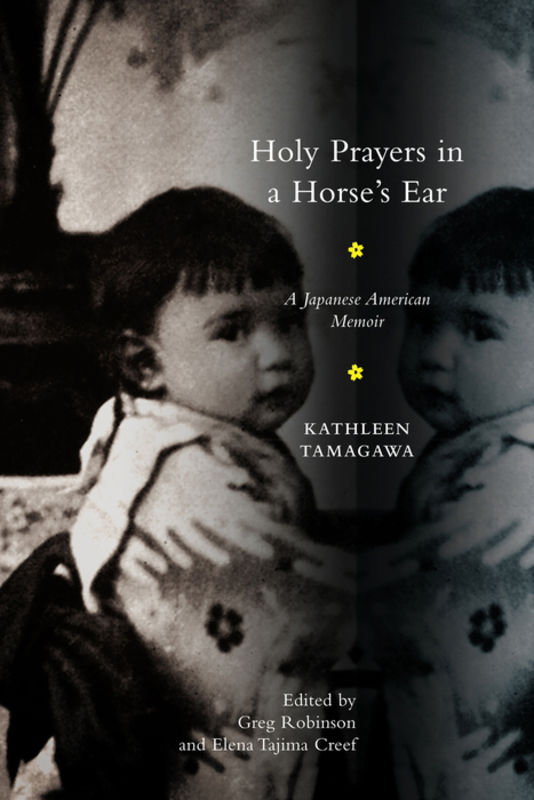
Holy Prayers in a Horse's Ear
Originally published in 1932, Kathleen Tamagawa's pioneering Asian American memoir is a sensitive and thoughtful look at the personal and social complexities of growing up racially mixed during the early twentieth century. Born in 1893 to an Irish American mother and a Japanese father and raised in Chicago and Japan, Tamagawa reflects on the difficulty she experienced fitting into either parent's native culture.
eBook

Made in Asian America : a history for young people
\"This book is a stirring account of the ordinary people and extraordinary acts that made Asian America and the young people who are remaking America today\"--Amazon.
Book

Cosmopolitan Publics
Early twentieth-century China paired the local community to the worldùa place and time when English dominated urban-centered higher and secondary education and Chinese-edited English-language magazines surfaced as a new form of translingual practice.
Cosmopolitan Publics focuses on China's \"cosmopolitans\"ùWestern-educated intellectuals who returned to Shanghai in the late 1920s to publish in English and who, ultimately, became both cultural translators and citizens of the wider world. Shuang Shen highlights their work in publications such as The China Critic and T'ien Hsia, providing readers with a broader understanding of the role and function of cultural mixing, translation, and multilingualism in China's cultural modernity.
Decades later, as nationalist biases and political restrictions emerged within China, the influence of the cosmopolitans was neglected and the significance of cosmopolitan practice was underplayed. Shen's encompassing study revisits and presents the experience of Chinese modernity as far more heterogeneous, emergent, and transnational than it has been characterized until now.
eBook

Fake Chinese sounds
\"Between homework, studying, and Chinese school, Měi Yīng's summer is shaping up to be a boring one. Her only bright spots are practice with her soccer team, the Divas, and the time spent with her năi nai, who is visiting from Taiwan. Although Měi Yīng's Mandarin isn't the best and Năi Nai doesn't speak English, they find other ways to connect, like cooking guōtiē together and doing tai chi in the mornings. By the end of the summer, Měi Yīng is sad to see Năi Nai go-she's the complete opposite of Měi Yīng serious professor mother-but excited to start fifth grade. Until new kid Sid starts making her the butt of racist jokes. Her best friend, Kirra, says to ignore him, but does everyone else's silence about the harassment mean they're also ignoring Sid . . . or her? As Sid's bullying fuels Měi Yīng's feelings of invisibility, she must learn to reclaim her identity and her voice.\"--Back cover.
Book

Art in the Lives of Immigrant Communities in the United States
Art in the Lives of Immigrant Communities in the United Statesis the first book to provide a comprehensive and lively analysis of the contributions of artists from America's newest immigrant communities--Africa, the Middle East, China, India, Southeast Asia, Central America, and Mexico. Adding significantly to our understanding of both the arts and immigration, multidisciplinary scholars explore tensions that artists face in forging careers in a new world and navigating between their home communities and the larger society. They address the art forms that these modern settlers bring with them; show how poets, musicians, playwrights, and visual artists adapt traditional forms to new environments; and consider the ways in which the communities' young people integrate their own traditions and concerns into contemporary expression.
eBook

Spider eaters
Spider Eaters is at once a moving personal story, a fascinating family history, and a unique chronicle of political upheaval told by a Chinese woman who came of age during the turbulent years of the Cultural Revolution. With stunning honesty and a lively, sly humor, Rae Yang records her life from her early years as the daughter of Chinese diplomats in Switzerland, to her girlhood at an elite middle school in Beijing, to her adolescent experience as a Red Guard and later as a laborer on a pig farm in the remote northern wilderness. She tells of her eventual disillusionment with the Maoist revolution, how remorse and despair nearly drove her to suicide, and how she struggled to make sense of conflicting events that often blurred the line between victim and victimizer, aristocrat and peasant, communist and counter-revolutionary. Moving gracefully between past and present, dream and reality, the author artfully conveys the vast complexity of life in China as well as the richness, confusion, and magic of her own inner life and struggle. Much of the power of the narrative derives from Yang's multi-generational, cross-class perspective. She invokes the myths, legends, folklore, and local customs that surrounded her and brings to life the many people who were instrumental in her life: her nanny, a poor woman who raised her from a baby and whose character is conveyed through the bedtime tales she spins; her father; and her beloved grandmother, who died as a result of the political persecution she suffered. Spanning the years from 1950 to 1980, Rae Yang's story is evocative, complex, and told with striking candor. It is one of the most immediate and engaging narratives of life in post-1949 China.
eBook

Suicide in Asia: Epidemiology, Risk Factors, and Prevention
This chapter contains sections titled:
Abstract
Introduction
Contribution of Asian Suicides to Global Suicide Rates
Risk Factors for Suicide in Asia
Common Methods of Suicide in Asian Countries
The Challenge of Suicide Prevention in Asia
Future Directions
Conclusions
References
Book Chapter