
Catalogue Search | MBRL


Are you sure you want to remove the book from the shelf?

{{itemTitle}}
23
result(s) for
"Asianists"
Sort by:

Arab France
Many think of Muslims in Europe as a twentieth century phenomenon, but this book brings to life a lost community of Arabs who lived through war, revolution, and empire in early nineteenth century France. Ian Coller uncovers the surprising story of the several hundred men, women, and children—Egyptians, Syrians, Greeks, and others—who followed the French army back home after Napoleon’s occupation of Egypt. Based on research in neglected archives, on the rediscovery of forgotten Franco-Arab authors, and on a diverse collection of visual materials, the book builds a rich picture of the first Arab France—its birth, rise, and sudden decline in the age of colonial expansion. As he excavates a community that was nearly erased from the historical record, Coller offers a new account of France itself in this pivotal period, one that transcends the binary framework through which we too often view history by revealing the deep roots of exchange between Europe and the Muslim world, and showing how Arab France was in fact integral to the dawn of modernity.
eBook


Scholarly personae in the history of Orientalism, 1870-1930
This volume examines how the history of the humanities might be written through the prism of scholarly personae, understood as time- and place-specific models of being a scholar. Focusing on the field of study known as Orientalism in the decades around 1900, this volume examines how Semitists, Sinologists, and Japanologists, among others, conceived of their scholarly tasks, what sort of demands these job descriptions made on the scholar in terms of habits, virtues, and skills, and how models of being an orientalist changed over time under influence of new research methods, cross-cultural encounters, and political transformations. Contributors are: Tim Barrett, Christiaan Engberts, Holger Gzella, Hans Martin Krämer, Arie L. Molendijk, Herman Paul, Pascale Rabault-Feuerhahn and Henning Trüper.
eBook


Languages and Nations
British rule of India brought together two very different traditions of scholarship about language, whose conjuncture led to several intellectual breakthroughs of lasting value. Two of these were especially important: the conceptualization of the Indo-European language family by Sir William Jones at Calcutta in 1786-proposing that Sanskrit is related to Persian and languages of Europe-and the conceptualization of the Dravidian language family of South India by F.W. Ellis at Madras in 1816-the \"Dravidian proof,\" showing that the languages of South India are related to one another but are not derived from Sanskrit. These concepts are valid still today, centuries later. This book continues the examination Thomas R. Trautmann began inAryans and British India(1997). While the previous book focused on Calcutta and Jones, the current volume examines these developments from the vantage of Madras, focusing on Ellis, Collector of Madras, and the Indian scholars with whom he worked at the College of Fort St. George, making use of the rich colonial record. Trautmann concludes by showing how elements of the Indian analysis of language have been folded into historical linguistics and continue in the present as unseen but nevertheless living elements of the modern.
eBook
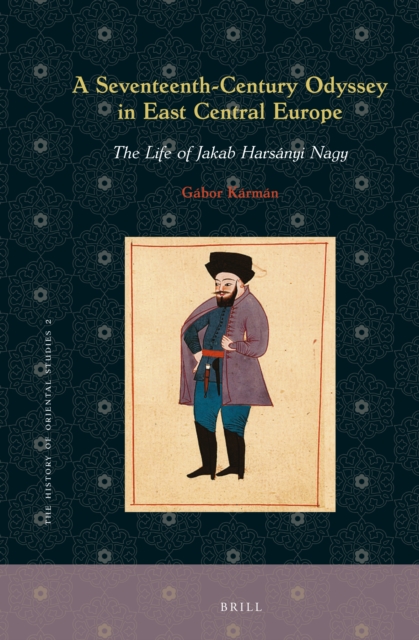
A Seventeenth-Century Odyssey in East Central Europe
In A Seventeenth-Century Odyssey Gábor Kármán reconstructs the life story of a lesser-known Hungarian orientalist, Jakab Harsányi Nagy. The discussion of his activities as a school teacher in Transylvania, as a diplomat and interpreter at the Sublime Porte, as a secretary of a Moldavian voivode in exile, as well as a court councillor of Friedrich Wilhelm, the Great Elector of Brandenburg not only sheds light upon the extraordinarily versatile career of this individual, but also on the variety of circles in which he lived. Gábor Kármán also gives the first historical analysis of Harsányi's contribution to Turkish studies, the Colloquia Familiaria Turcico-latina (1672).
eBook

The Passion of Max von Oppenheim
Born into a prominent German Jewish banking family, Baron Max von Oppenheim (1860-1946) was a keen amateur archaeologist and ethnologist. His discovery and excavation of Tell Halaf in Syria marked an important contribution to knowledge of the ancient Middle East, while his massive study of the Bedouins is still consulted by scholars today. He was also an ardent German patriot, eager to support his country's pursuit of its \"place in the sun\". Excluded by his part-Jewish ancestry from the regular diplomatic service, Oppenheim earned a reputation as \"the Kaiser's spy\" because of his intriguing against the British in Cairo, as well as his plan, at the start of the First World War, to incite Muslims under British, French and Russian rule to a jihad against the colonial powers. After 1933, despite being half-Jewish according to the Nuremberg Laws, Oppenheim was not persecuted by the Nazis. In fact, he placed his knowledge of the Middle East and his connections with Muslim leaders at the service of the regime. Ranging widely over many fields—from war studies to archaeology and banking history—The Passion of Max von Oppenheim tells the gripping and at times unsettling story of one part-Jewish man's passion for his country in the face of persistent and, in his later years, genocidal anti-Semitism.
eBook


The life of J.D. Åkerblad : Egyptian decipherment and orientalism in revolutionary times
This intellectual biography of Johan David Âkerblad presents a new account of the decipherment of ancient Egyptian. Oriental and classical studies and their entwinement in the turbulent politics of this age of revolutions are presented from a novel perspective.
eBook