
Catalogue Search | MBRL


Are you sure you want to remove the book from the shelf?

{{itemTitle}}
1,162
result(s) for
"Aspekt"
Sort by:


Political Agroecology
Political Agroecology is the first book to offer a systematic and articulated reflection on Political Agroecology from the Agroecological perspective. It defines the disciplinary field responsible for designing and producing actions, institutions and regulations aimed at achieving agrarian sustainability. In short, it aims to build a political theory that makes the scaling-up of agroecological experiences possible, turning them into the foundation of a new and alternative food regime.
The book proposes theoretical, practical and epistemological foundations of a new theoretical and practical field of work for agroecologists: Political Agroecology . It establishes a framework for a common agroecological strategy, covering the different levels of collective action and the different instruments with which it can be developed. This will be essential reading for agroecologists, environmentalists, farming and food communities, and an ideal textbook for advanced agroecology courses in universities.
Key features:
Offers a unique state of the art on this fundamental new topic: Political Agroecology
Presents a complete introduction to the political and institutional aspects of Agroecology, covering the whole food system
Offers an important tool for searching agrarian sustainability
Provides a broad epistemological, theoretical and methodological focus, exploring the connection between the different levels and scales involved in agroecological theory and practice
Manuel González de Molina
Full Professor of Modern History. Coordinator of the Agro-Ecosystems History Laboratory (Universidad Pablo de Olavide, Seville, Spain). Co-director of Master Degree Program on Agro-ecology at International University of Andalusia from 1996 to now.
Paulo Federico Petersen
Doctorate in Environmental Studies from Pablo de Olavide University (Spain), Master in Agroecology and Rural Development from the Universidad Internacional de Andalucía (Spain), Graduated in Agronomy from the Federal University of Viçosa (Brazil). Executive coordinator of the NGO AS-PTA - Family Agriculture and Agroecology, vice-president of ABA-Agroecology (Brazilian Association of Agroecology) and editor-in-chief of \"Agriculturas: experiencias em agroecologia\" magazine.
Francisco Garrido Peña
PhD in Philosophy of Law (Universidad de Granada) and full professor on Politics and Law at Universidad de Jaén (Spain). His research activity is focused on Political Ecology, Ethics and Institutional Design.
Francisco Roberto Caporal:
PhD in Agroecology, Peasantry and History, from the Institute of Sociology and Peasant Studies (Córdoba University, Spain). Master in Rural Extension by Federal University of Santa Maria (1991) and graduate in Agronomy, Federal University of Santa Maria (1975). Currently, he works as Associate Professor of the Federal Rural University of Pernambuco, in the Department of Education, teaching in Rural Extension.
Introduction. 1.Theoretical foundations of Political Agroecology 2.The industrialization of agriculture and the enlargement of the food chain 3. A regime on the road to collapse 4. Cognitive frameworks and institutional design for an agroecological transition 5.Scaling Agroecology 6. The agents of the agroecological transition 7. The role of the State and public policies 8.References
eBook
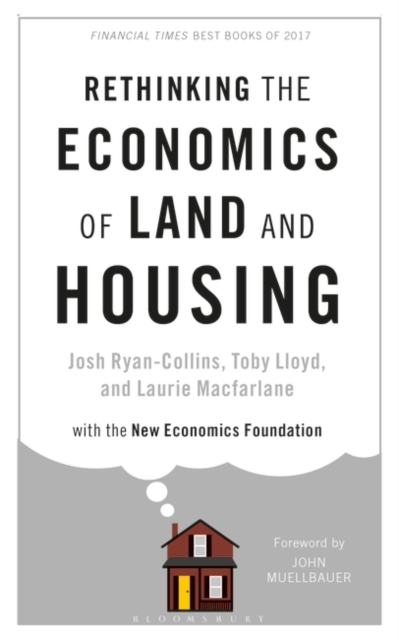
Rethinking the economics of land and housing
Why are house prices in many advanced economies rising faster than incomes? What is the relationship between the financial system and the price of land? In this accessible but provocative guide to the economics of land and housing, the authors reveal how many of the key challenges facing modern economies, including housing crises, financial instability, and growing inequalities, are intimately tied to the land economy. Looking at the ways in which discussions of land have been routinely excluded from both housing policy and economic theory, Rethinking the Economics of Land and Housing argues that in order to tackle these increasingly pressing issues a major re-thinking by both politicians and economists is required. This is the first comprehensive guide to the role of land in the economy, making this an essential reference for students, scholars, policymakers, activists, and NGOs working on land issues.
eBook

Globalization, Uncertainty and Youth in Society
Examining how youths in fourteen industrialized societies make the transition to adulthood in an era of globalization and rising uncertainty, this collection of essays investigates the impact that institutions working with social groups of youths have upon those youths' abilities to make adult decisions determining their life courses.
Covering both Europe and North America, the book includes case studies, and contains country-specific contributions on conservative, social-democratic, post-socialist, liberal and familistic welfare regimes, as well as data from the GLOBALIFE project.
Filling the gap in the market on the micro effects of globalization on individuals, and taking an empirical approach to the topic, this impressive volume brings the individual and nation-specific institutions back into the discussion on globalization.
eBook
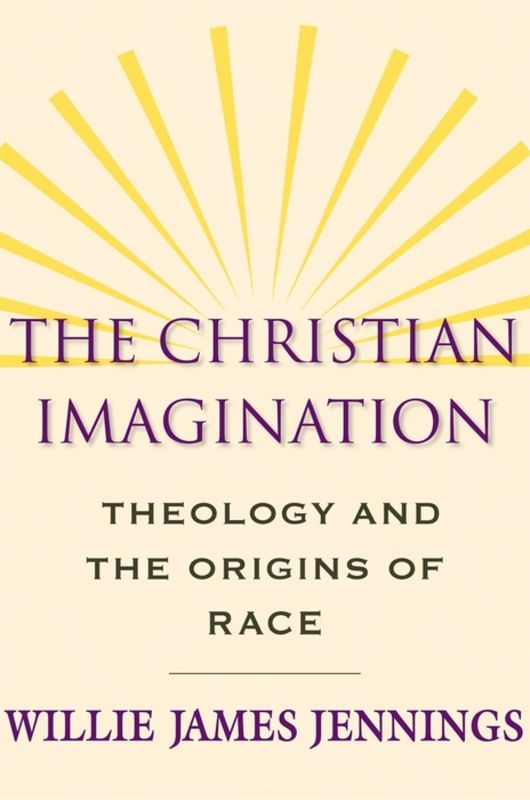
The Christian Imagination
Why has Christianity, a religion premised upon neighborly love, failed in its attempts to heal social divisions? In this ambitious and wide-ranging work, Willie James Jennings delves deep into the late medieval soil in which the modern Christian imagination grew, to reveal how Christianity's highly refined process of socialization has inadvertently created and maintained segregated societies. A probing study of the cultural fragmentation-social, spatial, and racial-that took root in the Western mind, this book shows how Christianity has consistently forged Christian nations rather than encouraging genuine communion between disparate groups and individuals.
Weaving together the stories of Zurara, the royal chronicler of Prince Henry, the Jesuit theologian Jose de Acosta, the famed Anglican Bishop John William Colenso, and the former slave writer Olaudah Equiano, Jennings narrates a tale of loss, forgetfulness, and missed opportunities for the transformation of Christian communities. Touching on issues of slavery, geography, Native American history, Jewish-Christian relations, literacy, and translation, he brilliantly exposes how the loss of land and the supersessionist ideas behind the Christian missionary movement are both deeply implicated in the invention of race.
Using his bold, creative, and courageous critique to imagine a truly cosmopolitan citizenship that transcends geopolitical, nationalist, ethnic, and racial boundaries, Jennings charts, with great vision, new ways of imagining ourselves, our communities, and the landscapes we inhabit.
eBook

Social Variation and the Latin Language
Languages show variations according to the social class of speakers and Latin was no exception, as readers of Petronius are aware. The Romance languages have traditionally been regarded as developing out of a 'language of the common people' (Vulgar Latin), but studies of modern languages demonstrate that linguistic change does not merely come, in the social sense, 'from below'. There is change from above, as prestige usages work their way down the social scale, and change may also occur across the social classes. This book is a history of many of the developments undergone by the Latin language as it changed into Romance, demonstrating the varying social levels at which change was initiated. About thirty topics are dealt with, many of them more systematically than ever before. Discussions often start in the early Republic with Plautus, and the book is as much about the literary language as about informal varieties.
eBook

Music, language, and the brain
In the first comprehensive study of the relationship between music and language from the standpoint of cognitive neuroscience, Aniruddh D. Patel challenges the widespread belief that music and language are processed independently. This volume argues that music and language share deep and critical connections, and that comparative research provides a powerful way to study the cognitive and neural mechanisms underlying these uniquely human abilities.
eBook

Conducting R&D in Countries with Weak Intellectual Property Rights Protection
Multinational enterprises (MNEs) are increasingly conducting research and development (R&D) in countries such as China and India, where intellectual property rights (IPR) protection is still far from adequate. This paper examines this seemingly puzzling situation. I argue that weak IPR leads to low returns to innovation and underutilization of innovative talents; MNEs that possess alternative mechanisms for protecting their intellectual properties will therefore find it attractive to conduct R&D at those locations. A theoretical framework is developed to capture the interaction between firm strategy and the institutional environment. The empirical analysis on a sample of 1,567 U.S.-headquartered innovating firms finds results consistent with the hypotheses that (i) technologies developed in countries with weak IPR protection are used more internally, and (ii) technologies developed by firms with R&D in weak IPR countries show stronger internal linkages. The results suggest that firms may use internal organizations to substitute for inadequate external institutions. By doing so, they are able to take advantage of the arbitrage opportunities presented by the institutional gap across countries.
Journal Article

The Dark Side of Creativity
With few exceptions, scholarship on creativity has focused on its positive aspects while largely ignoring its dark side. This includes not only creativity deliberately aimed at hurting others, such as crime or terrorism, or at gaining unfair advantages, but also the accidental negative side effects of well-intentioned acts. This book brings together essays written by experts from various fields (psychology, criminal justice, sociology, engineering, education, history, and design) and with different interests (personality development, mental health, deviant behavior, law enforcement, and counter-terrorism) to illustrate the nature of negative creativity, examine its variants, call attention to its dangers, and draw conclusions about how to prevent it or protect society from its effects.
eBook

Nine Wartime Lives
This book provides a fascinating re-evaluation of the social history of the Second World War and the 20th century making of the modern self. Using the wartime diaries of nine individuals, the book illuminates the impact of war on attitudes to citizenship, the changing relationships between men and women, and the search for meaning in a wartime context of limitless violence. The diaries from which this book is derived were written by some of the unusually self-reflective and public-spirited people who agreed to write intimate journals about their daily activity for the social research organisation, Mass Observation. Each in their way is vivid, interesting and surprising. One of the nine diarists discussed is Nella Last, whose published diaries have been a source of delight and fascination for thousands of readers. A central insight underpins the book: in seeking to make the best of our own lives, each of us makes selective use of the resources of our shared culture in a unique way; in so doing, we contribute, however modestly, to molecular processes of historical change. The book resists nostalgic contrasts between the presumed dutiful citizenship of wartime Britain and contemporary anti-social individualism, pointing instead to longer-run processes of change, rooted as much in struggles for personal autonomy in the private sphere, as in the politics of active citizenship in public life.
eBook