
Catalogue Search | MBRL


Are you sure you want to remove the book from the shelf?

{{itemTitle}}
6,382
result(s) for
"Assembly, Right of"
Sort by:

Brave New Neighborhoods
Fighting for First Amendment rights is as popular a pastime as ever, but just because you can get on your soapbox doesn't mean anyone will be there to listen. Town squares have emptied out as shoppers decamp for the megamalls; gated communities keep pesky signature gathering activists away; even most internet chatrooms are run by the major media companies. Brave New Neighborhood s considers what can be done to protect and revitalize our public spaces.
Margaret Kohn is Assistant Professor of Political Science at the University of Florida. She is the author of Radical Spaces , and she has published articles in Dissent , Polity , Political Theory , Constellations , and IPSR.
\"A very fine book... it raises profoundly important issues about the accessibility and availability of public space outside of corporate power and market relationships.\" - Jamin Raskin
eBook

The Umbrella Movement
This volume examines the most spectacular struggle for democracy in post-handover Hong Kong. Bringing together scholars with different disciplinary focuses and comparative perspectives from mainland China, Taiwan and Macau, one common thread that stitches the chapters is the use of first-hand data collected through on-site fieldwork. This study unearths how trajectories can create favourable conditions for the spontaneous civil resistance despite the absence of political opportunities and surveys the dynamics through which the protestors, the regime and the wider public responses differently to the prolonged contentious space. The Umbrella Movement: Civil Resistance and Contentious Space in Hong Kong offers an informed analysis of the political future of Hong Kong and its relations with the authoritarian sovereignty as well as sheds light on the methodological challenges and promises in studying modern-day protests.
eBook
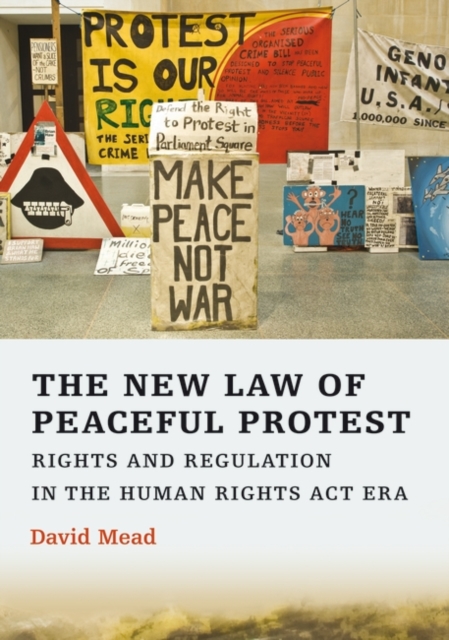
The New Law of Peaceful Protest
The right to demonstrate is considered fundamental to any democratic system of government, yet in recent years it has received little academic attention. However, events following the recent G20 protests in April 2009 make this a particularly timely work. Setting out and explaining in detail the domestic legal framework that surrounds the right of peaceful protest, the book provides the first extensive analysis of the Strasbourg jurisprudence under Articles 10 and 11 of the European Convention on Human Rights, offering a critical look at recent cases such as Öllinger, Vajnai, Bukta, Oya Ataman, Patyi and Ziliberberg, as well as the older cases that form its bedrock. The principles drawn from this case-law are then synthesised into the remainder of the book to see how the right of protest enshrined in the Human Rights Act 1998 now operates. The five central chapters show how the right is defined: the restrictions on the choice of location of a protest; the constraints imposed on peaceful, persuasive protest; the near total intolerance of any form of obstructive or disruptive protest; the scope of preventive action by the police; and the extent to which commercial targets can avail themselves of private law remedies. This contemporary landscape is highlighted by critical analysis of the principles and case law -- including the leading decisions in Laporte, Austin, Jones and Lloyd and Kay. The book also highlights and develops themes that are currently under-theorised or ignored, including the interplay of the public and the private in regulating protest; the pivotal role played by land ownership rules; and the disjuncture between the law in the books and the law in action. While the book will appeal primarily to scholars, students and practitioners of law – as well as to campaigners and interest groups – it also offers political and socio-legal insights, which will be of interest equally to non-specialists.
eBook

Challenging Beijing's mandate of heaven : Taiwan's Sunflower Movement and Hong Kong's Umbrella Movement
In 2014, the Sunflower Movement in Taiwan grabbed international attention as citizen protesters demanded the Taiwan government withdraw its free-trade agreement with China. In that same year, in Hong Kong, the Umbrella Movement sustained 79 days of demonstrations, protests that demanded genuine universal suffrage in electing Hong Kong's chief executive. It too, became an international incident before it collapsed. Both of these student-led movements featured large-scale and intense participation and had deep and far-reaching consequences. But how did two massive and disruptive protests take place in culturally conservative societies? And how did the two \"occupy\"-style protests against Chinese influences on local politics arrive at such strikingly divergent results? Challenging Beijing's Mandate of Heaven aims to make sense of the origins, processes, and outcomes of these eventful protests in Taiwan and Hong Kong. Ming-sho Ho compares the dynamics of the two movements, from the existing networks of activists that preceded protest, to the perceived threats that ignited the movements, to the government strategies with which they contended, and to the nature of their coordination. Moreover, he contextualizes these protests in a period of global prominence for student, occupy, and anti-globalization protests and situates them within social movement studies.
eBook

Activism and Protest
This topic examines protest movements, rights and protections, and explores how activism can influence public opinion and hold governments and business accountable. Is the current climate of protest growing hotter for social change? Is Australia witnessing a rising tide of activism which is shifting power to the people?.
eBook
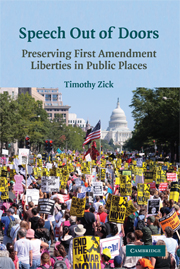
Speech Out of Doors
The Supreme Court has emphasized that expressive liberties require 'breathing space' in which to thrive. At a minimum, speakers need places in which to assemble, speak, and petition government. This book is a comprehensive examination of First Amendment rights in public places. It shows that the literal ground beneath speakers' feet has been steadily eroding, from personal spaces to college campuses and to once vast and important inscribed places, such as public parks and public squares. Through the study of 'expressive topography', this book considers a variety of contemporary speech contests including restrictions on abortion clinic sidewalk counselors, protests at military funerals, and restrictions on assembly and speech at political conventions. Countering or reversing these forces will require a focused and sustained effort by public officials, courts, and, of course, the people themselves.
eBook

Liberty's refuge : the forgotten freedom of assembly
This original and provocative book looks at an important constitutional freedom that today is largely forgotten: the right of assembly. While this right lay at the heart of some of the most important social movements in American historyabolitionism, women's suffrage, the labor and civil rights movementscourts now prefer to speak about the freedoms of association and speech. But the right of expressive association undermines protections for groups whose purposes are demonstrable not by speech or expression but through ways of being. John D. Inazu demonstrates that the forgetting of assembly and the embrace of association lose sight of important dimensions of our constitutional tradition.
eBook
The new law of peaceful protest
The right to demonstrate is considered fundamental to any democratic system of government, yet in recent years it has received little academic attention. However, events following the G20 protests in April 2009 make this book a particularly timely work. Setting out and explaining in detail the UK's domestic legal framework that surrounds the right of peaceful protest, the book provides the first extensive analysis of the Strasbourg jurisprudence under Articles 10 and 11, offering a critical look at cases such as Öllinger, Vajnai, Bukta, Oya Ataman, Patyi, and Ziliberberg, as well as the older cases that form its bedrock. The principles drawn from this case-law are then synthesized into the remainder of the book to see how the right of protest enshrined in the UK's Human Rights Act now operates. The five central chapters show how the right is defined: the restrictions on the choice of location of a protest * the constraints imposed on peaceful persuasive protest * the near total intolerance of any form of obstructive or disruptive protest * the scope of preventive action by the police * the extent to which commercial targets can avail themselves of private law remedies. This contemporary landscape is highlighted by critical analysis of UK principles and case-law, including the leading decisions in Laporte, Austin, Jones, and Lloyd and Kay. The book also highlights and develops themes that are currently under-theorized or ignored, including the interplay of the public and the private in regulating protest, the pivotal role played by land ownership rules, and the disjuncture between the law in the books and the law in action. While the book will appeal primarily to scholars, students, and practitioners of law - as well as to campaigners and interest groups - it also offers political and socio-legal insights which will be of interest equally to non-specialists.
eBook

First Amendment Institutions
Addressing a host of hot-button issues, Horwitz argues that rigidly doctrinal interpretation renders First Amendment law inept in the face of messy, real-world situations. Courts should let institutions with a stake in these freedoms do more work to enforce them. Self-regulation and public criticism should be the key restraints, not judicial fiat.
eBook
Liberty's Refuge
This original and provocative book looks at an important constitutional freedom that today is largely forgotten: the right of assembly. While this right lay at the heart of some of the most important social movements in American history-abolitionism, women's suffrage, the labor and civil rights movements-courts now prefer to speak about the freedoms of association and speech. But the right of \"expressive association\" undermines protections for groups whose purposes are demonstrable not by speech or expression but through ways of being. John D. Inazu demonstrates that the forgetting of assembly and the embrace of association lose sight of important dimensions of our constitutional tradition.
eBook