
Catalogue Search | MBRL


Are you sure you want to remove the book from the shelf?

{{itemTitle}}
13,342
result(s) for
"Assistive Technology"
Sort by:

Innovative technologies to benefit children on the autism spectrum
\"This book brings together relevant theoretical frameworks and empirical research concerning the emerging technologies that benefit individuals living with autism\"-- Provided by publisher.
Book

Upper limb soft robotic wearable devices: a systematic review
Introduction
Soft robotic wearable devices, referred to as exosuits, can be a valid alternative to rigid exoskeletons when it comes to daily upper limb support. Indeed, their inherent flexibility improves comfort, usability, and portability while not constraining the user’s natural degrees of freedom. This review is meant to guide the reader in understanding the current approaches across all design and production steps that might be exploited when developing an upper limb robotic exosuit.
Methods
The literature research regarding such devices was conducted in PubMed, Scopus, and Web of Science. The investigated features are the intended scenario, type of actuation, supported degrees of freedom, low-level control, high-level control with a focus on intention detection, technology readiness level, and type of experiments conducted to evaluate the device.
Results
A total of 105 articles were collected, describing 69 different devices. Devices were grouped according to their actuation type. More than 80% of devices are meant either for rehabilitation, assistance, or both. The most exploited actuation types are pneumatic (52%) and DC motors with cable transmission (29%). Most devices actuate 1 (56%) or 2 (28%) degrees of freedom, and the most targeted joints are the elbow and the shoulder. Intention detection strategies are implemented in 33% of the suits and include the use of switches and buttons, IMUs, stretch and bending sensors, EMG and EEG measurements. Most devices (75%) score a technology readiness level of 4 or 5.
Conclusion
Although few devices can be considered ready to reach the market, exosuits show very high potential for the assistance of daily activities. Clinical trials exploiting shared evaluation metrics are needed to assess the effectiveness of upper limb exosuits on target users.
Journal Article
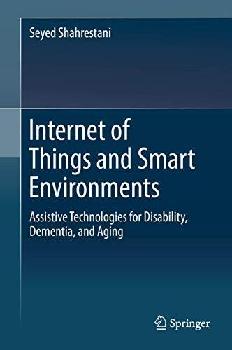
Internet of things and smart environments : assistive technologies for disability, dementia, and aging
This work is focused on the Internet of Things (IoT) services and smart environments that can be of assistance to the elderly and individuals living with dementia or some sensory impairment. The book outlines the requirements of the systems that aim to furnish some digital sensory or cognitive assistance to the individuals and their caregivers. The book covers the important evolutions of the IoT, the sensors, actuators, wireless communication and pervasive computing systems, and other enabling technologies that power up this megatrend infrastructure. The use of the IoT-based systems in improving the conventional assistive technologies and provisions of ambient assisted living are also covered.
Book

Assistive products and the Sustainable Development Goals (SDGs)
The Sustainable Development Goals (SDGs) have placed great emphasis on the need for much greater social inclusion, and on making deliberate efforts to reach marginalized groups. People with disabilities are often marginalized through their lack of access to a range of services and opportunities. Assistive products can help people overcome impairments and barriers enabling them to be active, participating and productive members of society. Assistive products are vital for people with disabilities, frailty and chronic illnesses; and for those with mental health problems, and gradual cognitive and physical decline characteristic of aging populations. This paper illustrates how the achievement of each of the 17 SDGs can be facilitated by the use of assistive products. Without promoting the availability of assistive products the SDGs cannot be achieved equitably. We highlight how assistive products can be considered as both a mediator and a moderator of SDG achievement. We also briefly describe how the Global Cooperation on Assistive Technology (GATE) is working to promote greater access to assistive products on a global scale.
Journal Article

Smart and intelligent systems : the human elements in artificial intelligence, robotics, and cybersecurity
\"This book is perfect for engineering students in data sciences, artificial intelligence, practitioners at all levels in the field of human factors and ergonomics, systems engineering, computer science, software engineering and robotics\"-- Provided by publisher.
Book

Informal carers’ experience of assistive technology use in dementia care at home: a systematic review
Background
Dementia is a health and care priority globally. Caring for persons with dementia is a challenge and can lead to negative psychological, physiological and financial consequences for informal carers. Advances in technology have the potential to assist persons with dementia and their carers, through assistive technology devices such as electronic medication dispensers, robotic devices trackers and motion detectors. However, little is known about carers’ experience and the impact of these technologies on them. This review aims to investigate the outcomes and experience of carers of persons with dementia, who live at home and use assistive technology.
Methods
A systematic search in seven databases and manual searches were carried out using pre-defined inclusion and exclusion criteria to identify studies on carers of persons with dementia involving the use of assistive technology. The search identified 56 publications with quantitative, qualitative and mixed-method designs.
Results
The studies reported positive and negative findings and focused on a wide variety of assistive technology devices. There were large differences in the uses of assistive technology, outcome measures used and the quality of studies. Knowledge and acceptance, competence to use and ethical issues when using assistive technology were themes that emerged from the studies. Carers generally appreciated using assistive technology and their experience of use varied.
Conclusions
The intention of this systematic review is to list and classify the various types of assistive technology used by carers of persons with dementia and explores the positive and negative aspects, knowledge, acceptance and ethical issues in the use of assistive technology by carers of persons with dementia. We recommend the use of a standard and person-centred system of classifying and naming assistive technology devices and systems and for future research efforts in assistive technology to incorporate a family/carer centred model.
Systematic review registration
PROSPERO -
CRD42017082268
.
Journal Article


A Systematic Review on Assistive Technology Terminologies, Concepts, and Definitions
This study examines the diversity of terminologies associated with assistive technology (AT), a crucial field that promotes autonomy and inclusion for people with disabilities. Although the wide use of assistive technology is observed in the literature, a variety of terms are often used interchangeably, which hinders research, technological development, and the formulation of public policies. In this sense, this systematic review aimed to identify, categorise, and analyse the diversity of terms used to describe AT in the scientific literature, contributing to greater conceptual clarity and supporting structured and interdisciplinary development in the field. A comprehensive search was conducted in July 2024 across the Scopus, Web of Science, and PubMed databases, covering publications from 1989 to 2024. Eligible studies were peer-reviewed journal articles in English that conceptually defined at least one AT-related term. The selection process followed the PRISMA 2020 guidelines and included studies from Q1 and Q2 journals to ensure academic rigour. A total of 117 studies were included out of 11,941 initial records. Sixteen distinct terms were identified and grouped into five clusters based on semantic and functional similarities: Cluster 1—Technologies for assistance and inclusion. Cluster 2—Functional assistive devices. Cluster 3—Assistive interaction interfaces. Cluster 4—Assistive environmental technologies. Cluster 5—Assistive systems. A complementary meta-analysis revealed geographic and temporal trends, indicating that terms such as “assistive technology” and “assistive device” are globally dominant. In contrast, others, like “enabling technology,” are more context-specific and emerging. The findings contribute theoretically by providing a structured framework for understanding AT terminology and practically by supporting the design of public policy and interdisciplinary communication.
Journal Article

Ambient integrated robotics : automation and robotic technologies for maintenance, assistance, and service
\"The new research field of Ambient/Active Assisted Living (AAL) is quickly evolving. Ambient Integrated Robotics provides an easy-to-understand medical perspective to architects, designers, and engineers, bridging the different disciplines and showing how they fuse together to create the future of AAL technology. Using robotics as an example, the book illustrates how embedding its subsystems results in unique ambient technology that can be used to help people, particularly in adapting to the needs of the unwell and elderly populations. You will be provided with the knowledge and tools to contribute to the future of AAL. The Cambridge Handbooks on Construction Robotics series gives professionals, researchers, lecturers, and students basic conceptual and technical skills and strategies to manage, research, or teach the implementation of advanced automation, and robot-technology-based processes and technologies in construction. Books discuss progress in robot systems theory and demonstrates their integration using real applications and projections\"-- Provided by publisher.
Book

User satisfaction and dissatisfaction with assistive technology devices and services in India
User satisfaction with Assistive Technology (AT) is one of the crucial factors in the success of any AT service. The current study aimed to estimate satisfaction with AT and the reasons for dissatisfaction and unsuitability among persons with functional difficulties in India. Using the WHO Rapid Assistive Technology Assessment tool, a cross-sectional study was conducted in eight districts, representing four zones of India. Multi-stage cluster random sampling and probability proportional to size techniques were used to select smaller administrative units from the larger ones. Satisfaction was reported in terms of assistive products and service delivery. In total, 8486 participants were surveyed out of which 8964 individuals were enumerated with a response rate of 94.6%. Around 22.2% (1888) of participants had functional difficulties and reported using AT, out of which 3.9% (74) were dissatisfied with their products. The assistive products, assessment and training, and repair and maintenance-related services were reported to be satisfied by approximately 92.2% (1740), 88.4% (1669), and 85.2% (1609) of respondents, respectively. Further, 3.2% (61) and 3.7% (70) of respondents reported that their AT was not suitable for home and public environments, respectively. According to 2.8% (53) respondents, their AT did not assist them in executing daily living activities. Discomfort (56.6%), poor fitting (37.7%), low quality of service (20.7%), and poor aesthetic values (18.9%) were identified as reasons for dissatisfaction. Satisfaction was good for AT received from friends and family but was poor for those received from the public sector. The study shows that overall satisfaction and suitability with AT were high among users with functional difficulties, but few have reported barriers to effective device use and facing challenges in accessing repair and follow-up services.
Journal Article