
Catalogue Search | MBRL


Are you sure you want to remove the book from the shelf?

{{itemTitle}}
13
result(s) for
"Associated Press History."
Sort by:

The international distribution of news : the Associated Press, Press Association, and Reuters, 1848-1947
\"Based on newly available and extensive archival evidence, this book traces the history of international news agencies and associations around the world from 1848 to 1947. Jonathan Silberstein-Loeb argues that newspaper publishers formed news associations and patronized news agencies to cut the costs of news collection and exclude competitors from gaining access to the news. In this way, cooperation facilitated the distribution of news. The extent to which state regulation permitted cooperation, or prohibited exclusivity, determined the benefit newspaper publishers derived from these organizations. This book revises our understanding of the operation and organization of the Associated Press, the BBC, the Press Association, Reuters, and the United Press. It also sheds light on the history of competition policy respecting the press, intellectual property, and the regulation of telecommunications\"-- Provided by publisher.
Book

Joseph Pulitzer and the New York World
To determine how and why Pulitzer turned the unsuccessful New York World into the most widely read and probably the most prosperous newspaper in the country, Professor Juergens isolates and analyzes the special qualities of Pulitzer's new style of journalism.
Originally published in 1966.
The Princeton Legacy Library uses the latest print-on-demand technology to again make available previously out-of-print books from the distinguished backlist of Princeton University Press. These editions preserve the original texts of these important books while presenting them in durable paperback and hardcover editions. The goal of the Princeton Legacy Library is to vastly increase access to the rich scholarly heritage found in the thousands of books published by Princeton University Press since its founding in 1905.
eBook

AP foreign correspondents in action from World War II to the present
\"Based on extended interviews conducted from the Pakistani countryside to Washington, AP Foreign Correspondents in Action: World War II to the Present reveals for the first time what it takes to get the stories that brought the world home to America. It gives new front-line insights into major events from the Japanese surrender in 1945 to the 2010s Syrian civil war, and it helps to understand news impact on international affairs through evolving journalistic practices. Both successes and failures through eight decades of foreign correspondence from Afghanistan to Zimbabwe show that public discourse has been best served by correspondents who, at great risk, challenged accepted narratives, exposed omnipresent lies, gave a voice to the voiceless, and stymied the frequently violent efforts of those who feared truth-telling eyewitnesses\"-- Provided by publisher.
Book

Beyond Camelot
This book argues that many of the basic concepts that we use to describe and analyze our governmental system are out of date. Developed in large part during the Middle Ages, they fail to confront the administrative character of modern government. These concepts, which include power, discretion, democracy, legitimacy, law, rights, and property, bear the indelible imprint of this bygone era's attitudes, and Arthurian fantasies, about governance. As a result, they fail to provide us with the necessary tools for understanding, critiquing and improving the government we actually possess. Beyond Camelot explains the causes and character of this failure, and then proposes a new conceptual framework, drawn from management science and engineering, which describes our administrative government more accurately, and identifies its weaknesses instead of merely bemoaning its modernity.
eBook

Translating Spain to the United States during the Cuban War of Independence
This article examines the life and work of Mary J. Serrano (1840–1923), a successful translator and popularizer of Spanish literature in late nineteenth-century United States. It provides a short biography of Serrano and focuses on her work for the Spanish Legation in in Washington DC during the Cuban War of Independence (1895–98), a period of increasing anti-Spanish sentiment in the country. The article seeks to recover the figure of this important, yet largely unknown translator. Her biography also illuminates a number of trends that helped define this moment in history: the bourgeoning role of women as translators and authors, but also cultural mediators and engaged citizens; the diffusion and popularization of the emerging field of Hispanism in the United States; and the complex web of interactions and ethnic identities that shaped the immigrant experience in urban America.
Journal Article
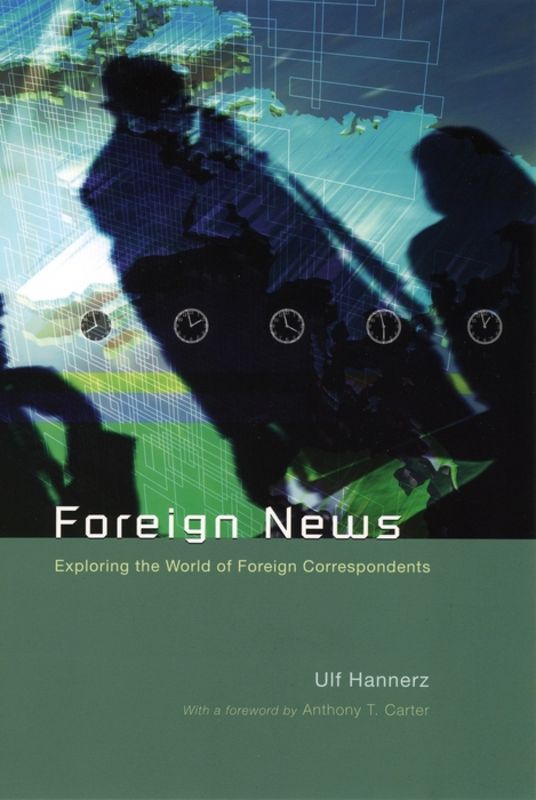
Foreign News
Foreign News gives us a fascinating, behind-the-scenes look into the practices of the global tribe we call foreign correspondents. Exploring how they work, Ulf Hannerz also compares the ways correspondents and anthropologists report from one part of the world to another.
Hannerz draws on extensive interviews with correspondents in cities as diverse as Jerusalem, Tokyo, and Johannesburg. He shows not only how different story lines evolve in different correspondent beats, but also how the correspondents' home country and personal interests influence the stories they write. Reporting can go well beyond coverage of a specific event, using the news instead to reveal deeper insights into a country or a people to link them to long-term trends or structures of global significance. Ultimately, Hannerz argues that both anthropologists and foreign correspondents can learn from each other in their efforts to educate a public about events and peoples far beyond our homelands.
The result of nearly a decade's worth of work, Foreign News is a provocative study that will appeal to both general readers and those concerned with globalization.
eBook
WRITING THE WAR
Jacob Nathaniel Raymer is a literary adventurer: a lean, handsome young man with a long, angular face, a strong nose, and intense eyes. At age twenty-one, he leaves his home in Catawba County and strikes out for the west—Arkansas—his mind set on seeing the world beyond the mountains. At Swannanoa Gap, east of Asheville, he lingers for a last look homeward, “and from that lofty pinnacle, the dividing line between home and strangers,” he writes in his diary, “I did take a long farewell.”
Well-read and already erudite, he composes a wistful poem of 201 lines, preoccupied with
Book Chapter

Facing Up to the American Dream
The ideology of the American dream--the faith that an individual can attain success and virtue through strenuous effort--is the very soul of the American nation. According to Jennifer Hochschild, we have failed to face up to what that dream requires of our society, and yet we possess no other central belief that can save the United States from chaos. In this compassionate but frightening book, Hochschild attributes our national distress to the ways in which whites and African Americans have come to view their own and each other's opportunities. By examining the hopes and fears of whites and especially of blacks of various social classes, Hochschild demonstrates that America's only unifying vision may soon vanish in the face of racial conflict and discontent.
Hochschild combines survey data and vivid anecdote to clarify several paradoxes. Since the 1960s white Americans have seen African Americans as having better and better chances to achieve the dream. At the same time middle-class blacks, by now one-third of the African American population, have become increasingly frustrated personally and anxious about the progress of their race. Most poor blacks, however, cling with astonishing strength to the notion that they and their families can succeed--despite their terrible, perhaps worsening, living conditions. Meanwhile, a tiny number of the estranged poor, who have completely given up on the American dream or any other faith, threaten the social fabric of the black community and the very lives of their fellow blacks.
Hochschild probes these patterns and gives them historical depth by comparing the experience of today's African Americans to that of white ethnic immigrants at the turn of the century. She concludes by claiming that America's only alternative to the social disaster of intensified racial conflict lies in the inclusiveness, optimism, discipline, and high-mindedness of the American dream at its best.
eBook

News as a Public Good: Cooperative Ownership, Price Commitments, and the Success of the Associated Press
In this article Professor Shmanske examines the history of the wire service industry with special attention to two economic peculiarities: the “public good” nature of news dissemination and the different ownership structures of the competing firms. By focusing on the interplay of the nonprofit, cooperative organizational structure of the Associated Press and the public good characteristics of news, the author provides a new and economically sound explanation for the AP's relative success. In addition, he demonstrates that many unusual institutions in the news-providing industry, particularly pricing structures, can be understood by analyzing the economic and marketing problems associated with private-sector production of a public good.
Journal Article
AP Was There: 150 Years Ago, Lee Surrenders to Grant
\"When Confederate Gen. Robert E. Lee surrendered to Union Lt. Gen. Ulysses S. Grant in a farmhouse parlor in Appomattox Court House, Virginia, on April 9, 1865, standing with other war correspondents in the front yard was William Downs MacGregor of The Associated Press.\" (Examiner-Enterprise) Several first-hand reports from AP Civil War correspondents are presented.
Newspaper Article