
Catalogue Search | MBRL


Are you sure you want to remove the book from the shelf?

{{itemTitle}}
122,425
result(s) for
"Associations, institutions, etc"
Sort by:


Institutions in Global Distributive Justice
Defining an institution as a public system of rules that sets out positions, rights and duties, this book uses a philosophical argument to analyse the roles that social, economic and political institutions play in conditioning the justification, scope and content of principles of justice. It critically evaluates a number of positions about the role of institutions in generating requirements of distributive justice and considers their implications for the scope – global or otherwise – of justice. It then develops a novel theory about the role political and economic institutions play in determining the content of requirements of distributive justice and, in a cosmopolitan argument against statist positions, shows how they can affect the scope of application of these requirements.
eBook


Barriers to Democracy
Democracy-building efforts from the early 1990s on have funneled billions of dollars into nongovernmental organizations across the developing world, with the U.S. administration of George W. Bush leading the charge since 2001. But are many such \"civil society\" initiatives fatally flawed? Focusing on the Palestinian West Bank and the Arab world,Barriers to Democracymounts a powerful challenge to the core tenet of civil society initiatives: namely, that public participation in private associations necessarily yields the sort of civic engagement that, in turn, sustains effective democratic institutions. Such assertions tend to rely on evidence from states that are democratic to begin with. Here, Amaney Jamal investigates the role of civic associations in promoting democratic attitudes and behavioral patterns in contexts that are less than democratic.
Jamal argues that, in state-centralized environments, associations can just as easily promote civic qualities vital to authoritarian citizenship--such as support for the regime in power. Thus, any assessment of the influence of associational life on civic life must take into account political contexts, including the relationships among associations, their leaders, and political institutions.
Barriers to Democracyboth builds on and critiques the multifaceted literature that has emerged since the mid-1990s on associational life and civil society. By critically examining associational life in the West Bank during the height of the Oslo Peace Process (1993-99), and extending her findings to Morocco, Egypt, and Jordan, Jamal provides vital new insights into a timely issue.
eBook

A survey of voluntaristics : research on the growth of the global, interdisciplinary, socio-behavioral science field and emergent inter-discipline
\"This article provies survey of the growth of research on Nonprofit Sector and Voluntary Action Research, now termed simply voluntaristics. The author founded the organized, global interdisciplinary, socio-behavioral science field of voluntaristics in 1971, with his formation and establishment of the Association for Research on Nonprofit Organizations and Voluntary Action (ARNOVA; www.arnova.org). Both ARNOVA, and its interdisciplinary, academic journal, Nonprofit and Voluntary Sector Quarterly (NVSQ), have served as initial models for the global diffusion of this interdisciplinary field, now present in all inhabited continents and with upwards of 20,000 academic participants in at least 130 nations and territories, and likely more.\"
Book

Between War and the State
In Between War and the
State , Van Nguyen-Marshall examines an array
of voluntary activities, including mutual-help, professional,
charitable, community development, student, women's, and rights
organizations active in South Vietnam from 1954 to 1975.
By bringing focus to the public lives of South Vietnamese people,
Between War and the State challenges persistent
stereotypes of South Vietnam as a place without society or agency.
Such robust associational life underscores how an active civil
society survived despite difficulties imposed by the war,
government restrictions, economic hardship, and external political
forces. These competing political forces, which included the United
States, Western aid agencies, and Vietnamese communist agents,
created a highly competitive arena wherein the South Vietnamese
state did not have a monopoly on persuasive or coercive power. To
maintain its influence, the state sometimes needed to accommodate
groups and limit its use of violence. Civil society participants in
South Vietnam leveraged their social connections, made alliances,
appealed to the domestic and international public, and used street
protests to voice their concerns, secure their interests, and carry
out their activities.
eBook


The Associational State
In the wake of the New Deal, U.S. politics has been popularly imagined as an ongoing conflict between small-government conservatives and big-government liberals. In practice, narratives of left versus right or government versus the people do not begin to capture the dynamic ways Americans pursue civic goals while protecting individual freedoms. Brian Balogh proposes a new view of U.S. politics that illuminates how public and private actors collaborate to achieve collective goals. This \"associational synthesis\" treats the relationship between state and civil society as fluid and challenges interpretations that map the trajectory of American politics solely along ideological lines. Rather, both liberals and conservatives have extended the authority of the state but have done so most successfully when state action is mediated through nongovernmental institutions, such as universities, corporations, interest groups, and other voluntary organizations.
The Associational Stateprovides a fresh perspective on the crucial role that the private sector, trade associations, and professional organizations have played in implementing public policies from the late nineteenth through the twenty-first century. Balogh examines key historical periods through the lens of political development, paying particular attention to the ways government, social movements, and intermediary institutions have organized support and resources to achieve public ends. Exposing the gap between the ideological rhetoric that both parties deploy today and their far less ideologically driven behavior over the past century and a half,The Associational Stateoffers one solution to the partisan gridlock that currently grips the nation.
eBook
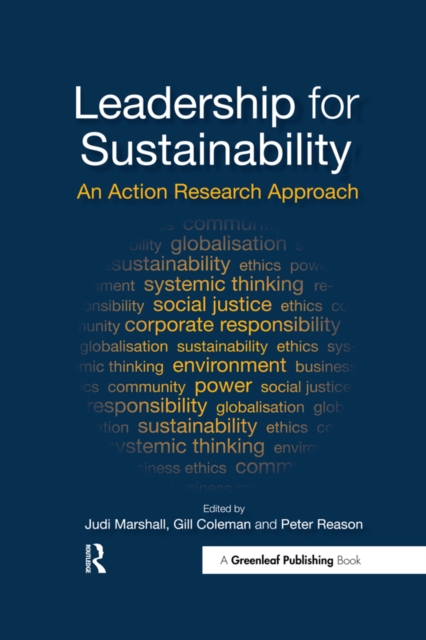
Leadership for Sustainability
Those who advocate moving towards sustainability debate how change can be achieved. Does it have necessarily to be top-down or can it also be bottom-up? Can radical organizational and social change be spread from \"the middle\"? Who can lead change when those with seniority and credibility are necessarily embedded in currently dominant mind-sets and power structures? This book focuses on what it means to take up leadership for sustainability, from a variety of organizational and social positions, and considers the consequences of different strategies and practices for influencing change. Leadership for Sustainability shows what an action research based practice of leadership for sustainability looks like and provides a sense of the personal and professional challenges this involves; it demonstrates how people who are influencing change draw on reflective practice strategically (to create a context in which they can be influential) and also tactically (in moment-to-moment choices about how to act). It also illustrates and reflects on the kinds of outcomes that can be expected from this work, both the specific and strategic achievements, and the difficulties, challenges and disappointments. Thus the major part of this volume consists of accounts by graduates of an innovative master's programme, the MSc in Responsibility and Business Practice, of their activities, projects, achievements and learning. Accompanying sections from the editors overview, analyse and reflect on these accounts and the issues they raise for notions of leadership, practice, sustainability and change. One substantial chapter offers ideas, frameworks and practices for people taking leadership.
One of the most dispiriting aspects of the environmental challenges that beset us is the lack of agency that many people experience: we do not know what to do or how to do it. Many organizations espouse a sustainable approach. This may be lip service or it may be a genuine attempt to integrate sustainability into business strategy. Whatever form it takes, organizational sustainability programmes need committed, intelligent, reflective leadership at all levels to make them work. The examples in this book show how people in very different contexts have seized the opportunities open to them and acted with courage and initiative to make a difference. This book will be relevant to a wide range of people, including managers, consultants and others in commercial, non-profit, public and intergovernmental organisations who want to contribute to the development of a sustainable world. It will be of particular interest to people working in organizations already thinking about issues of sustainability and those who are seeking to take on the role of change agents in organisations or communities. In addition, the book will be a resource for those in educational fields, primarily but not exclusively higher and further education, who wish to work with their students to develop leadership practices through action research based educational approaches. All contributors to this book have been associated with the MSc in Responsibility & Business Practice at the University of Bath, School of Management, UK, either as tutors or participants. This innovative degree course used action research to engage with challenging issues in a wide range of business, public service and civil society contexts.At the heart of this book are stories from 29 people who are seeking to make the world more environmentally sustainable and socially just. They report their purposes, journeys, impacts, learning and disappointments. Their accounts are diverse and from many different worlds, ranging from fast moving consumer goods to international forestry and conservation projects. They have in common that they are among the 254 graduates of an innovative Master's programme, the MSc in Responsibility and Business Practice community, who in one way or another are adopting action research as a practice of taking leadership for sustainability, and believe their actions can be significant contributions to the causes that matter to them.
This book brings ecological concerns slap bang into the realms of corporate business. Using the language of sustainability the contributors write openly about spiritual and emotional engagement, knowing ourselves as nature and helping business reconnect with cyclical systems that emulate the natural world. This is a story of stories promoting the importance of storytelling as we strive to achieve some semblance of leadership for sustainability. I rarely read a leadership text from cover to cover, but I found this to be a page turner, reading more like a novel, difficult to put down, and I wondered what each of the short stories would reveal as people have been moved to: \"take on the challenges of living courageously in extraordinary times\" (p.1). The main purpose of the book is to publicise and promote ...stories of leadership for sustainability. And what a range of leadership activities they include! From a local neighbourhood action research project in the northwest of England to the conservation of black-maned lions in Addis Ababa, via local produce for school meals in New York, a triathlon event in Weymouth and building an eco-factory to make clothes for Marks & Spencer in Sri Lanka ... I cannot do justice to 29 stories here, and I would hate to miss out any one, as they each tell of unique ways of applying common threads of learning, shared beliefs and values. This is where you have to read the book to really appreciate the passion, energies, highs and lows of everyday managers and leaders, putting their learning into practice, each in their individual contexts. They go to show how we can all do something if we are moved to do so ... For myself as a social researcher this book has renewed my confidence to follow my values, take notice of my instincts, listen to my inner thoughts and reconnect with the power of the earth. For those in this field of leadership inquiry I think there are rich pickings here. - Business Leadership Review 8.4 (October 2011) - Sue Chapman, Independent Leadership Learning Coach and Facilitator || Marshall and her colleagues have shown leadership ... using a Trojan horse approach by setting up their MSc in the heart of a traditional business school, and seeding other courses. Positive deviance in practice! The power of the action research approach shines through in the collection of twenty-nine stories, which made this book – despite the somewhat heavy going of the theoretical chapters – the most compelling sustainability book I've read for a long time. People have taken action about things they care about, and they have learnt from it. Their stories demonstrate that we encourage people to show leadership in part by allowing them to be humble and to experiment, not by pretending that only the perfect can show leadership. The stories do not trumpet an approach or sell us a technique. They are travellers' tales for people who'll see themselves in the narrative, and be inspired and comforted by it. Marshall and her colleagues on the MSc course have evidently created a safe space for people to reflect about their doubts and uncertainties as well as their hopes and insights. Chapters including this kind of personal testimony from people like Gater, Bent and Karp are intriguing, dramatic and engaging. Karp's story about food procurement shows the difference between an action learning approach and the leader as hero – she's as open about the set-backs as the successes. I instantly recognised Bent's description of holding professional optimism with personal pessimism, and many people I know have had that same conversation: wondering where their bolt-hole will be, to escape the impacts of runaway climate change. Gater's story is a brilliantly honest account of his work within a mainstream financial institution, moving a certain distance and then coming up against a seemingly insurmountable systemic challenge. In a model of authentic story-telling, he describes tensions I have heard so many organisational change agents express. He talks about visiting his colleagues 'in their world' and inviting them to visit him in his. At the end of his story, the two worlds remain unreconciled, \"but it was okay – I had done what I could do as well as I believe I could have done it, and that had to be enough.\" Full review on Defra website - Penny Walker, independent consultant on change and sustainability
Part 1: Taking up the challengePart 2: Educating for inquiring practice in sustainabilityPart 3: Ideas and practicesPart 4: Promoting alternative questioning, policies and practices in mainstream organisationsCatalysing a strategic approach to sustainability in a major IT companyChris PreistOn being a change agent for sustainabilityChristel ScholtenImbuing work with ecological valuesHelen GouldenThinking out of the box: Introducing action research into neighbourhood practice in the north-west of EnglandHelena KettleboroughChoose lifeJames BarlowLeadership for change in USA public food procurement: People, products and policyKaren KarpTwo worlds?Mark GaterPutting my learning into practicePrishani SatyapalPart 5: Establishing sustainability practices in organisations and industriesWorking below the parapetAlison KennedyProtesting and engaging for changeKené UmeasiegbuBuilding an iconic eco-factoryVidhura RalapanawePart 6: Paying attention to everyday practices of sustainable livingLike a river flows: How do we call forth 'a world worthy of human aspiration'?Helen SierodaSport as inquiry: Safe escape, activism and a journey into selfJon AlexanderPart 7: Seeking to shift systemic rules and awarenessLessons from the entrepreneurial pathCharles O'MalleyCreating places to stand and the levers to move the worldDavid BentLeading by natureJen MorganThe practice of making business responsiblePaul DickinsonThe gap between discourse and practice: Holding promoters of Amazon infra
eBook