
Catalogue Search | MBRL


Are you sure you want to remove the book from the shelf?

{{itemTitle}}
108
result(s) for
"Astronomical unit"
Sort by:

Heavenly Mathematics
Spherical trigonometry was at the heart of astronomy and ocean-going navigation for two millennia. The discipline was a mainstay of mathematics education for centuries, and it was a standard subject in high schools until the 1950s. Today, however, it is rarely taught.Heavenly Mathematicstraces the rich history of this forgotten art, revealing how the cultures of classical Greece, medieval Islam, and the modern West used spherical trigonometry to chart the heavens and the Earth. Glen Van Brummelen explores this exquisite branch of mathematics and its role in ancient astronomy, geography, and cartography; Islamic religious rituals; celestial navigation; polyhedra; stereographic projection; and more. He conveys the sheer beauty of spherical trigonometry, providing readers with a new appreciation for its elegant proofs and often surprising conclusions.
Heavenly Mathematicsis illustrated throughout with stunning historical images and informative drawings and diagrams that have been used to teach the subject in the past. This unique compendium also features easy-to-use appendixes as well as exercises at the end of each chapter that originally appeared in textbooks from the eighteenth to the early twentieth centuries.
eBook

Secular increase of astronomical unit from analysis of the major planet motions, and its interpretation
From the analysis of all available radiometric measurements of distances between the Earth and the major planets (including observations of martian landers and orbiters over 1971-2003 with the errors of few meters) the positive secular trend in the Astronomical Unit AU is estimated as (d/dt)AU = 15 +/- 4m/cy. The given uncertainty is the 10 times enlarged formal error of the least-squares estimate and so accounts for possible systematic errors of measurements and deficiencies of the mathematical model. The reliability of this estimate as well as its physical meaning are discussed. A priori most plausible attribution of this effect to the cosmological expansion of the Universe turns out inadequate. A model of the observables developed in the frame of the relativistic background metric of the uniform isotropic Universe shows that the corresponding dynamical perturbations in the major planet motions are completely canceled out by the Einstein effect of dependence of the rate of the observer's clock (that keeps the proper time) on the gravitational field, though separately values of these two effects are quite large and attainable with the accuracy achieved. Another tentative source of the secular rate of AU is the loss of the solar mass due to the solar wind and electromagnetic radiation but it amounts in (d/dt)AU only to 0.3 m/cy. Excluding other explanations that seem exotic (such as secular decrease of the gravitational constant) at present there is no satisfactory explanation of the detected secular increase of AU, at least in the frame of the considered uniform models of the Universe.[PUBLICATION ABSTRACT]
Journal Article
Proposals for the masses of the three largest asteroids, the Moon-Earth mass ratio and the Astronomical Unit
We propose to the NSFA (the IAU Working Group on Numerical Standards for Fundamental Astronomy) the following representative values and realistic uncertainties for the masses of the three largest asteroids (Ceres, Pallas, Vesta), to be used as the current best estimates:
Unlike the values previously adopted in the Astronomical Almanac, these are consistent with nearly all of the twenty or so modern accurate determinations from various authors. We also have proposed the following values for the Moon-Earth mass ratio and the astronomical unit in meters obtained from the ephemeris improvement processes at JPL in Pasadena and at IAA RAS in St.Petersburg:
M
Moon
/
M
Earth
= 0.0123000371(4) and
AU
= 149597870700(3) m. The numerical value of the
AU
in meters is identical in both the TDB-based and the TCB-based systems of units if one uses the conversion proposed by Irwin and Fukushima, Brumberg and Groten, Brumberg and Simon.
Journal Article

Application of time transfer function to McVittie spacetime: gravitational time delay and secular increase in astronomical unit
We attempt to calculate the gravitational time delay in a time-dependent gravitational field, especially in McVittie spacetime, which can be considered as the spacetime around a gravitating body such as the Sun, embedded in the FLRW (Friedmann–Lemaître–Robertson–Walker) cosmological background metric. To this end, we adopt the time transfer function method proposed by Le Poncin-Lafitte et al. (Class Quantum Gravity 21:4463, 2004) and Teyssandier and Le Poncin-Lafitte (Class Quantum Gravity 25:145020, 2008), which is originally related to Synge’s world function Ω(xA, xB) and enables to circumvent the integration of the null geodesic equation. We re-examine the global cosmological effect on light propagation in the solar system. The round-trip time of a light ray/signal is given by the functions of not only the spacial coordinates but also the emission time or reception time of light ray/signal, which characterize the time-dependency of solutions. We also apply the obtained results to the secular increase in the astronomical unit, reported by Krasinsky and Brumberg (Celest Mech Dyn Astron 90:267, 2004), and we show that the leading order terms of the time-dependent component due to cosmological expansion is 9 orders of magnitude smaller than the observed value of dAU/dt, i.e., 15 ± 4 (m/century). Therefore, it is not possible to explain the secular increase in the astronomical unit in terms of cosmological expansion.
Journal Article

Increase of the mean Sun–Earth distance caused by a secular mass accumulation
Based on many planetary observations between the years 1971 and 2003, Krasinsky and Brumberg (Celest. Mech. Dyn. Astron. 90:267–288,
2004
) have estimated a rate of increase in the mean Sun-Earth distance of (15±4) m per century. Together with other anomalous observations in the solar system, this increase appears to be unexplained (Lämmerzahl et al. in Astrophys. Space Sci. Lib., vol. 349, pp. 75–101,
2008
). We explain these findings by invoking a recently proposed gravitational impact model (Wilhelm et al. in Astrophys. Space Sci. 343:135–144,
2013
) that implies a secular mass increase of all massive bodies. This allows us to formulate a quantitative understanding of the effect within the parameter range of the model with a mass accumulation rate of the Sun of (6.4±1.7)×10
10
kg s
−1
.
Journal Article

Planetary Motion on an Expanding Locally Anisotropic Background
In this work are computed analytical solutions for orbital motion on a background described by an Expanding Locally Anisotropic (ELA) metric ansatz. This metric interpolates between the Schwarzschild metric near the central mass and the Robertson-Walker metric describing the expanding cosmological background far from the central mass allowing for a fine-tuneable covariant parameterization of gravitational interactions corrections in between these two asymptotic limits. In particular it is shown that the decrease of the Sun’s mass by radiation emission plus the General Relativity corrections due to the ELA metric background with respect to Schwarzschild backgrounds can be mapped to the reported yearly variation of the gravitational constant
through Kepler’s third law. Based on the value of the heuristic fit corresponding to the more recent heliocentric ephemerides of the Solar System are derived bounds for the value of a constant parameter
α
0
for the ELA metric as well as the maximal corrections to perihelion advance and orbital radii variation within this framework. Hence it is shown that employing the ELA metric as a functional covariant parameterization to model gravitational interactions corrections within the Solar System allows to maintain the measurement projection standards constant over time, specifically both the Astronomical Unit (AU) and the Gravitational constant (
G
). Also it is noted that the effect obtained is not homogeneous for all planetary orbits consistently with the diversity of estimates in the literature obtained assuming Schwarzschild backgrounds.
Journal Article

Effect of Inhomogeneity of the Universe on a Gravitationally Bound Local System: A No-Go Result for Explaining the Secular Increase in the Astronomical Unit
We will investigate the influence of the inhomogeneity of the Universe, especially that of the Lemaître–Tolman–Bondi (LTB) model, on a gravitationally bound local system such as the solar system. We concentrate on the dynamical perturbation to the planetary motion and derive the leading order effect generated from the LTB model. It will be shown that there appear not only a well-known cosmological effect arisen from the homogeneous and isotropic model, such as the Robertson–Walker (RW) model, but also the additional terms due to the radial inhomogeneity of the LTB model. We will also apply the obtained results to the problem of secular increase in the astronomical unit, reported by Krasinsky and Brumberg (2004), and imply that the inhomogeneity of the Universe cannot have a significant effect for explaining the observed dAU/d
t
= 15 ±4 [m/century].
Journal Article
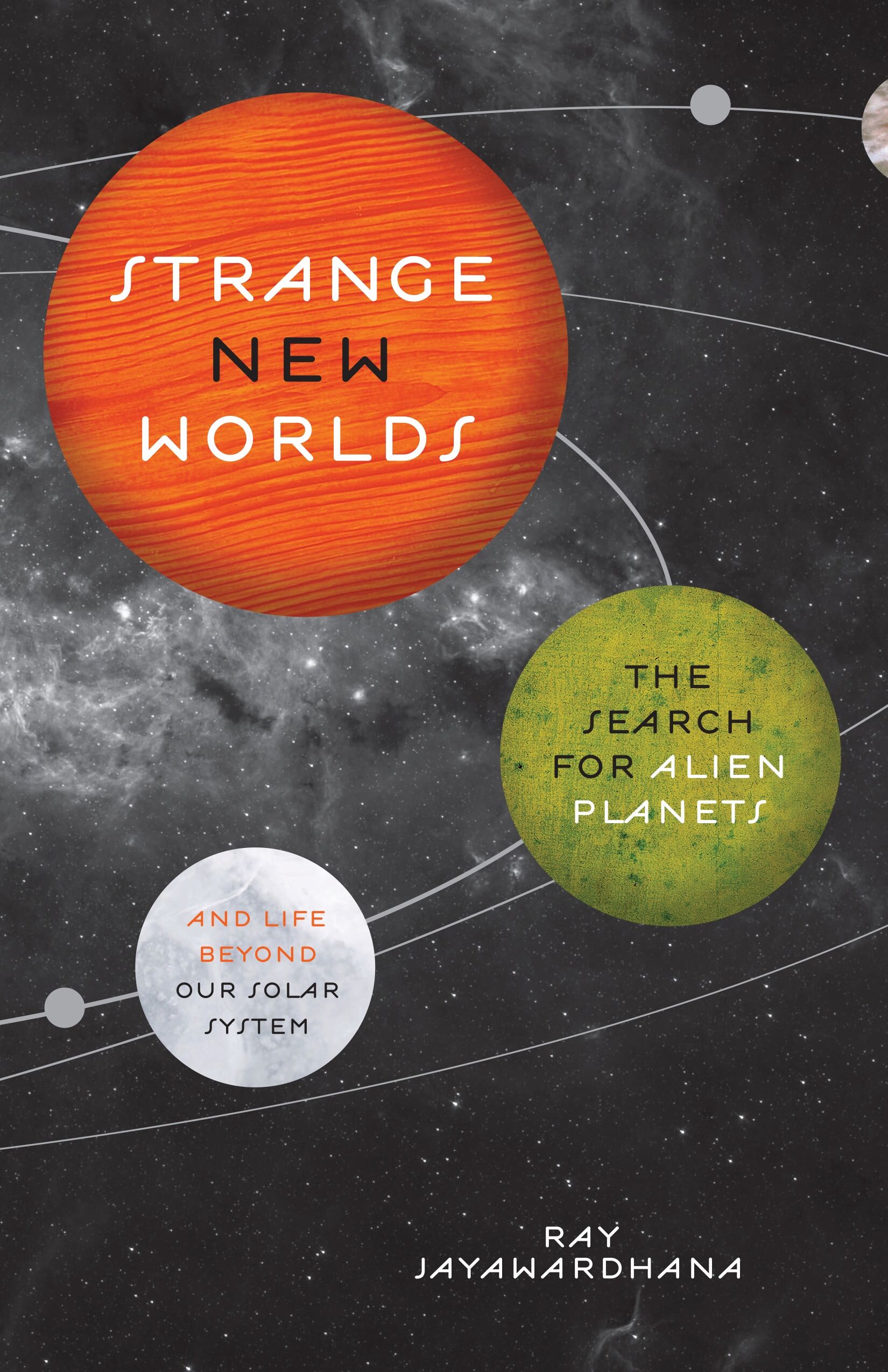
Strange New Worlds
Soon astronomers expect to find alien Earths by the dozens in orbit around distant suns. Before the decade is out, telltale signs that they harbor life may be found. If they are, the ramifications for all areas of human thought and endeavor--from religion and philosophy to art and biology--will be breathtaking. In Strange New Worlds, renowned astronomer Ray Jayawardhana brings news from the front lines of the epic quest to find planets--and alien life--beyond our solar system.
eBook


What Are Gamma-Ray Bursts?
Gamma-ray bursts are the brightest--and, until recently, among the least understood--cosmic events in the universe. Discovered by chance during the cold war, these evanescent high-energy explosions confounded astronomers for decades. But a rapid series of startling breakthroughs beginning in 1997 revealed that the majority of gamma-ray bursts are caused by the explosions of young and massive stars in the vast star-forming cauldrons of distant galaxies. New findings also point to very different origins for some events, serving to complicate but enrich our understanding of the exotic and violent universe.What Are Gamma-Ray Bursts?is a succinct introduction to this fast-growing subject, written by an astrophysicist who is at the forefront of today's research into these incredible cosmic phenomena.
Joshua Bloom gives readers a concise and accessible overview of gamma-ray bursts and the theoretical framework that physicists have developed to make sense of complex observations across the electromagnetic spectrum. He traces the history of remarkable discoveries that led to our current understanding of gamma-ray bursts, and reveals the decisive role these phenomena could play in the grand pursuits of twenty-first century astrophysics, from studying gravity waves and unveiling the growth of stars and galaxies after the big bang to surmising the ultimate fate of the universe itself.
What Are Gamma-Ray Bursts?is an essential primer to this exciting frontier of scientific inquiry, and a must-read for anyone seeking to keep pace with cutting-edge developments in physics today.
eBook