
Catalogue Search | MBRL


Are you sure you want to remove the book from the shelf?

{{itemTitle}}
273
result(s) for
"Astronomy, Greek"
Sort by:

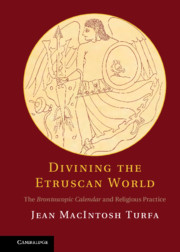
Divining the Etruscan World
The Etruscan Brontoscopic Calendar is a rare document of omens foretold by thunder. It long lay hidden, embedded in a Greek translation within a Byzantine treatise from the age of Justinian. The first complete English translation of the Brontoscopic Calendar, this book provides an understanding of Etruscan Iron Age society as revealed through the ancient text, especially the Etruscans' concerns regarding the environment, food, health and disease. Jean MacIntosh Turfa also analyzes the ancient Near Eastern sources of the Calendar and the subjects of its predictions, thereby creating a picture of the complexity of Etruscan society reaching back before the advent of writing and the recording of the calendar.
eBook
On Aristotle On the heavens 1.2-3
One of the arguments in Aristotle's On the Heavens propounds that the world neither came to be nor will perish. This volume contains the pagan Neoplatonist Simplicius of Cilicia's commentary on the first part of this this important work. The commentary is notable and unusual because Simplicius includes in his discussion lengthy representations of the Christian John Philoponus' criticisms of Aristotle along with his own, frequently sarcastic, responses.This is the first complete translation into a modern language of Simplicius' commentary, and is accompanied by a detailed introduction, extensive explanatory notes and a bibliography.
eBook

Hellenistic Astronomy
In Hellenistic Astronomy: The Science in Its Contexts, new essays by renowned scholars address questions about what the ancient science of the heavens was in the ancient Near East and Mediterranean worlds, and the numerous contexts in which it was pursued. Together, these essays will enable readers not only to understand the technical accomplishments of this ancient science but also to appreciate their historical significance by locating the questions, challenges, and issues inspiring them in their political, medical, philosophical, literary, and religious contexts. Winner of the 2020 Choice Outstanding Academic Title Award.
eBook

A portable cosmos : revealing the Antikythera Mechanism, scientific wonder of the ancient world
\"The Antikythera Mechanism, now 82 small fragments of corroded bronze, was an ancient Greek machine simulating the cosmos as the Greeks understood it. Reflecting the most recent researches, A Portable Cosmos presents it as a gateway to Greek astronomy and technology and their place in Greco-Roman society and thought\"-- Provided by publisher.
Book

Simplicius
One of the arguments in Aristotle's On the Heavens propounds that the world neither came to be nor will perish. This volume contains the pagan Neoplatonist Simplicius of Cilicia's commentary on the first part of this this important work. The commentary is notable and unusual because Simplicius includes in his discussion lengthy representations of the Christian John Philoponus' criticisms of Aristotle along with his own, frequently sarcastic, responses. This is the first complete translation into a modern language of Simplicius' commentary, and is accompanied by a detailed introduction, extensive explanatory notes and a bibliography.
eBook
Cleomedes' lectures on astronomy
At some time around 200 A.D., the Stoic philosopher and teacher Cleomedes delivered a set of lectures on elementary astronomy as part of a complete introduction to Stoicism for his students. The result was The Heavens (Caelestia), the only work by a professional Stoic teacher to survive intact from the first two centuries A.D., and a rare example of the interaction between science and philosophy in late antiquity. This volume contains a clear and idiomatic English translation—the first ever—of The Heavens, along with an informative introduction, detailed notes, and technical diagrams. This important work will now be accessible to specialists in both ancient philosophy and science and to readers interested in the history of astronomy and cosmology but with no knowledge of ancient Greek.
eBook