
Catalogue Search | MBRL


Are you sure you want to remove the book from the shelf?

{{itemTitle}}
3,433
result(s) for
"Astronomy in literature."
Sort by:


Celestial Hellscapes
The common thread of astronomy is fantastically important for understanding the Strugatskiis' works--their most important works are experiments in cosmology. This book explores how the Strugatskiis cosmological explorations are among the most fundamental elements of their art. It also examines how these explorations connect to their predecessors in the Russian literary tradition.
eBook


Celestial Hellscapes
Neither Arkadii nor Boris Strugatskii had originally intended to
make a living in writing. Arkadii dreamed of becoming an
astronomer, but his wartime experience and training led him to work
as a translator and editor of Japanese literature. Boris intended
to become a physicist, trained as an astronomer, and ended up as a
computer specialist at Pulkovo Observatory. This common thread of
astronomy turns out to be fantastically important for understanding
their works, as their most important ones are experiments in
cosmology, and their shared expertise is instrumental in their
construction of literary hellscapes. This book explores how the
Strugatskiis' cosmological explorations are among the most
fundamental elements of their art. It examines also how these
explorations connect to their predecessors in the Russian literary
tradition-particularly to the poetry of Pushkin.
eBook

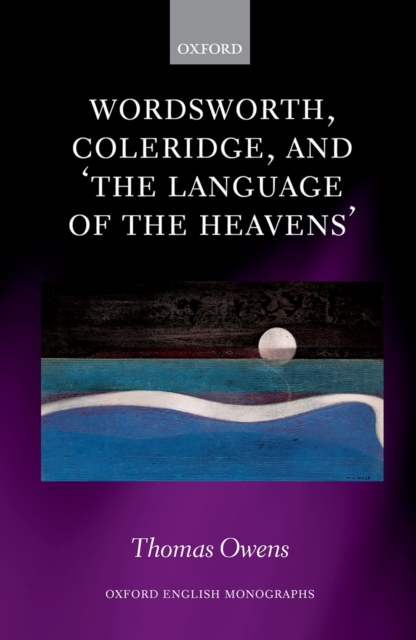
Wordsworth, Coleridge, and 'the language of the heavens'
This book explores some of the exultant visions inspired by Wordsworth’s and Coleridge’s close scrutiny of the night sky, the natural world, and the domains of science. It examines a set of scientific patterns drawn from natural, geometric, celestial, and astronomical sources which Wordsworth and Coleridge used to express their ideas about poetry, religion, literary criticism, and philosophy. It establishes the central important of analogy in their creative thinking. Analogies prompted the poets’ imaginings in geometry and cartography, in nature (representations of the Moon) and natural history (studies of spider-webs, streams, and dew), in calculus and conical refraction, and in the discovery of infra-red and ultraviolet light. Although this is primarily a study of the patterns which inspired their writing, the findings overturn the prevalent critical consensus that Wordsworth and Coleridge did not have the access, interest, or capacity to understand the latest developments in nineteenth-century astronomy and mathematics, which they did in fact possess. This research reinstates many relationships which the poets had with scientists and their sources. Most significantly, the book illustrates that these sources are not simply another context or historical lens through which to engage with Wordsworth’s and Coleridge’s work but are instead a controlling device of the symbolic imagination. Exploring the structures behind Wordsworth’s and Coleridge’s poems and metaphysics stakes out a return to the evidence of the Romantic imagination, not for its own sake, but in order to reveal that their analogical configuration of the world provided them with a scaffold for thinking, an intellectual orrery which ordered artistic consciousness and which they never abandoned.
eBook

Finding the speed of light : the 1676 discovery that dazzled the world
Describes how Danish astronomer Ole Romer measured the speed of light using a crude telescope and a mechanical timepiece.
Book

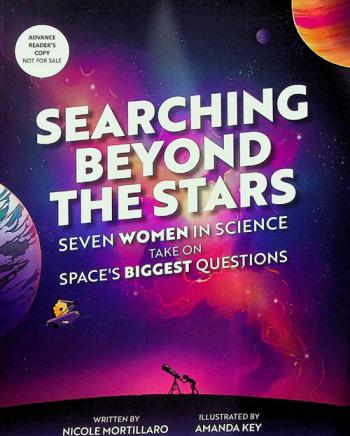
Searching beyond the stars : seven women in science take on space's biggest questions
\"An in-depth look at the lives and accomplishments of seven extraordinary women in the world of astronomy and space study. With a focus on feminist and stem-related content, this non-fiction book is written by a Senior Science Reporter for CBC.\"-- Provided by publisher.