
Catalogue Search | MBRL


Are you sure you want to remove the book from the shelf?

{{itemTitle}}
1,776
result(s) for
"Athènes"
Sort by:

Dogs in Athenian Sculpture and Vase Painting of the Archaic and Classical Periods
This book analyses the iconography of dogs in Athenian art, highlighting their roles as companions, hunters, pets, and status symbols. It explores their presence in various aspects of ancient Greek life, their association with gods and heroes, and their depiction in funerary reliefs, reflecting the deep human-canine bond.
eBook
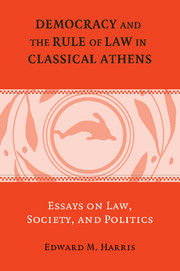
Democracy and the Rule of Law in Classical Athens
This volume brings together essays on Athenian law by Edward M. Harris, who challenges much of the recent scholarship on this topic. Presenting a balanced analysis of the legal system in ancient Athens, Harris stresses the importance of substantive issues and their contribution to our understanding of different types of legal procedures. He combines careful philological analysis with close attention to the political and social contexts of individual statutes. Collectively, the essays in this volume demonstrate the relationship between law and politics, the nature of the economy, the position of women, and the role of the legal system in Athenian society. They also show that the Athenians were more sophisticated in their approach to legal issues than has been assumed in the modern scholarship on this topic.
eBook

Les sorts croisés de deux célèbres exilés : Thémistocle et Cimon
Parmi les réfugiés les plus célèbres de l’antiquité grecque figure sans doute l’athénien Thémistocle. L’expulsion de Thémistocle a de quoi frapper, non seulement parce qu’elle a lieu au terme d’une carrière riche en succès militaires et politiques, mais surtout parce qu’elle se déroule dans le pays de son vieil ennemi: le roi de Perse. Plutarque en expose l’histoire dans la Vie de Thémistocle (26-31) et la rappelle aussi dans la Vie de Cimon (18, 6-7). Cimon lui aussi fut expulsé d’Athènes suite à un procès d’ostracisme, vers la fin des années 460, alors que Thémistocle dont les projets politiques semblaient remonter sur scène, était probablement mort. Bien que la bibliographie sur ce sujet soit touffue, il vaut la peine de réexaminer les sorts (croisés) des deux célèbres exilés, en vue d’opérer une mise au point sur quelques-unes des nombreuses questions encore en suspens.
Journal Article

Retour sur l’éphébie antique
Dans cet entretien accordé à Sophie Lalanne le 21 janvier 2023, le professeur Andrzej Chankowski (Université de Poitiers, HeRMA UR 15071) revient sur les différentes étapes qui ont jalonné la réflexion des historiens de l’Antiquité sur l’éphébie, le service militaire des jeunes Athéniens, qui jouait un rôle central dans l’éducation des jeunes hommes sous la démocratie et qui a été étendu à l’ensemble du monde grec à l’époque hellénistique, notamment l’Asie Mineure étudiée par Andrzej Chankowski. La connaissance de cette « institution sociale » a bénéficié des travaux des épigraphistes, comme Philippe Gauthier, et des historiens-anthropologues, comme Pierre Vidal-Naquet, et illustre bien la richesse des apports d’un débat scientifique périodiquement renouvelé.
Journal Article

Polytheism and Society at Athens
This book makes use of recently discovered archaeological and epigraphical evidence to give an account of the religious life of ancient Athens. The city's many festivals are discussed in detail, with attention to recent anthropological theory; so too, for instance, are the cults of households and of smaller groups, the role of religious practice and argumentation in public life, the authority of priests, the activities of religious professionals such as seers and priestesses, magic, and the place of theatrical representations of the gods within public attitudes to the divine. A final section considers the sphere of activity of the various gods, and takes Athens as a uniquely detailed test case for the structuralist approach to polytheism.
eBook

Origins of Democracy in Ancient Greece
This book presents a state-of-the-art debate about the origins of Athenian democracy by five eminent scholars. The result is a stimulating, critical exploration and interpretation of the extant evidence on this intriguing and important topic. The authors address such questions as: Why was democracy first realized in ancient Greece? Was democracy \"invented\" or did it evolve over a long period of time? What were the conditions for democracy, the social and political foundations that made this development possible? And what factors turned the possibility of democracy into necessity and reality? The authors first examine the conditions in early Greek society that encouraged equality and \"people's power.\" They then scrutinize, in their social and political contexts, three crucial points in the evolution of democracy: the reforms connected with the names of Solon, Cleisthenes, and Ephialtes in the early and late sixth and mid-fifth century. Finally, an ancient historian and a political scientist review the arguments presented in the previous chapters and add their own perspectives, asking what lessons we can draw today from the ancient democratic experience. Designed for a general readership as well as students and scholars, the book intends to provoke discussion by presenting side by side the evidence and arguments that support various explanations of the origins of democracy, thus enabling readers to join in the debate and draw their own conclusions.
eBook

Public Spending and Democracy in Classical Athens
In his On the Glory of Athens, Plutarch complained that the Athenian people spent more on the production of dramatic festivals and \"the misfortunes of Medeas and Electras than they did on maintaining their empire and fighting for their liberty against the Persians.\" This view of the Athenians' misplaced priorities became orthodoxy with the publication of August Böckh's 1817 book Die Staatshaushaltung der Athener [The Public Economy of Athens], which criticized the classical Athenian dēmos for spending more on festivals than on wars and for levying unjust taxes to pay for their bloated government. But were the Athenians' priorities really as misplaced as ancient and modern historians believed?Drawing on lines of evidence not available in Böckh's time, Public Spending and Democracy in Classical Athens calculates the real costs of religion, politics, and war to settle the long-standing debate about what the ancient Athenians valued most highly. David M. Pritchard explains that, in Athenian democracy, voters had full control over public spending. When they voted for a bill, they always knew its cost and how much they normally spent on such bills. Therefore, the sums they chose to spend on festivals, politics, and the armed forces reflected the order of the priorities that they had set for their state. By calculating these sums, Pritchard convincingly demonstrates that it was not religion or politics but war that was the overriding priority of the Athenian people.
eBook
Extradition et saisie de la personne des réfugiés athéniens à l’époque des Trente Tyrans
Le phénomène massif des exils de citoyens athéniens sous l’oligarchie des Trente Tyrans pose beaucoup de problèmes variés. Outre les questions chronologiques, il convient d’approcher les problèmes concernant le nombre des exilés, les causes des exils, les lieux où les exilés se réfugièrent, etc. Après avoir étudié ces thèmes en 1994 (Esilii, deportazioni ed emigrazioni forzate in Atene sotto regimi non democratici, dans Emigrazione e immigrazione nel mondo antico, CISA 20, p. 141-167), je voudrais maintenant me pencher sur les sources dont nous disposons sur la demande d’extradition et la saisie de la personne des exilés. Les témoignages de Lysias, Démosthène, Diodore, Plutarque (Vie de Lysandre et Vie de Pélopidas) et Justin nous renseignent sur l’initiative des Lacédémoniens à l’appui des Trente concernant les exilés (un décret adressé aux Grecs demandant leur collaboration pour l’extradition et la saisie des réfugiés athéniens), l’extension de la revendication (toute la Grèce), les menaces adressées aux Grecs (amende, exclusion des traités), la réaction des Grecs. Ces témoignages mettent en lumière, d’une part, la position juridique des réfugiés et leurs difficultés quotidiennes et de l’autre, les rapports d’étroite collaboration entre Sparte et les Trente Tyrans et les relations parfois controversées entre Sparte et le reste du monde grec, dont elle revendiquait à ce moment l’hégémonie absolue.
Journal Article
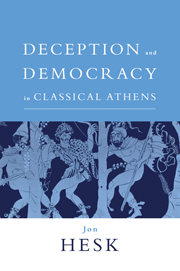
Deception and Democracy in Classical Athens
This book, first published in 2000, is a full-length study of the representation of deceit and lies in classical Athens. Dr Hesk traces the ways in which Athenian drama, democratic oratory and elite prose-writing construct and theorize a relationship between dishonesty and civic identity. He focuses on the ideology of military trickery, notions of the 'noble lie' and the developing associations of rhetorical language with deceptive communication. Deception and Democracy in Classical Athens combines close analysis of Athenian texts with lively critiques of modern theorists and classical scholars. Athenian democratic culture was crucially informed by a nuanced, anxious and dynamic discourse on the problems and opportunities which deception presented for its citizenry. Mobilizing comparisons with twentieth-century democracies, the author argues that Athenian literature made deception a fundamental concern for democratic citizenship. This ancient discourse on lying highlights the dangers of modern resignation and postmodern complacency concerning the politics and morality of deception.
eBook

L’utilisation de l’argument religieux durant les procès politiques et privés à Athènes au IVe s. avant J.-C
In the political assemblies and before the popular law courts, the litigants use some oratory strategies for their defence. These oratory strategies encompass the use of the legal and extra legal arguments in which one finds the religious arguments or in relation with the sacred. One notices in one hand the religious transgressions committed by their opponents or by their entourage or other people, and the arguments against a decree’s proposal. In the other hand, the religious’ facts or the objects in relation with the sacred which concerned the orators themselves. In using the religious arguments against their opponents, the litigants targeted a heavy condemnation or the cancellation of a decree’s proposal. Nevertheless the religious ‘arguments which concerned the litigious themselves tended to prove their citizen status. En las asambleas políticas y ante los tribunales, los litigantes utilizaron estrategias oratorias para defender sus causas. Estas estrategias incluían el uso de argumentos legales y extralegales en los que encontramos argumentos religiosos o sagrados. Hay dos categorías de argumentos, a saber: por un lado, las transgresiones religiosas cometidas por sus oponentes, su entorno o provenientes de una persona con la que no tenían conexión, y los argumentos en contra de algún decreto propuesto. Por otra parte, los hechos u objetos religiosos en relación con los propios litigantes. Utilizando hechos religiosos contra sus adversarios, su entorno y contra un decreto, los litigantes esperaban obtener de los jurados condenas con penas severas y la invalidación del decreto. Sin embargo, al emplear argumentos religiosos concernientes a ellos mismos, los litigantes querían probar su estatus de ciudadanía. Dans les assemblées politiques et devant les tribunaux, les plaideurs avaient utilisé des stratégies oratoires pour défendre leurs causes. Ces stratégies comprenaient l’utilisation d’arguments juridiques et extra juridiques dans lesquels l’on retrouvait des arguments religieux ou en relation avec le sacré. L’on distingue deux catégories d’arguments à savoir : d’une part les transgressions religieuses commises par leurs adversaires, leur entourage ou provenant d’une personne avec qui ils n’avaient aucun lien, et les arguments contre quelque proposition de décret. D’autre part, les faits ou des objets religieux en relation avec les plaideurs eux-mêmes. En utilisant des faits religieux contre leurs adversaires, leur entourage et contre un décret, les plaideurs espéraient obtenir des jurés des condamnations à de lourdes peines et l’invalidation du décret. Cependant, en employant des faits religieux concernant eux-mêmes, les plaideurs voulaient prouver leur statut de citoyen.
Journal Article