
Catalogue Search | MBRL


Are you sure you want to remove the book from the shelf?

{{itemTitle}}
544
result(s) for
"Atlantic slave trade"
Sort by:


Chained to History
In Chained to History
, Steven J. Brady places slavery at the center of the story
of America's place in the world in the years prior to the
calamitous Civil War. Beginning with the immediate
aftermath of the War of the American Revolution, Brady follows the
military, economic, and moral lines of the diplomatic challenges of
attempting to manage, on the global stage, the actuality of human
servitude in a country dedicated to human freedom. Chained to
History shows how slavery was interwoven with America's
foreign relations and affected policy controversies ranging from
trade to extradition treaties to military alliances.
Brady highlights the limitations placed on American policymakers
who, working in an international context increasingly supportive of
abolition, were severely constrained regarding the formulation and
execution of preferred policy. Policymakers were bound to the slave
interest based in the Democratic Party and the tortured state of
domestic politics bore heavily on the conduct of foreign affairs.
As international powers not only abolished the slave trade but
banned human servitude as such, the American position became
untenable.
From the Age of Revolutions through the American Civil War,
slavery was a constant factor in shaping US relations with the
Atlantic World and beyond. Chained to History addresses
this critical topic in its complete scope and shows the immoral
practice of human bondage to have informed how the United States
re-entered the community of nations after 1865.
eBook

Making the black Atlantic : Britain and the African diaspora
This text presents a coherent story of the African exile, of its origins, progress and transformation from bondage to freedom, within the broadest context, and with particular reference to Britain's central role.
Book

Biography and the Black Atlantic
InBiography and the Black Atlantic, leading historians in the field of Atlantic studies examine the biographies and autobiographies of eighteenth- and nineteenth-century African-descended people and reflect on the opportunities and limitations these life stories present to studies of slavery and the African diaspora. The essays remind us that historical developments like slavery and empire-building were mostly experienced and shaped by men and women outside of the elite political, economic, and military groups whom historians often turn to as sources. Despite the scarcity of written records and other methodological challenges, the contributors to Biography and the Black Atlantic have pieced together vivid glimpses into lives of remarkable, through previously unknown, enslaved and formerly enslaved people who moved, struggled, and endured in different parts of Africa, the Americas, and Europe. From the woman of Fulani origin who made her way from Revolutionary Haiti to Louisiana to the free black American who sailed for Liberia and the former slave from Brazil who became a major slave trader in Angola, these stories render the Atlantic world as a densely and sometimes unpredictably interconnected sphere.Biography and the Black Atlanticdemonstrates the power of individual stories to illuminate history: though the life histories recounted here often involved extraordinary achievement and survival against the odds, they also portray the struggle for self-determination and community in the midst of alienation that lies at the heart of the modern condition. Contributors: James T. Campbell, Vincent Carretta, Roquinaldo Ferreira, Jean-Michel Hébrard, Martin Klein, Lloyd S. Kramer, Sheryl Kroen, Jane Landers, Lisa A. Lindsay, Joseph C. Miller, Cassandra Pybus, João José Reis, Rebecca J. Scott, Jon Sensbach, John Wood Sweet.
eBook


The Black Urban Atlantic in the Age of the Slave Trade
During the era of the Atlantic slave trade, vibrant port cities became home to thousands of Africans in transit. Free and enslaved blacks alike crafted the necessary materials to support transoceanic commerce and labored as stevedores, carters, sex workers, and boarding-house keepers. Even though Africans continued to be exchanged as chattel, urban frontiers allowed a number of enslaved blacks to negotiate the right to hire out their own time, often greatly enhancing their autonomy within the Atlantic commercial system. InThe Black Urban Atlantic in the Age of the Slave Trade, eleven original essays by leading scholars from the United States, Europe, and Latin America chronicle the black experience in Atlantic ports, providing a rich and diverse portrait of the ways in which Africans experienced urban life during the era of plantation slavery. Describing life in Portugal, Brazil, Mexico, the Caribbean, and Africa, this volume illuminates the historical identity, agency, and autonomy of the African experience as well as the crucial role Atlantic cities played in the formation of diasporic cultures. By shifting focus away from plantations, this volume poses new questions about the nature of slavery in the sixteenth to nineteenth centuries, illustrating early modern urban spaces as multiethnic sites of social connectivity, cultural incubation, and political negotiation. Contributors: Trevor Burnard, Mariza de Carvalho Soares, Matt D. Childs, Kevin Dawson, Roquinaldo Ferreira, David Geggus, Jane Landers, Robin Law, David Northrup, João José Reis, James H. Sweet, Nicole von Germeten.
eBook

The Atlantic slave trade from West Central Africa, 1780-1867
The Atlantic Slave Trade from West Central Africa traces for the first time the origins of slaves leaving West Central Africa at the peak period of the transatlantic slave trade. West Central Africa was one of the principal sources of slaves for the Americas. During the nineteenth century, the importance of the region as a supplier of slaves increased as a result of the suppression of the trade north of the Equator. Although some nations retreated from the business early in that century, others remained active, expanding their activities along the coast of West Central Africa. Some scholars of the slave trade claim that a quest for political power motivated Africans to sell one another into the transatlantic commerce as prisoners of war. They argue that the expansion of the slave trade from West Central Africa in the nineteenth century increased the incidence of warfare in the region, which in turn spread the enslaving frontiers further into the region's interior. However, as this book demonstrates, the rate of slaves leaving from West Central Africa remained relatively constant from the lat eighteenth until the mid-nineteenth century, with slaves originating from places much closer to the coast than previously thought. Moreover, the book shows that cultural and economic motivations were also important factors shaping the participation of Africans in the slave trade. More Africans engaged in this activity than a handful of rulers and warlords, but their participation depended significantly on the ability of merchants in Europe and the Americas to deliver the goods required for exchanging for slaves.--Abstract.
Book
American Slavers
BThe first telling of the unknown story of America's two-hundred-year history as a slave-trading nation/BBR / BR / A total of 305,000 enslaved Africans arrived in the New World aboard American vessels over a span of two hundred years as American merchants and mariners sailed to Africa and to the Caribbean to acquire and sell captives. Using exhaustive archival research, including many collections that have never been used before, historian Sean M. Kelley argues that slave trading needs to be seen as integral to the larger story of American slavery.BR / BR / Engaging with both African and American history and addressing the trade over time, Kelley examines the experience of captivity, drawing on more than a hundred African narratives to offer a portrait of enslavement in the regions of Africa frequented by American ships. Kelley also provides a social history of the two American ports where slave trading was most intensive, Newport and Bristol, Rhode Island.BR / BR / In telling this tragic, brutal, and largely unknown story, Kelley corrects many misconceptions while leaving no doubt that Americans were a nation of slave traders.
eBook

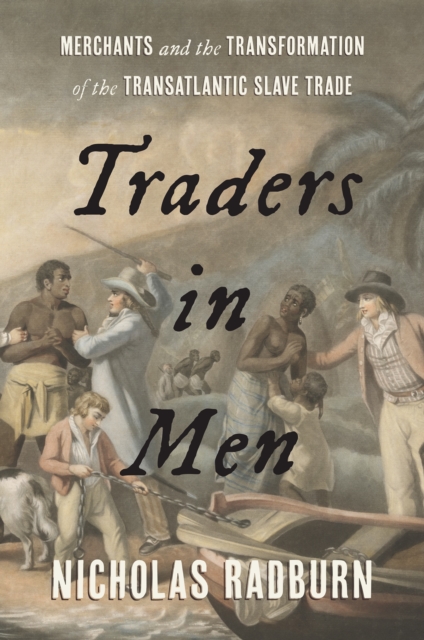
Traders in Men
BA sweeping new history that reveals how British, African, and American merchants developed the transatlantic slave trade/BBR / BR /B\"This is a landmark study given its clear status as easily the best researched and most comprehensive book on the British slave trade to date.\"-David Eltis, coauthor of IAtlas of the Transatlantic Slave Trade/I/BBR / BR /B\"A masterful account of one of the most brutal moments in the history of capitalist modernity. Radburn brilliantly details all aspects of the process of commodification of human beings in the Liverpool slave trade, vividly depicting the long journeys endured by Africans in Africa, across the Atlantic, and in the Americas.\"-Leonardo Marques, Universidade Federal Fluminense/BBR / BR / During the eighteenth century, Britain's slave trade exploded in size. Formerly a small and geographically constricted business, the trade had, by the eve of the American Revolution, grown into a transatlantic system through which fifty thousand men, women, and children were enslaved every year.BR / BR / In this wide-ranging history, Nicholas Radburn explains how thousands of merchants collectively transformed the slave trade by devising highly efficient but violent new business methods. African brokers developed commercial infrastructure that facilitated the enslavement and sale of millions of people. Britons invented shipping methods that quelled enslaved people's constant resistance on the Middle Passage. And American slave traders formulated brutal techniques through which shiploads of people could be quickly sold to colonial buyers. Truly Atlantic-wide in its vision, this study shows how the slave trade dragged millions of people into its terrible vortex and became one of the most important phenomena in world history.
eBook