
Catalogue Search | MBRL


Are you sure you want to remove the book from the shelf?

{{itemTitle}}
15
result(s) for
"Attic Greek dialect."
Sort by:


Athens and Macedon
Little of the historiography of third-century Athens survives, and much of what we know—or might know—about the period has come down to us in inscriptions carved by Attic stonemasons of the time. In this book Stephen Tracy, the world's preeminent expert in this area, provides new insight into an unsettled and obscure moment in antiquity.
eBook
Sophisticated Speakers
Trends in Classics, a new series and journal to be edited by Franco Montanari and Antonios Rengakos, will publish innovative, interdisciplinary work which brings to the study of Greek and Latin texts the insights and methods of related disciplines such as narratology, intertextuality, reader-response criticism, and oral poetics. Both publications will seek to publish research across the full range of classical antiquity. The series Trends in Classics Studies welcomes monographs, edited volumes, conference proceedings and collections of papers; it will provide an important forum for the ongoing debate about where Classics fits in modern cultural and historical studies. The journal Trends in Classics will be published twice a year with approx. 160 pp. per issue. Each year one issue will be devoted to a specific subject with articles edited by a guest editor.
eBook
The Languages of Aristophanes
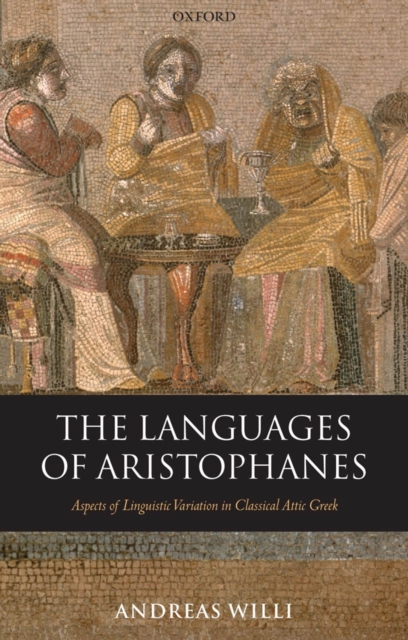
By examining linguistic variation in Aristophanic comedy, this book opens up a new perspective on intra-dialectal diversity in Classical Attic Greek. A representative range of registers, technical languages, sociolects, and (comic) idiolects is described and analyzed. Stylistic and statistical observations are combined and supplemented by typological comparisons with material drawn from sociolinguistic research on modern languages. The resulting portrayal of the Attic dialect deepens our understanding of various socio-cultural phenomena reflected in Aristophanes' work, such as the spread of ‘sophistic’ culture, the re-evaluation of gender roles, and the status of foreigners in Athenian society.
eBook

Athens and Macedon
Little of the historiography of third-century Athens survives, and much of what we know--or might know--about the period has come down to us in inscriptions carved by Attic stonemasons of the time. In this book Stephen Tracy, the world's preeminent expert in this area, provides new insight into an unsettled and obscure moment in antiquity.
eBook

The Antiatticist
The so-called Antiatticista is a Greek Atticistic lexicon crucial for understanding the Atticism of the 2nd cent. CE. The anonymous author approved a broader idea of Attic language in contrast to the most rigorous Atticists. For this (polemic) purpose, he used some older sources (in particular Hellenistic ones, such as Aristophanes of Byzantium) where he could find rich quotations from classical authors, especially from comic poets. Given that many of them are no longer extant, this work now represents the only source for them. The first critical edition of this lexicon is prefaced by a survey of its textual tradition, direct and indirect, which concerns its relationship to the Byzantine lexicon Synagoge. The authorship, the typology, and the sources of the work are also investigated. The unedited annotations by David Ruhnkenius for his planned edition of the text are appended. Comprehensive indexes are provided at the end of the book.
eBook
Introduction to Attic Greek
Thoroughly revised and expanded,Introduction to Attic Greek, 2nd Editiongives student and instructors the most comprehensive and accessible presentation of ancient Greek available. The text features: • Full exposure to the grammar and morphology that students will encounter in actual texts • Self-contained instructional chapters, with challenging, carefully tailored exercises • Progressively more complex chapters to build the student's knowledge of declensions, tenses, and constructions by alternating emphasis on morphology and syntax • Readings based on actual texts and include unadapted passages from Xenophon, Lysias, Plato, Aristophanes, and Thucydides. • Concise introduction to the history of the Greek language • Composite list of verbs with principal parts, and an appendix of all paradigms • Greek-English and English-Greek glossaries Additional Resources: •Robust online supplements for teaching and learning available at atticgreek.org •Answer Key to exercises also available from UC Press (978-0-520-27574-4)
eBook

The outcome of -er/ni-̯ in Greek
It is widely accepted that *-er/ni-̯ became -ēr/n- outside Aeolic, but the material in favour of or against this view has never been collected and thoroughly discussed. In this study, it is shown, particularly in the light of some newly identified forms, that the result of *-er/ni-̯ was both -ēr/n- and -eir̯ /n- in Greek dialects other than Thessalian and Lesbian. In Attic, there are dialectal forms pointing in both directions, but it is possible to cite parallels to this situation from other dialects. The paper closes with a short discussion of the word ἀμείνων.
Journal Article

SELINUS OR ATHENS?
An examination of the evidence for the authorship of a fragmentary verse in Greek is presented. It is argued that the dialect used indicates the author was from Athens, not Sicily.
Journal Article