
Catalogue Search | MBRL


Are you sure you want to remove the book from the shelf?

{{itemTitle}}
61,837
result(s) for
"Attitude of Health Personnel"
Sort by:


Beyond Myalgic Encephalomyelitis/Chronic Fatigue Syndrome
Myalgic encephalomyelitis (ME) and chronic fatigue syndrome (CFS) are serious, debilitating conditions that affect millions of people in the United States and around the world. ME/CFS can cause significant impairment and disability. Despite substantial efforts by researchers to better understand ME/CFS, there is no known cause or effective treatment. Diagnosing the disease remains a challenge, and patients often struggle with their illness for years before an identification is made. Some health care providers have been skeptical about the serious physiological - rather than psychological - nature of the illness. Once diagnosed, patients often complain of receiving hostility from their health care provider as well as being subjected to treatment strategies that exacerbate their symptoms.
Beyond Myalgic Encephalomyelitis/Chronic Fatigue Syndrome proposes new diagnostic clinical criteria for ME/CFS and a new term for the illness - systemic exertion intolerance disease(SEID). According to this report, the term myalgic encephalomyelitis does not accurately describe this illness, and the term chronic fatigue syndrome can result in trivialization and stigmatization for patients afflicted with this illness. Beyond Myalgic Encephalomyelitis/Chronic Fatigue Syndrome stresses that SEID is a medical - not a psychiatric or psychological - illness. This report lists the major symptoms of SEID and recommends a diagnostic process.One of the report's most important conclusions is that a thorough history, physical examination, and targeted work-up are necessary and often sufficient for diagnosis. The new criteria will allow a large percentage of undiagnosed patients to receive an accurate diagnosis and appropriate care.
Beyond Myalgic Encephalomyelitis/Chronic Fatigue Syndrome will be a valuable resource to promote the prompt diagnosis of patients with this complex, multisystem, and often devastating disorder; enhance public understanding; and provide a firm foundation for future improvements in diagnosis and treatment.
eBook

The walking med : zombies and the medical image
\"Shows how our understanding of narratives of illness can by transformed by recognizing the zombie metaphors within them and how the recent medicalization of popular zombie narratives has added new dimensions to what is symbolized by this figure\"-- Provided by publisher.
Book

Impact of surgeon race, ethnicity, and gender on perceptions of professional behavior in the operating room
Surgeons’ behaviors may be perceived differentially by operating room (OR) personnel, and implicit biases may have potential impact on those perceptions. We aimed to characterize OR team responses to surgeon behaviors based on perceived demographic traits of the surgeon.
This multi-institutional, randomized study surveyed OR personnel responses to five scenarios of surgeon behaviors. Participants were randomized to six different surgeon descriptors, with gender, race, and ethnicity implied by name. Chi-squared analyses assessed differences in responses.
296 individuals completed the survey, with responses found to be dependent on perceived surgeon demographics. In scenarios describing an impatient surgeon and shouting surgeon, Black woman (BW) and Hispanic woman (HW) surgeons’ behaviors were seen as more inappropriate (p ≤ 0.01 for both). Respondents were more likely to report BW surgeons arriving late for surgery (p < 0.01), and directly address Black and Hispanic surgeons omitting the time-out (p = 0.03).
Our findings highlight the demographic associations with perceptions of surgeon behaviors, with gender and race resulting in harsher expectations of Black women. Work is needed to better understand and mitigate such inequities.
•Surgeon demographics influence how their behaviors are perceived by others.•Operative teams judged Black women surgeons more harshly for identical behaviors.•Black and Hispanic surgeons were seen as inappropriate in various scenarios.•Implicit biases affect behavioral perceptions and impact career trajectories.•More work is needed to mitigate bias and ensure fair respect and trust in surgery.
Journal Article


Implicit bias in healthcare professionals: a systematic review
Background
Implicit biases involve associations outside conscious awareness that lead to a negative evaluation of a person on the basis of irrelevant characteristics such as race or gender. This review examines the evidence that healthcare professionals display implicit biases towards patients.
Methods
PubMed, PsychINFO, PsychARTICLE and CINAHL were searched for peer-reviewed articles published between 1st March 2003 and 31st March 2013. Two reviewers assessed the eligibility of the identified papers based on precise content and quality criteria. The references of eligible papers were examined to identify further eligible studies.
Results
Forty two articles were identified as eligible. Seventeen used an implicit measure (Implicit Association Test in fifteen and subliminal priming in two), to test the biases of healthcare professionals. Twenty five articles employed a between-subjects design, using vignettes to examine the influence of patient characteristics on healthcare professionals’ attitudes, diagnoses, and treatment decisions. The second method was included although it does not isolate implicit attitudes because it is recognised by psychologists who specialise in implicit cognition as a way of detecting the possible presence of implicit bias. Twenty seven studies examined racial/ethnic biases; ten other biases were investigated, including gender, age and weight. Thirty five articles found evidence of implicit bias in healthcare professionals; all the studies that investigated correlations found a significant positive relationship between level of implicit bias and lower quality of care.
Discussion
The evidence indicates that healthcare professionals exhibit the same levels of implicit bias as the wider population. The interactions between multiple patient characteristics and between healthcare professional and patient characteristics reveal the complexity of the phenomenon of implicit bias and its influence on clinician-patient interaction. The most convincing studies from our review are those that combine the IAT and a method measuring the quality of treatment in the actual world. Correlational evidence indicates that biases are likely to influence diagnosis and treatment decisions and levels of care in some circumstances and need to be further investigated. Our review also indicates that there may sometimes be a gap between the norm of impartiality and the extent to which it is embraced by healthcare professionals for some of the tested characteristics.
Conclusions
Our findings highlight the need for the healthcare profession to address the role of implicit biases in disparities in healthcare. More research in actual care settings and a greater homogeneity in methods employed to test implicit biases in healthcare is needed.
Journal Article

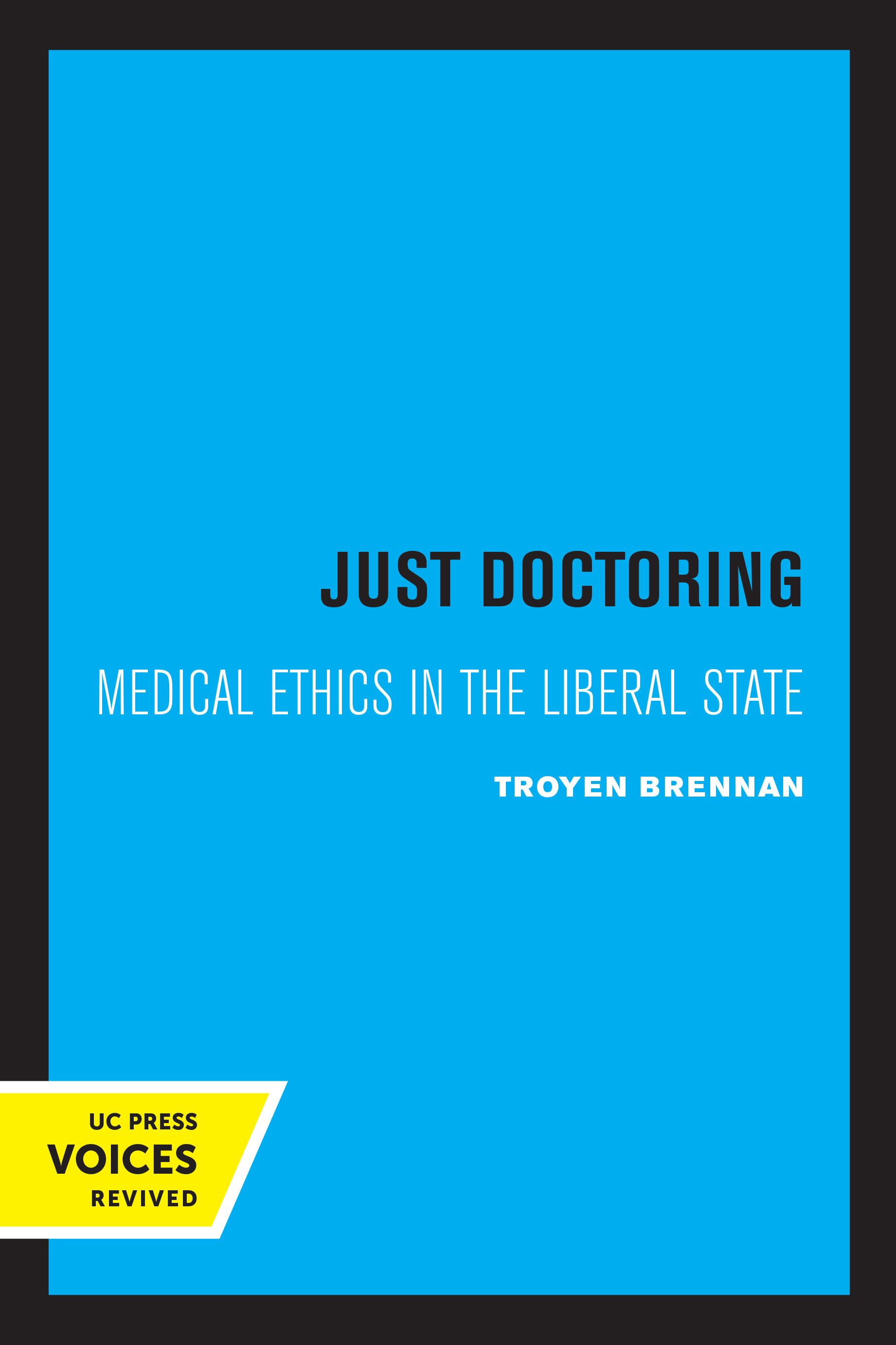
Just Doctoring
Just Doctoring draws the doctor-patient relationship out of the consulting room and into the middle of the legal and political arenas where it more and more frequently appears. Traditionally, medical ethics has focused on the isolated relationship of physician to patient in a setting that has left the physician virtually untouched by market constraints or government regulation. Arguing that changes in health care institutions and legal attention to patient rights have made conventional approaches obsolete, Troyen Brennan points the way to a new, more aware and engaged medical ethics. The medical profession is no longer isolated, even theoretically, from the liberal, market-dominated state. Old ideas of physician beneficence and altruism must make way for a justice-based medical ethics, assuming a relationship between equals more compatible with liberal political philosophy. Brennan offers clinical examples of many of today's most challenging medical problems--from informed consent to care rationing and the repercussions of the HIV epidemic--and gives his recommendation for a new ethical perspective. This lively and controversial plea for a rethinking of medical ethics goes right to the heart of medical care at the end of the twentieth century. This title is part of UC Press's Voices Revived program, which commemorates University of California Press's mission to seek out and cultivate the brightest minds and give them voice, reach, and impact. Drawing on a backlist dating to 1893, Voices Revived makes high-quality, peer-reviewed scholarship accessible once again using print-on-demand technology. This title was originally published in 1991. Many titles in the Voices Revived program are also newly available as ebooks, offered at a discounted price to support wider access to scholarly work.
eBook

How we do harm : a doctor breaks ranks about being sick in America
Dr. Brawley exposes the underbelly of healthcare today--the under-treatment of the poor, the over-treatment of the rich, the financial conflicts of interests physicians face, insurance that doesn't demand the best (or even cheapest) care, and a pharmaceutical behemoth concerned with selling drugs, not providing health.
Book

A Social Psychological Approach to Improving the Outcomes of Racially Discordant Medical Interactions
BACKGROUND
Medical interactions between Black patients and non-Black physicians are less positive and productive than racially concordant ones and contribute to racial disparities in the quality of health care.
OBJECTIVE
To determine whether an intervention based on the common ingroup identity model, previously used in nonmedical settings to reduce intergroup bias, would change physician and patient responses in racially discordant medical interactions and improve patient adherence.
IINTERVENTION
Physicians and patients were randomly assigned to either a common identity treatment (to enhance their sense of commonality) or a control (standard health information) condition, and then engaged in a scheduled appointment.
DESIGN
Intervention occurred just before the interaction. Patient demographic characteristics and relevant attitudes and/or behaviors were measured before and immediately after interactions, and 4 and 16 weeks later. Physicians provided information before and immediately after interactions.
PARTICIPANTS
Fourteen non-Black physicians and 72 low income Black patients at a Family Medicine residency training clinic.
MAIN MEASURES
Sense of being on the same team, patient-centeredness, and patient trust of physician, assessed immediately after the medical interactions, and patient trust and adherence, assessed 4 and 16 weeks later.
KEY RESULTS
Four and 16 weeks after interactions, patient trust of their physician and physicians in general was significantly greater in the treatment condition than control condition. Sixteen weeks after interactions, adherence was also significantly greater.
CONCLUSIONS
An intervention used to reduce intergroup bias successfully produced greater Black patient trust of non-Black physicians and adherence. These findings offer promising evidence for a relatively low-cost and simple intervention that may offer a means to improve medical outcomes of racially discordant medical interactions. However, the sample size of physicians and patients was small, and thus the effectiveness of the intervention should be further tested in different settings, with different populations of physicians and other health outcomes.
Journal Article