
Catalogue Search | MBRL


Are you sure you want to remove the book from the shelf?

{{itemTitle}}
17
result(s) for
"Audio-visual materials -- Translating"
Sort by:
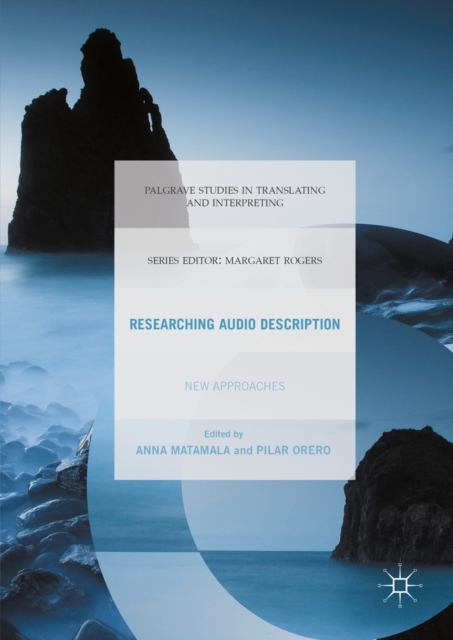
Researching audio description : new approaches
Audio description is one of the many services available to guarantee accessibility to audiovisual media. It describes and narrates images and sounds and resulting audio is then mixed with the original soundtrack. Audio description is a complex process that touches production, distribution and reception. Researching Audio Description: New Approachesgathers academic information and data from the many existing research projects, practices, and training across the world. The book has a telescopic approach, from two introductory chapters where accessibility in general is contextualised as a human right, and the basic concepts of disability and impairment are explored. Research on specific features for audio description script drafting are focused in the second part of the book, with a view to revising existing funded projects and their outcomes. The book offers a wealth of information on both the practical and philosophical, from different approaches in perception and cognition,and different research methodologies. Project information contained in the contributions identifies trends in current research-funded studies which will be valuable as a pointer towards future proposals. The book shows the dynamic state of audio description practice, training and research, while contributing towards the growing critical mass needed in building the field of accessibility studies.
eBook
Audio description : new perspectives illustrated
Audio description (AD) is a narrative technique which provides complementary information regarding the where, who, what and how of any audiovisual content. It translates the visuals into words. The principal function of this ad hoc narrative is to make audiovisual content available to all: be it a guided city tour of Barcelona, a 3D film, or a Picasso painting. Audio description is one of the younger siblings of Audiovisual Translation, and it is epigonic to the audiovisual translation modality chosen. This book is the first volume on the topic written in English and it brings together an international team of leading audio description teachers, scholars, and practitioners to address the basic issues regarding audio description strategies. Using one stimulus, Quentin Tarantino's film Inglourious Basterds (2009), the authors analysed what, when, where and how to audio describe. The book is written in a collaborative effort, following a bottom up approach. The many issues that surfaced in the process of the analysis were grouped in broader categories represented in the ten chapters this book contains. A good example of a successful international collaboration, the volume sets a robust practical and theoretical framework for the many studies on audio description to come in the future. Considering the structure of the individual contributions, the book is not only oriented towards the identification of the challenges that await the describer, but it also offers an insight into their possible solutions.
eBook

Reception Studies and Audiovisual Translation
The coming of age of audiovisual translation studies has brought about a much-needed surge of studies focusing on the audience, their comprehension, appreciation or rejection of what reaches them through the medium of translation. Although complex to perform, studies on the reception of translated audiovisual texts offer a uniquely thorough picture of the life and afterlife of these texts. This volume provides a detailed and comprehensive overview of reception studies related to audiovisual translation and accessibility, from a diachronic and synchronic perspective. Focusing on all audiovisual translation techniques and encompassing theoretical and methodological approaches from translation, media and film studies, it aims to become a reference for students and scholars across these fields.
eBook

Audiovisual translation and media accessibility at the crossroads : Media for All 3
This third volume in the Media for All series offers a diverse selection of articles which bear testimony to the vigour and versatility of research and developments in audiovisual translation and media accessibility. The collection reflects the critical impact of new technologies on AVT, media accessibility and consumer behaviour and shows the significant increase in collaborative and interdisciplinary research targeting changing consumer perceptions as well as quality issues. Complementing newcomers such as crowdsourcing and potentially universal emoticons, classical themes of AVT studies such as linguistic analyses and corpus-based research are featured. Prevalent throughout the volume is the impact of technology on both methodologies and content. The book will be of interest to researchers from a wide range of disciplines as well as audiovisual translators, lecturers, trainers and students, producers and developers working in the field of language and media accessibility.
eBook
Traducción y accesibilidad audiovisual
Traducción y accesibilidad audiovisual ofrece un breve pero riguroso recorrido a través de la historia de la traducción audiovisual, que va ganando cada vez más fuerza en el mundo académico conforme se consolidan sus líneas de investigación y va adquiriendo mayor relevancia pública, gracias a su valiosa contribución a la accesibilidad universal y al diseño para todos. Este manual sintetiza los conceptos básicos, así como los últimos avances de la literatura especializada en el campo de la traducción audiovisual, procurando acercarlos a cualquier lector interesado, empleando un tono divulgativo y describiendo de forma pormenorizada en qué consisten técnicas como el subtitulado, el doblaje y la accesibilidad en los medios. Además de un apartado bibliográfico muy completo y actualizado, todos aquellos que deseen profundizar en esta materia tan apasionante encontrarán en esta obra una serie de capítulos de lectura amena que vienen acompañados de actividades formativas y de tareas de aplicación práctica.
eBook
Interpreting Technologies - Current and Future Trends
While interpreting long remained unaffected by the technological progress that transformed the translation industry, recent years have witnessed a paradigm shift. This volume aims to inform and to empower interpreters and spark reflections on the future of technology in the interpreting industry.
eBook

Exploring challenges in audiovisual translation: A comparative analysis of human- and AI-generated Arabic subtitles in Birdman
Movies often use allusions to add depth, create connections, and enrich the storytelling. However, translators may face challenges when subtitling movie allusions, as they must render both meaning and culture accurately despite existing language and cultural barriers. These challenges could be further complicated by the use of available AI tools attempting to subtitle movie allusions, while probably unaware of existing cultural complexities. This research investigates these challenges using qualitative and descriptive quantitative approaches by analyzing the movie Birdman or (The Unexpected Virtue of Ignorance) , comprising13.014 words, to identify the types of allusions used and compare the human- vs. AI (ChatGPT)-generated Arabic subtitles in terms of the subtitling strategies, their frequency, and quality. The results revealed that the movie used 52 Noun Phrase (NP) allusions, where the writer intertextually employed a proper name to convey meaning, and 8 Key-Phrase (KP) allusions, where the writer used phrases that convey implicit meaning easily perceived by members of the source culture (by referring to religious, literary, or entertainment texts). For NP allusions, both the human translator and AI opted for retentive strategies; however, the human translator’s preference to add guidance/parentheses to mark NP allusions was distinct. Additionally, it was observed that AI used neologism to render technology-related allusions, which could be a suggested strategy for NP subtitling into Arabic. For KP allusions, while the human translator seemed to be cognizant of the idea that KP allusions typically require a change in wording, AI fell short. Specifically, the human translator employed reduction in 5 out of 8 KPs, opting for minimum change/literal translation only three times. Conversely, AI utilized literal translation in all 8 examples, despite its awareness of the allusion and its intricate meaning/reference. As for the FAR assessment, for NP allusions, it revealed minor semantic errors in AI’s subtitles that did not affect the plot. Regarding KP allusions, AI’s subtitles were penalized in 5 out of its 8 Arabic renditions, in contrast to the human translator. Most of the errors were serious semantic errors that likely disrupted the flow of reading the subtitles due to conveying irrelevant meanings in the movie’s/scene’s context. Despite its functionality, this study suggests adding an extra parameter to the FAR model: consistency, as it plays a role in enhancing audience involvement and understanding. Its absence, as observed in some AI instances, can be misleading.
Journal Article

Language Variation and Multimodality in Audiovisual Translation
Society is characterized by a constant flow of multimodal products, which increasingly blur the lines between screen and reality, and audiovisual translation allows overcoming geographical and linguistic frontiers between small realities across the planet.
eBook

Audio–Visual Speech Recognition Based on Dual Cross-Modality Attentions with the Transformer Model
Since attention mechanism was introduced in neural machine translation, attention has been combined with the long short-term memory (LSTM) or replaced the LSTM in a transformer model to overcome the sequence-to-sequence (seq2seq) problems with the LSTM. In contrast to the neural machine translation, audio–visual speech recognition (AVSR) may provide improved performance by learning the correlation between audio and visual modalities. As a result that the audio has richer information than the video related to lips, AVSR is hard to train attentions with balanced modalities. In order to increase the role of visual modality to a level of audio modality by fully exploiting input information in learning attentions, we propose a dual cross-modality (DCM) attention scheme that utilizes both an audio context vector using video query and a video context vector using audio query. Furthermore, we introduce a connectionist-temporal-classification (CTC) loss in combination with our attention-based model to force monotonic alignments required in AVSR. Recognition experiments on LRS2-BBC and LRS3-TED datasets showed that the proposed model with the DCM attention scheme and the hybrid CTC/attention architecture achieved at least a relative improvement of 7.3% on average in the word error rate (WER) compared to competing methods based on the transformer model.
Journal Article

Multilingualism as a Functional Element, a Useful Category for the Study of the Construction and Translation of Linguistically Diverse Discourse
This article is a discursive and equivalence-generating study of the use of the multilingual property as a narrative transmission mechanism in audiovisual texts. Specific functions can be constructed and different events and aspects of the plot can be presented through the introduction of linguistic variation and its deliberate application to achieve defined purposes. The analysis is based on functionalist approaches to the study of fiction and translation and on the binary branching classification model of solution types for determining textual problems in translation based on the form these adopt. This article presents the findings of multilingual property identification and translation related to the application of this forms- and functions-based approach. Several classifications of solution types are also developed with representative examples extracted from film and series.
Journal Article