
Catalogue Search | MBRL


Are you sure you want to remove the book from the shelf?

{{itemTitle}}
2,820
result(s) for
"Audio-visual materials."
Sort by:

Singing out : the musical voice in audiovisual media
'Singing Out' explores a broad range of singing voices and sung moments, from lavish film musical sequences, television and videogames, through to online platforms, advertising, and multimedia installation work. It illustrates the diverse ways in which the singing voice is produced and understood in different media across international contexts, taking into consideration issues such as corporeal form, age, race, reception, and gender. The act of singing emphasises issues of identity, technology, and the identifying markers of the voice itself, heightening communication, acting as an aid to memory, and inviting judgement.
BOOK

Introduction to audiovisual archives
Today, audiovisual archives and libraries have become very popular especially in the field of collecting, preserving and transmitting cultural heritage. However, the data from these archives or libraries – videos, images, sound tracks, etc. – constitute as such only potential cognitive resources for a given public (or “target community”). They have to undergo more or less significant qualitative transformations in order to become user- or community-relevant intellectual goods.
These qualitative transformations are performed through a series of concrete operations such as: audiovisual text segmentation, content description and indexing, pragmatic profiling, translation, etc. These and other operations constitute what we call the semiotic turn in dealing with digital (audiovisual) texts, corpora of texts or even entire (audiovisual) archives and libraries. They demonstrate practically and theoretically the well-known “from data to meta-data” or “from (simple) information to (relevant) knowledge” problem – a problem that obviously directly influences the effective use, the social impact and relevancy and therefore also the future of digital knowledge archives.
It constitutes, indeed, the heart of a diversity of important R&D programs and projects all over the world.
eBook


Indexing and Retrieval of Non-Text Information
The scope of this volume will encompass a collection of research papers related to indexing and retrieval of online non-text information. In recent years, the Internet has seen an exponential increase in the number of documents placed online that are not in textual format. These documents appear in a variety of contexts, such as user-generated content sharing websites, social networking websites etc. and formats, including photographs, videos, recorded music, data visualizations etc. The prevalence of these contexts and data formats presents a particularly challenging task to information indexing and retrieval research due to many difficulties, such as assigning suitable semantic metadata, processing and extracting non-textual content automatically, and designing retrieval systems that \"speak in the native language\" of non-text documents.
eBook

Makerspace sound and music projects for all ages
\"This easy-to-follow guide shows, step-by-step, how to work with sound generation, recording, editing, and distribution tools. Co-written by a professional audio engineer and a dedicated maker-librarian featur[ing] dozens of do-it-yourself projects complete with parts lists, start-to-finish instructions, and full-color illustrations\"-- Provided by publisher.
Book

Audiovisual archives
This book explains how to include the coupling between thin wires and electromagnetic waves and how to include passive and active components. A matrix formulation of TLM method is given allowing a rigorous simulation of propagation in a dispersive environment.
eBook

Research visual primary sources : photographs, paintings, video, and more!
\"How do we know so much about people and events from the past? Much of what we know comes from studying items used long ago. Research Visual Primary Sources: Photographs, Paintings, Video, and More! will help you dive deeper into studying history by showing you how to examine objects that were part of everyday life in the past\"-- Provided by publisher.
Book


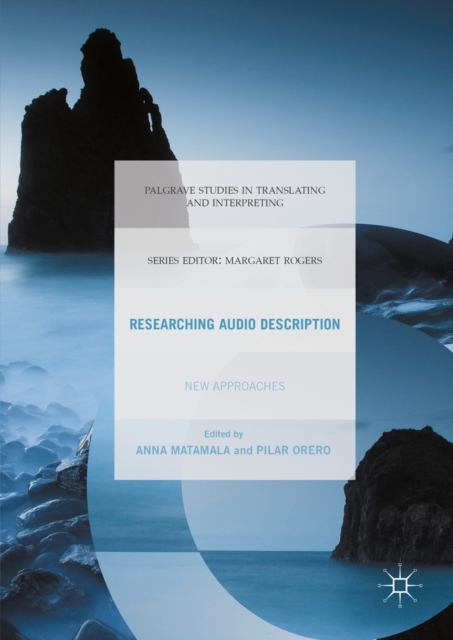
Researching audio description : new approaches
Audio description is one of the many services available to guarantee accessibility to audiovisual media. It describes and narrates images and sounds and resulting audio is then mixed with the original soundtrack. Audio description is a complex process that touches production, distribution and reception. Researching Audio Description: New Approachesgathers academic information and data from the many existing research projects, practices, and training across the world. The book has a telescopic approach, from two introductory chapters where accessibility in general is contextualised as a human right, and the basic concepts of disability and impairment are explored. Research on specific features for audio description script drafting are focused in the second part of the book, with a view to revising existing funded projects and their outcomes. The book offers a wealth of information on both the practical and philosophical, from different approaches in perception and cognition,and different research methodologies. Project information contained in the contributions identifies trends in current research-funded studies which will be valuable as a pointer towards future proposals. The book shows the dynamic state of audio description practice, training and research, while contributing towards the growing critical mass needed in building the field of accessibility studies.
eBook