
Catalogue Search | MBRL


Are you sure you want to remove the book from the shelf?

{{itemTitle}}
11
result(s) for
"Auschwitz (Concentration camp) Fiction"
Sort by:

Psalm 44
A last major work by the influential Serbian writer to be translated into English demonstrates his use of lyrical and unguarded language and is inspired by the stories of real inmates and warders at Auschwitz, including Dr. Mengele, whose experiences shaped the themes and patterns of Kis' subsequent writings.
Book

Judging 'Privileged' Jews : Holocaust Ethics, Representation, and the 'Grey Zone'
The Nazis’ persecution of the Jews during the Holocaust included the creation of prisoner hierarchies that forced victims to cooperate with their persecutors. Many in the camps and ghettos came to hold so-called “privileged” positions, and their behavior has often been judged as self-serving and harmful to fellow inmates. Such controversial figures constitute an intrinsically important, frequently misunderstood, and often taboo aspect of the Holocaust. Drawing on Primo Levi’s concept of the “grey zone,” this study analyzes the passing of moral judgment on “privileged” Jews as represented by writers, such as Raul Hilberg, and in films, including Claude Lanzmann’s Shoah and Steven Spielberg’s Schindler’s List. Negotiating the problems and potentialities of “representing the unrepresentable,” this book engages with issues that are fundamental to present-day attempts to understand the Holocaust and deeply relevant to reflections on human nature.
eBook

The zone of interest : a novel
\"From one of England's most renowned authors, an unforgettable new novel that provides a searing portrait of life-and, shockingly, love-in a concentration camp. Once upon a time there was a king, and the king commissioned his favorite wizard to create a magic mirror. This mirror didn't show you your reflection. It showed you your soul-it showed you who you really were. The wizard couldn't look at it without turning away. The king couldn't look at it. The courtiers couldn't look at it. A chestful of treasure was offered to anyone who could look at it for sixty seconds without turning away. And no one could. The Zone of Interest is a love story with a violently unromantic setting. Can love survive the mirror? Can we even meet each other's eye, after we have seen who we really are? In a novel powered by both wit and pathos, Martin Amis excavates the depths and contradictions of the human soul\"-- Provided by publisher.
Book

Nazis in Auschwitz: Reflections on Anglophone Perpetrator Fiction
This article considers the various ways in which the topographies of Auschwitz are used as a symbolic means of articulating particular kinds of guilt in fiction relating to the Holocaust. To do this, I analyse three primary examples: John Donoghue’s The Death’s Head Chess Club (2015), Martin Amis’ The Zone of Interest (2014), and Dalton Trumbo’s unfinished novel, Night of the Aurochs (1979). These texts, I argue, employ the complex spatial dynamics of the site in order to address important questions of power, agency, and moral ambiguity. More specifically, such imagery reveals a spectrum of complicity that, without exonerating those responsible for the genocide, suggests the need for a more nuanced understanding of the Holocaust and those that were responsible for its implementation.
Journal Article


History, Fiction, and the Holocaust: Narrative Perspective and Ethical Responsibility
In this article Jeremy Hawthorn argues that fictional accounts of the Holocaust that include historical characters and events face special ethical challenges. In particular, the presentation of the inner lives of characters representing real people (such as their private thoughts and emotions, their inner speech) is seen to be especially problematic, especially in the case of victims. The article focuses on three fictional accounts of an actual event that took place in the Auschwitz death camp: the shooting of an SS officer named Josef Schillinger by a female prisoner awaiting gassing. These accounts are “The Death of Schillinger” by Tadeusz Borowski (first published in Polish 1959 and in English translation in 1967, but written shortly after Borowski’s release from Auschwitz in 1945 and before his suicide in 1951), “Revenge of a Dancer” by Sara Nomberg-Przytyk (which came out in English translation from the unpublished Polish manuscript in 1985, but was written before 1967 when publication in Poland was denied), and A Prayer for Katerina Horovitzova by Arnošt Lustig (published in Czech in 1964 and in English translation in 1973). While Lustig’s novel presents the reader with the female victim’s thoughts and feelings, the two shorter works do not, and the article explores the ethical ramifications of this difference.
Journal Article

The tattooist of Auschwitz : a novel
\"In April 1942, Lale Sokolov, a Slovakian Jew, is forcibly transported to the concentration camps at Auschwitz-Birkenau. When his captors discover that he speaks several languages, he is put to work as a Tèatowierer (the German word for tattooist), tasked with permanently marking his fellow prisoners. Imprisoned for more than two and a half years, Lale witnesses horrific atrocities and barbarism--but also incredible acts of bravery and compassion. Risking his own life, he uses his privileged position to exchange jewels and money from murdered Jews for food to keep his fellow prisoners alive. One day in July 1942, Lale, prisoner 32407, comforts a trembling young woman waiting in line to have the number 34902 tattooed onto her arm. Her name is Gita, and in that first encounter, Lale vows to somehow survive the camp and marry her. A vivid, harrowing, and ultimately hopeful re-creation of Lale Sokolov's experiences as the man who tattooed the arms of thousands of prisoners with what would become one of the most potent symbols of the Holocaust, The Tattooist of Auschwitz is also a testament to the endurance of love and humanity under the darkest possible conditions\"-- Provided by publisher.
BOOK
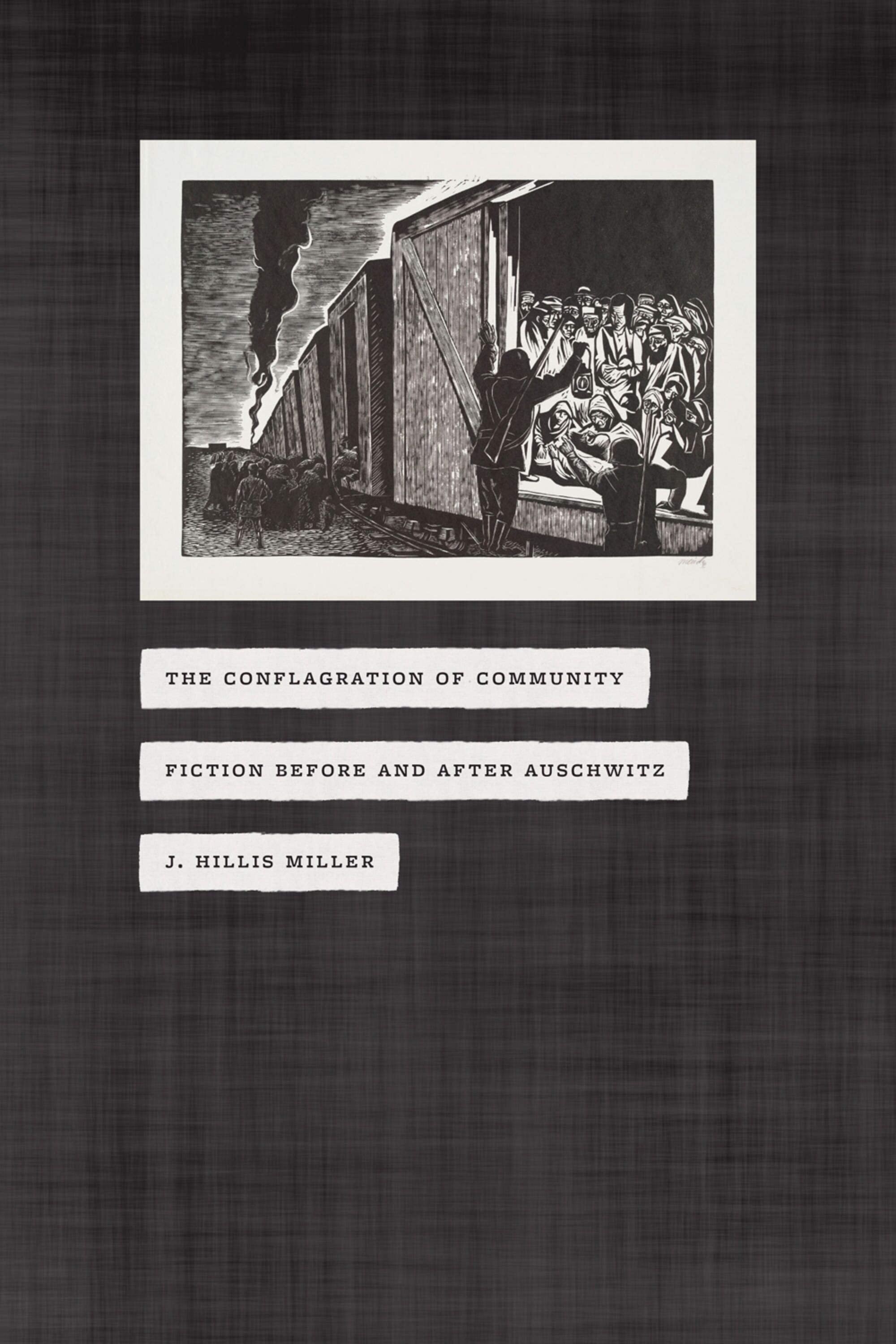
The conflagration of community
\"After Auschwitz to write even a single poem is barbaric.\" The Conflagration of Community challenges Theodor Adorno's famous statement about aesthetic production after the Holocaust, arguing for the possibility of literature to bear witness to extreme collective and personal experiences. J. Hillis Miller masterfully considers how novels about the Holocaust relate to fictions written before and after it, and uses theories of community from Jean-Luc Nancy and Derrida to explore the dissolution of community bonds in its wake.
Miller juxtaposes readings of books about the Holocaust—Keneally's Schindler's List, McEwan's Black Dogs, Spiegelman's Maus, and Kertész's Fatelessness—with Kafka's novels and Morrison's Beloved, asking what it means to think of texts as acts of testimony. Throughout, Miller questions the resonance between the difficulty of imagining, understanding, or remembering Auschwitz—a difficulty so often a theme in records of the Holocaust—and the exasperating resistance to clear, conclusive interpretation of these novels. The Conflagration of Community is an eloquent study of literature's value to fathoming the unfathomable.
eBook

Mischling : a novel
It's 1944 when the twin sisters arrive at Auschwitz with their mother and grandfather. In their benighted new world, Pearl and Stasha Zagorski take refuge in their identical natures, comforting themselves with the private language and shared games of their childhood. As part of the experimental population of twins known as Mengele's Zoo, the girls experience privileges and horrors unknown to others, and they find themselves changed, stripped of the personalities they once shared, their identities altered by the burdens of guilt and pain. That winter, at a concert orchestrated by Mengele, Pearl disappears. Stasha grieves for her twin, but clings to the possibility that Pearl remains alive.
BOOK

After Every War
They are nine women with much in common—all German speaking, all poets, all personal witnesses to the horror and devastation that was World War II. Yet, in this deeply moving collection, each provides a singularly personal glimpse into the effects of war on language, place, poetry, and womanhood.
After Every War is a book of translations of women poets living in Europe in the decades before and after World War II: Rose Ausländer, Elisabeth Langgässer, Nelly Sachs, Gertrud Kolmar, Else Lasker-Schüler, Ingeborg Bachmann, Marie Luise Kaschnitz, Dagmar Nick, and Hilde Domin. Several of the writers are Jewish and, therefore, also witnesses and participants in one of the darkest occasions of human cruelty, the Holocaust. Their poems, as well as those of the other writers, provide a unique biography of the time—but with a difference. These poets see public events through the lens of deep private losses. They chart the small occasions, the bittersweet family ties, the fruit dish on a table, the lost soul arriving at a railway station; in other words, the sheer ordinariness through which cataclysm is experienced, and by which life is cruelly shattered. They reclaim these moments and draw the reader into them.
The poems are translated and introduced, with biographical notes on the authors, by renowned Irish poet Eavan Boland. Her interest in the topic is not abstract. As an Irish woman, she has observed the heartbreaking effects of violence on her own country. Her experience has drawn her closer to these nine poets, enabling her to render into English the beautiful, ruminative quality of their work and to present their poems for what they are: documentaries of resilience—of language, of music, and of the human spirit—in the hardest of times.
eBook