
Catalogue Search | MBRL


Are you sure you want to remove the book from the shelf?

{{itemTitle}}
30,449
result(s) for
"Austen, Jane (1775-1817)"
Sort by:


Matters of Fact in Jane Austen
Discover the links between characters in Jane Austen novels and real-life celebrities of the time. Winner of the CHOICE Outstanding Academic Title of the Choice ACRL In Matters of Fact in Jane Austen: History, Location, and Celebrity, Janine Barchas makes the bold assertion that Jane Austen's novels allude to actual high-profile politicians and contemporary celebrities as well as to famous historical figures and landed estates. Barchas is the first scholar to conduct extensive research into the names and locations in Austen's fiction by taking full advantage of the explosion of archival materials now available online. According to Barchas, Austen plays confidently with the tension between truth and invention that characterizes the realist novel. Of course, the argument that Austen deployed famous names presupposes an active celebrity culture during the Regency, a phenomenon recently accepted by scholars. The names Austen plucks from history for her protagonists (Dashwood, Wentworth, Woodhouse, Tilney, Fitzwilliam, and many more) were immensely famous in her day. She seems to bank upon this familiarity for interpretive effect, often upending associations with comic intent. Barchas re-situates Austen's work closer to the historical novels of her contemporary Sir Walter Scott and away from the domestic and biographical perspectives that until recently have dominated Austen studies. This forward-thinking and revealing investigation offers scholars and ardent fans of Jane Austen a wealth of historical facts, while shedding an interpretive light on a new aspect of the beloved writer's work.
eBook


Jane Austen and the Enlightenment
Jane Austen was received by her contemporaries as a new voice, but her late twentieth-century reputation as a nostalgic reactionary still lingers on. In this radical revision of her engagement with the culture and politics of her age, Peter Knox-Shaw argues that Austen was a writer steeped in the Enlightenment, and that her allegiance to a sceptical tradition within it, shaped by figures such as Adam Smith and David Hume, lasted throughout her career. Knox-Shaw draws on archival and other neglected sources to reconstruct the intellectual atmosphere of the Steventon Rectory where Austen wrote her juvenilia, and follows the course of her work through the 1790s and onwards, showing how minutely responsive it was to the many shifting movements of those turbulent years. Jane Austen and the Enlightenment is an important contribution to the study both of Jane Austen and of intellectual history at the turn of the nineteenth century.
eBook


The Historical Austen
Selected byChoicemagazine as an Outstanding Academic Title Jane Austen, arguably the most beloved of all English novelists, has been regarded both as a feminist ahead of her time and as a social conservative whose satiric comedies work to regulate rather than to liberate. Such viewpoints, however, do not take sufficient stock of the historical Austen, whose writings, as William Galperin shows, were more properly oppositional rather than either disciplinary or subversive. Reading the history of her novels' reception through other histories-literary, aesthetic, and social-The Historical Austenis a major reassessment of Jane Austen's achievement as well as a corrective to the historical Austen that abides in literary scholarship. In contrast to interpretations that stress the conservative aspects of the realistic tradition that Austen helped to codify, Galperin takes his lead from Austen's contemporaries, who were struck by her detailed attention to the dynamism of everyday life. Noting how the very act of reading demarcates an horizon of possibility at variance with the imperatives of plot and narrative authority,The Historical Austensees Austen's development as operating in two registers. Although her writings appear to serve the interests of probability in representing \"things as they are,\" they remain, as her contemporaries dubbed them, histories of the present, where reality and the prospect of change are continually intertwined. In a series of readings of the six completed novels, in addition to the epistolaryLady Susanand the uncompletedSanditon, Galperin offers startling new interpretations of these texts, demonstrating the extraordinary awareness that Austen maintained not only with respect to her narrative practice-notably, free indirect discourse-but also with attention to the novel's function as a social and political instrument.
eBook


The Cambridge Companion to 'Pride and Prejudice'
Named in many surveys as Britain's best-loved work of fiction, Pride and Prejudice is now a global brand, with film and television adaptations making Elizabeth Bennet and Mr Darcy household names. With a combination of original readings and factual background information, this Companion investigates some of the sources of the novel's power. It explores key themes and topics in detail: money, land, characters and style. The history of the book's composition and first publication is set out, both in individual essays and in the section of chronology. Chapters on the critical reception, adaptations and cult of the novel reveal why it has become an enduing classic with a unique and timeless appeal.
eBook

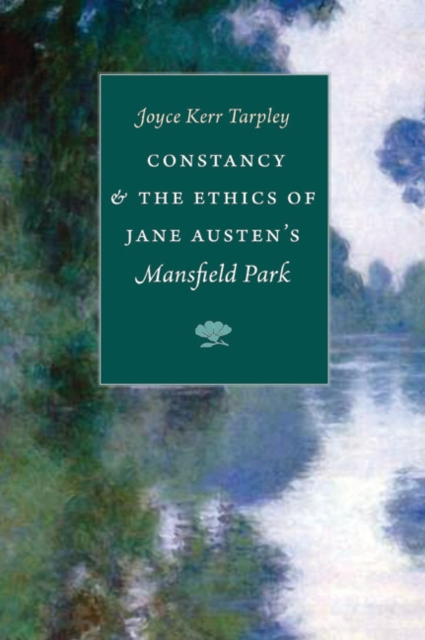
Constancy and the Ethics of Jane Austen's 'Mansfield Park'
Offers a rigorous philosophical examination of the novel. It begins with an introduction that provides a background for reading Austen's ethics, noting her genius for synthesis, in particular her synthesis of ethical contexts. The book brings together classical thinkers with Christian, and modern. While acknowledging these influences, it argues that constancy relies primarily on a Christian philosophical framework.
eBook