
Catalogue Search | MBRL


Are you sure you want to remove the book from the shelf?

{{itemTitle}}
3,472
result(s) for
"Australasia"
Sort by:

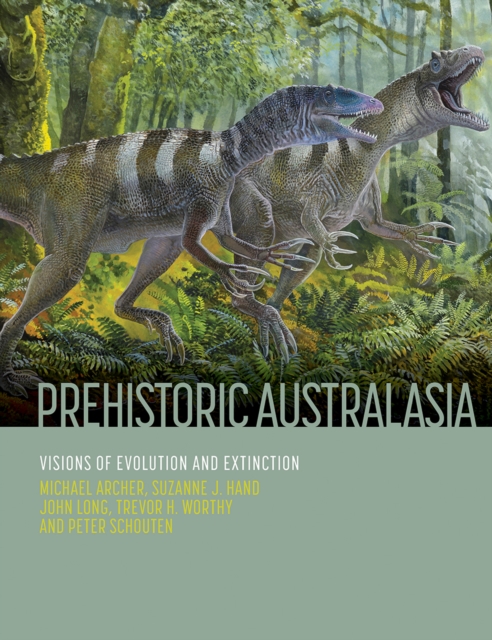
Prehistoric Australasia
For most of the past 300 million years, the world's continents were interlinked as the supercontinents Pangaea and then Gondwana. Around 50 million years ago, Australia tore itself free from Antarctica to become the huge, splendidly isolated island it is today. Over time, its creatures began to evolve in ways not seen anywhere else on Earth, with tree-climbing crocodiles, gigantic venomous lizards, walking omnivorous bats and flesh-eating kangaroos roaming the continent. Prehistoric Australasia: Visions of Evolution and Extinction presents some of the most extraordinary creatures the world has ever seen - all unique to Australia, New Guinea, New Zealand and their surrounding islands.Over 100 meticulously painted panoramas by palaeoartist Peter Schouten are accompanied by descriptions of the unique environments and features of these animals, written by four of Australia's foremost palaeontologists. This book explores the nature and timing of extinction events in the Southern Hemisphere, considers whether some of these losses might be able to be reversed, and how we can use the fossil record to help save today's critically endangered species.Through stunning artwork and fascinating text, Prehistoric Australasia brings this globally unique transformation over time to glorious, colourful life.FeaturesOffers fascinating glimpses into the prehistoric past of Australia, New Zealand and New Guinea.More than 100 paintings showcasing the changing biotas of Australasia over the last 3.6 billion years.Reveals the unique features of prehistoric animals and the environments where they lived.
eBook


Biogeography of Australasia
Over the last decade, molecular studies carried out on the Australasian biota have revealed a new world of organic structure that exists from submicroscopic to continental scale. Furthermore, in studies of global biogeography and evolution, DNA sequencing has shown that many large groups, such as flowering plants, passerine birds and squamates, have their basal components in this area. Using examples ranging from kangaroos and platypuses to kiwis and birds of paradise, the book examines the patterns of distribution and evolution of Australasian biodiversity and explains them with reference to tectonic and climatic change in the region. The surprising results from molecular biogeography demonstrate that an understanding of evolution in Australasia is essential for understanding the development of modern life on Earth. A milestone in the literature on this subject, this book will be a valuable source of reference for students and researchers in biogeography, biodiversity, ecology and conservation.
eBook



Corporate manslaughter by unsafe food: an Australasian perspective
This book promotes the relatively new concept of food manslaughter or manslaughter by unsafe food and is presented in light of the laws of Australia, Bangladesh and India with sporadic references to the laws of the United Kingdom, the United States and a few countries from the Asia-Pacific region. Analysis persuasively justifies the characterisation of this heinous crime as criminally negligent manslaughter considering the elements of the offence together with different theories of criminalisation and deterrence. This book provides novel research and is the first of its kind in the existing literature. It will be an immensely useful resource for researchers, academics, practitioners, prosecutors, regulators, and consumers in general to fight for the right to safe food.
eBook

Madness in the family : insanity and institutions in the Australasian colonial world, 1860-1914
\"Madness in the Family explores how colonial families coped with insanity through a trans-colonial study of the relationships between families and public colonial hospitals for the insane in New South Wales, Victoria, Queensland and New Zealand between 1860 and 1914\"--Provided by publisher.
Book

Selecting CMIP6 GCMs for CORDEX Dynamical Downscaling: Model Performance, Independence, and Climate Change Signals
Global climate models (GCMs) are essential for investigating climate change, but their coarse scale limits their efficacy for climate adaptation planning at the regional scales where climate impacts manifest. Dynamical downscaling of GCM outputs better resolves regional climate and thus provides improved guidance for climate policy at regional scales. Being expensive to run, downscaling uses a subset of GCMs, necessitating careful GCM selection. This evaluation identifies a suitable subset of CMIP6 GCMs for downscaling over Australia by assessing individual GCMs against three criteria: (a) performance simulating daily climate variable distributions, climate means, extremes, and modes; (b) model independence; and (c) climate change signal diversity. Over Australia, GCMs are generally biased cold (warm) for maximum (minimum) temperature, with larger biases for minimum temperature. GCMs are generally wet biased, especially over the monsoonal north, but dry biased over eastern regions. Most GCMs show larger biases for temperature and precipitation over geographically complex, heavily populated eastern regions, relative to other regions. Evaluations identify a distinct group of 11 GCMs that perform consistently poorly across climate variables, statistics, and timescales with widespread, statistically significant biases, versus 13 GCMs that show consistent adequate‐to‐good performance with substantially reduced errors. Assessment of model independence highlights the lack of independence between several high‐performing GCMs, particularly from allied modeling groups, demonstrating the importance of careful ensemble selection when making selective samples of climate space. Once GCM climate signal diversity is considered, 6–8 mid‐to‐high‐performing, independent GCMs occupy the full range of the future climate space and, thus, are suitable for dynamical downscaling over CORDEX‐Australasia. Key Points Per‐global climate model (GCM) performances varied markedly, though the best‐performing GCMs simulated consistently well across temperature variables and statistics Assessment of model independence highlights the lack of independence between several high‐performing GCMs Six to eight mid‐to‐high‐performing, independent GCMs capturing a broad range of the future climate space are identified as suitable for downscaling
Journal Article