
Catalogue Search | MBRL


Are you sure you want to remove the book from the shelf?

{{itemTitle}}
593
result(s) for
"Australia Military policy."
Sort by:

Island off the coast of Asia : instruments of statecraft in Australian foreign policy
\"This is an unprecedented 230-year study that reveals the full arsenal of Australian foreign policy: diplomacy, law, investment, research, negotiations, military force and espionage. It shows the central role of economic actors in defining and pursuing the \"national interest.\"--Provided by publisher.
Book
Australia's Defence Strategy
How would we know a good defence strategy if we saw one? The Asian Century is challenging many of the traditional assumptions at the heart of Australian defence policy and strategy. Defence scholars have risen to the challenge of these transformational times and have collectively produced a smorgasbord of alternatives for policy-makers. The problem is that these recommendations all point in very different directions. How should we evaluate these options? Adam Lockyer tackles this question and develops a novel conceptual framework for evaluating defence strategies. By doing so, this book breaks new theoretical ground and makes an important contribution to our understanding of strategy in general and defence strategy in particular. Lockyer then applies this analytical tool to the leading arguments in Australia's defence debate and finds that there is still substantial work to be done. Lockyer concludes by proposing a new Australian defence strategy for a contested Asia that would pass the test for a 'good' defence strategy. The result is essential reading for anyone interested in strategy or the future of Australian defence policy.
eBook


The conscription conflict and the Great War
But while the memory of the conscription campaigns once loomed large, it has increasingly been overshadowed by a preoccupation with the sacrifice and heroism of Australian soldiers a preoccupation that has been reinforced during the centennial commemorations.
eBook

Australian peacekeeping : sixty years in the field
\"Peacekeeping has been a significant part of Australia's overseas military engagement since the end of the Second World War. Yet it is part of our history that has been largely neglected until the 1990s, and even since then interest has been slow to develop. In the last sixty years, between 30,000 and 40,000 Australian military personnel and police have served in more than 50 peacekeeping missions in at least 27 different conflicts. From the first Australian mission to Indonesia in 1947 to operations in East Timor, Bosnia and Rwanda among others, this book finally gives Australian peacekeeping its proper status. This work approaches Australian peacekeeping from four angles: its history, its agencies, some personal reflections, and its future. Contributors discuss the distinction between peacekeeping and war-fighting, the importance of peacekeeping in terms of public policy, the problems of multinational command, and the specialist contributions of the military, civilian police, mine-clearers, weapons inspectors and diplomats. The collection concludes with experts in the field including Tim Ford, a former Military Adviser to the UN Secretary-General, and distinguished academic Ramesh Thakur offering their perspectives on future directions for Australian peacekeeping.\"--Provided by publisher.
Book


Geography, Power, Strategy and Defence Policy
Paul Dibb AM has had an extraordinary career. He enjoys an international scholarly reputation of the highest order, while at the same time he has done much distinguished public service. He was a pioneer in moving back and forth between posts in government departments, notably the Department of Defence, and academia. He began as a student of Soviet economic geography, and then spent nearly two decades in Australian Defence intelligence, including service as Head of the National Assessments Staff (NAS) in the Joint Intelligence Organisation (JIO) from 1974 to 1978, Deputy Director of JIO in 1978–80, Director of JIO in 1986–88, and Deputy Secretary of Defence (Strategy and Intelligence) in 1988–91, before becoming a Professor in the Strategic and Defence Studies Centre (SDSC) at The Australian National University (where he is now an Emeritus Professor). He has been quite happy to engage in vigorous public debate about important and controversial strategic and defence issues, giving him a high public profile. The contributors include two former Chancellors of ANU, one a former Minister of Defence, and the other a former Secretary of the Department of Defence, a former Chief of the Defence Force (CDF), and other former senior officials, as well as academic specialists in geography, international relations, and strategic and defence studies. ‘This would be a high-quality set of essays for any edited volume, but for a festschrift – a genre that sometimes generates uneven collections – this is an exceptional assembly. The individual pieces are very good; together, they have coherence and power.’ – Professor Ian Hall, Professor of International Relations, Griffith University
eBook

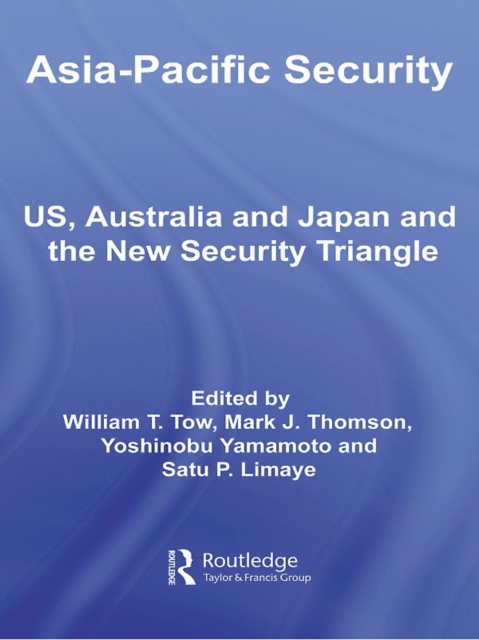
Asia-Pacific security : US, Australia and Japan and the new security triangle
The aim of this book is to explore the implications stemming from the recent upgrading of Australia-Japan-US security interactions and the implications for Asia-Pacific regional security that these represent. While a fully functioning trilateral security alliance binding Australia, Japan and the United States is unlikely to materialize or supplant existing bilateral arrangements, the convergence of the strategic interests of these three states makes it imperative that the full-range of such interests and the policy ramifications flowing from them warrants extensive investigation. The need to do so is particularly compelling given that the 'Trilateral Security Dialogue' is one of several contending recent approaches to reshaping Asia-Pacific regional security architectures and mechanisms for confronting new strategic challenges in a post-Cold War and post-9/11 environment. Key issues to be considered in this volume include the theoretical and empirical context of 'trilateralism'; the evolving history of the Australia-Japan-United States trilateral security relationship; its connection to and impact on the U.S. bilateral alliance network in Asia; how domestic politics in each country relates to regional security politics; Sino-Australian and Sino-Japanese bilateral security ties; arms control, maritime security and the ‘economic security nexus’. This book will be of much interest to all students of Asia-Pacific Security, US foreign policy, Asian politics and International Relations in general.
eBook