
Catalogue Search | MBRL


Are you sure you want to remove the book from the shelf?

{{itemTitle}}
218
result(s) for
"Australian labour movement"
Sort by:

Why Is There No Labor Party in the United States?
Why is the United States the only advanced capitalist country with no labor party? This question is one of the great enduring puzzles of American political development, and it lies at the heart of a fundamental debate about the nature of American society. Tackling this debate head-on, Robin Archer puts forward a new explanation for why there is no American labor party--an explanation that suggests that much of the conventional wisdom about \"American exceptionalism\" is untenable.
Conventional explanations rely on comparison with Europe. Archer challenges these explanations by comparing the United States with its most similar New World counterpart--Australia. This comparison is particularly revealing, not only because the United States and Australia share many fundamental historical, political, and social characteristics, but also because Australian unions established a labor party in the late nineteenth century, just when American unions, against a common backdrop of industrial defeat and depression, came closest to doing something similar.
Archer examines each of the factors that could help explain the American outcome, and his systematic comparison yields unexpected conclusions. He argues that prosperity, democracy, liberalism, and racial hostility often promoted the very changes they are said to have obstructed. And he shows that it was not these characteristics that left the United States without a labor party, but, rather, the powerful impact of repression, religion, and political sectarianism.
eBook

The Labour Movement and Co-operatives
Professor of Business and Labour History at the University of Sydney School of Business. The labour and co-operative movements are collective organisations that have similar roots and share a strong emphasis on democratic practices that seek to ensure the best for their community. There is both alignment and tensions in their relationship. Consumer co-operatives have supported unions and provided support to striking workers. However, co-operatives are also businesses that need to ensure financial survival. This has the potential to place co-operatives in conflict with organised labour particularly regarding labour costs. Workers may also have greater commitment to the organisation given that they are also part owners, particularly in the case of worker co-operatives. The co-operative ideal of \"political neutrality\" has also complicated the relationship between co-operatives and the labour movement. This paper will focus on some areas of alignment and tension between the labour movement and consumer retail and worker co-operatives drawing primarily on the Australian, Canadian, New Zealand, UK and US experience.
Journal Article
Revolutionary Ireland and Transnational Labour Solidarity on the Victorian Railways: The Case of Alex Morrison and Tom Wilson, 1921–22
In 1921, the Victorian railways became a site of contested loyalties surrounding the response of the Australian labour movement to the Irish revolution. This paper will examine the case of Alex Morrison and Tom Wilson, two non-Irish shop stewards of the Victorian Branch of the Australian Railways Union (ARU) victimised by the Lawson Government in March 1921 for publicly sympathising with Irish railway workers killed by the \"Black and Tans\" in Cork during the Anglo-Irish War. The controversy, which coincided with the birth of the Self-Determination for Ireland League, became a focus for both an Empire loyalist backlash and a labour movement defence campaign in the lead up to the 1921 State Election. It marked a moment at which the Irish crisis of 1916-23 catalysed organised campaign activity in the industrial wing, in addition to the political wing, of the Australian labour movement. Framed within the paradigm of international labour solidarity instead of Irish diaspora, the stance of Morrison and Wilson reflected the mutual entanglement of Irish-Australian and labour internationalist allegiances in the wake of both the Australian conscription plebiscites and the Russian Revolution. A \"view from below\" of the \"Irish Question\" in the Victorian railways presents an alternative, if parallel, form of transnational politicisation around Ireland to that of \"long-distance nationalism.\"
Journal Article
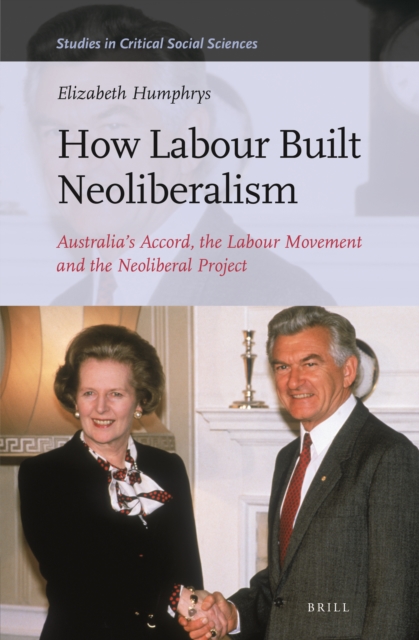
How Labour Built Neoliberalism
In How Labour Built Neoliberalism Elizabeth Humphrys examines the role of Labor Party and trade unions in constructing neoliberalism in Australia, and the implications of this for understanding neoliberalism's global advance.
eBook
Mutualism and Labourism in the Experience of Westfund
This paper explores the dynamic by which \"labourism\" potentially undermines \"mutualism\" by examining the experience of Westfund under Australian Labour Party governments. The principle of self-help and the act of organising to provide mutual benefits have strong traditions in the labour movement. Westfund was a health fund established in 1953 by the Western District Branch of the Miners' Federation in Lithgow New South Wales, largely to provide medical benefits to miners. Organised labour historically has also campaigned for state provision of welfare services. In Australia, the notion of \"Labourism\" refers to a particular approach adopted by organised labour whereby they represented their interests directly in the political sphere through the Australian Labor Party. When the labour movement achieved its aim of a more universal health care system under the Whitlam ALP government, Westfund chose to work within the system in order to survive. Mutualism and labourism co-existed. The subsequent introduction of Medicare by the Hawke ALP government brought changes which created a more threatening business environment for health funds. In this instance to mitigate the danger it posed to their business, Westfund chose to oppose more aggressively aspects of the universal health system. Westfund weakened its institutional ties to the labour movement, and became more autonomous from its roots as a mutual.
Journal Article

Social movements and the Whitlam-initiated community health movement in Australia
BackgroundThis paper examines the social movements that influenced the development and implementation of the original Whitlam Government Community Health Program, the community health movement that emerged, and the opportunities it created for people to develop and deliver health programs in new ways.MethodsOral history interviews with 93 people involved in community health in South Australia, Victoria and New South Wales, and 212 community health policy and archival documents were collected as a part of an Australian Research Council study documenting the history of community health services in Australia since the 1970s.ResultsIdeas about community health in Australia were influenced by several social movements that had overlapping, but distinctive, contributions: (1) left-wing movements: political parties, workers’ health; trade unions, anti-war and anti-establishment; (2) international social medicine and community-oriented primary care; (3) Indigenous rights/Black Power; (4) feminist; and (5) community development/community power. These movements influenced Australian community health to embrace community management, advocacy and community development strategies in addition to multi-disciplinary care. However, these progressive elements were undermined by neo-liberal management reforms and medical opposition to elements of the Community Health Program.ConclusionsThe early passion for community health in the 1970s and 1980s was fuelled by social movements, but the inconsistent support from the federal and most state governments limited progressive and innovative community health practice. The window of opportunity for the Community Health Program was supported by progressive social movements, but restricted from the 1990s onwards.
Journal Article
What Did We Want? Debates within the Australian Nuclear Disarmament Movement in the 1980s
In the 1980s, a large, diverse and vibrant nuclear disarmament movement rose again in Australia. This article uses findings from archival research and interviews conducted by the author over a number of years to show that strategy in the movement was contested and the movement's debates and internal development had a substantial impact on its rise and decline. The views of movement activists about how to campaign for its demands, in particular, for the closure of nuclear war-fighting bases in the country, differed greatly. The appearance of the Nuclear Disarmament Party highlighted divergent views that had arisen in the movement about how to relate to the Australian Labor Party. A potential for alternative political and social leadership underlay the insurgent movement's debates and differences.
Journal Article
Clyde Cameron: An Architect of “The Great Labor Schism”
South Australian Labor MHR Clyde Cameron had a huge impact on the fortunes of the Australian Labor Party in the post-war period. When he died in 2008, he was most remembered as having been a \"numbers man\" of the 1950s and 1960s who had done more than any other, excepting Whitlam himself, to secure a victory for that party at the watershed federal elections in December 1972. Yet Cameron figured just as decisively, albeit less conspicuously, in the Labor split of the mid-1950s that did much to consign the Party to opposition at the federal level for more than a generation. Cameron's commitment to the ALP's socialisation objective and his antipathy toward those anti-communists who were either hostile or just indifferent to it compelled him to oppose The Movement and the industrial groups, from the mid-1940s in South Australia and thereafter in all states. His commitment to what he saw as Labor's most cherished goal never wavered, even when the party to which he had devoted his life turned against it in the mid and late 1980s.
Journal Article
Completing the Order's History Down Under: The Knights of Labor in Australia
The rise and fall of an American movement, the Noble and Holy Order of the Knights of Labor, in the Australian colonies between the 1880s and the 1900s is a neglected chapter in labour history. This unusual movement, at once a fraternal order, trade union, political grouping and co-operative enterprise, became the first truly national organisation of American workers. The Knights also became a global movement with branches in England, Wales, Ireland, Scotland, France, Belgium, South Africa, New Zealand and Australia. Scholars have explored the parameters of the Order's North American history in great detail. They have not given anywhere near the same level of scrutiny to the Order's history in other parts of the world, however, and this discrepancy is particularly striking when it comes to their branches in Australia. Australian labour historians have never neglected the American ideas, individuals and institutions that helped to shape the early history of the Australian labour movement. Henry George, Edward Bellamy, Laurence Gronlund, Daniel De Leon and the Industrial Workers of the World, amongst others, all have major studies devoted to their activities and influence in Australia. The Australian Knights of Labor, by contrast, have been the subject of only several pages in a small selection of books and articles. This article provides their future historian with the necessary material to fill this gap in the scholarship and mount a proper study of their history. It provides a narrative of their activities in the various Australian colonies, so far as we can ascertain them, and draws attention to the many holes and unclear parts of that narrative. It then provides a series of questions to inform future research into the Australian Knights, compares with them with the histories of Knights in other non-American countries, and connects them to wider fields of historical scholarship, including imperial and global labour history. This article is, in other words, the first sustained study of the Australian Knights of Labor; it also provides the foundation from which a larger study might hopefully come.
Journal Article

Second to None in the International Fight
The participation of trade unions in the anti-apartheid movement is a subject which arguably merits more attention. This article brings into focus a group of unionists whose activism against apartheid was in the forefront of key initiatives. Drawing on new research the argument recounts the role of Australian seafarers on the international stage, particularly its association with the World Federation of Trade Unions (WFTU), and shows how knowledge of events in South Africa passed from the WFTU to educate the union membership. By the 1980s, Australian seafarers were taking the lead in bringing European unionists together in united action to enforce the United Nations’ embargo on oil supplies to South Africa by founding a new organization, the Maritime Unions Against Apartheid (MUAA). Reconstructing these events demonstrates two aspects of significance: the growing importance of monitoring shipping as an anti-apartheid strategy coordinated and led by European unions, which we point out relied on ships’ officers and crews for knowledge, and the breaking down of the ideological divide between the WFTU and the anti-Communist International Confederation of Free Trade Unions (ICFTU) working together in the MUAA. The article contributes new understanding of connections between anti-apartheid activism and its Cold War context.
Journal Article