
Catalogue Search | MBRL


Are you sure you want to remove the book from the shelf?

{{itemTitle}}
599
result(s) for
"Authorship Data processing."
Sort by:

Who wrote this? : how AI and the lure of efficiency threaten human writing
\"Would you read this book if a computer wrote it? Would you even know? And why would it matter? Today's eerily impressive artificial intelligence writing tools present us with a crucial challenge: As writers, do we unthinkingly adopt AI's time-saving advantages or do we stop to weigh what we gain and lose when heeding their siren call? To understand how AI is redefining what it means to write and think, linguist and educator Naomi Baron leads us on a journey connecting the dots between human literacy and today's technology. From nineteenth century lessons in composition, to mathematician Alan Turing's work creating a machine for deciphering war-time messages, to contemporary engines like ChatGPT, Baron gives readers a spirited overview of the emergence of both literacy and AI, and a glimpse of their possible future. As the technology becomes increasingly sophisticated and fluent, it's tempting to take the easy way out and let AI do the work for us. Baron cautions that such efficiency isn't always in our interest. As AI plies us with suggestions or full-blown text, we risk losing not just our technical skills but the power of writing as a springboard for personal reflection and unique expression. Funny, informed, and conversational, Who Wrote This? urges us as individuals and as communities to make conscious choices about the extent to which we collaborate with AI. The technology is here to stay. Baron shows us how to work with AI and how to spot where it risks diminishing the valuable cognitive and social benefits of being literate\"-- Provided by publisher.
Book
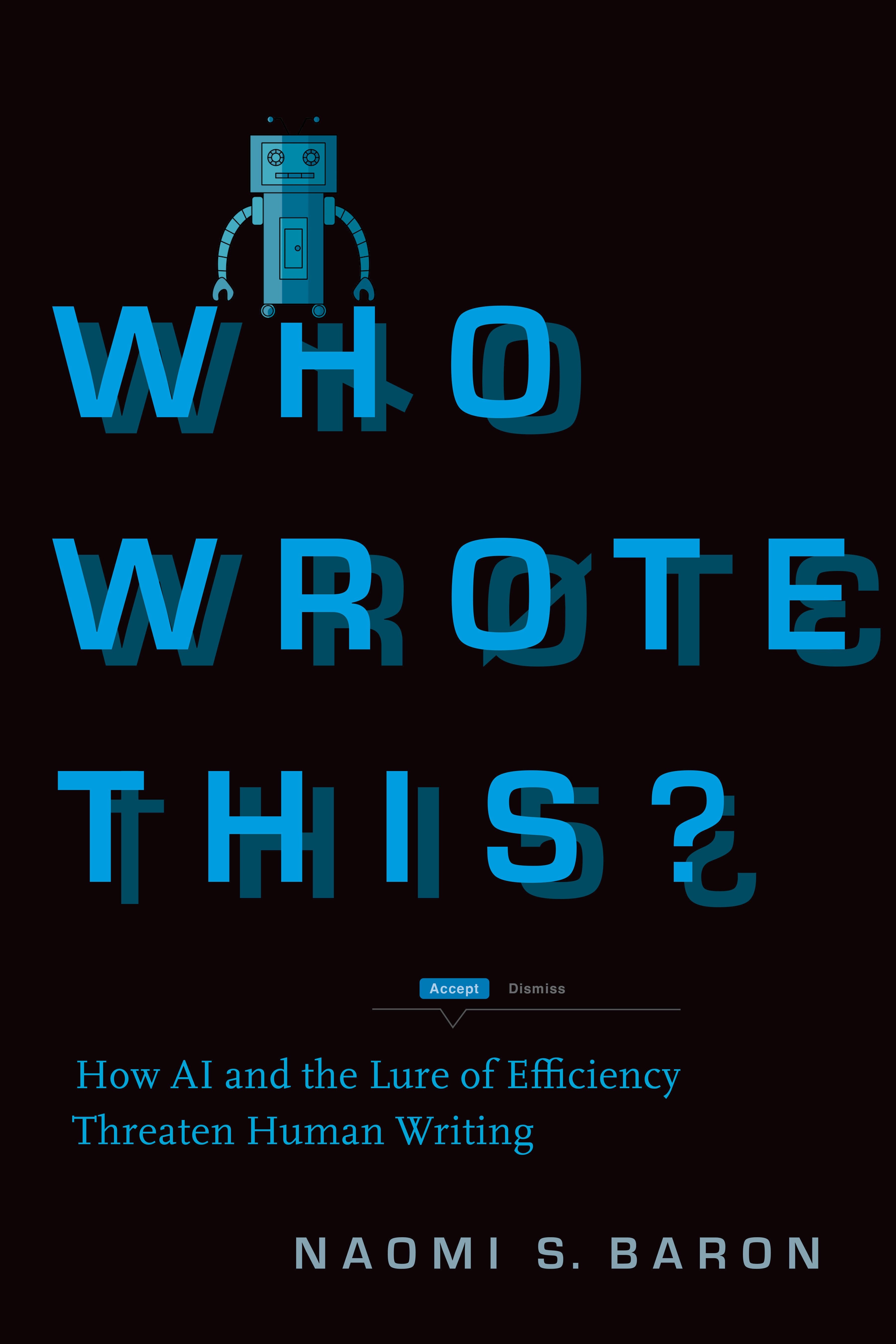
Who Wrote This?
Would you read this book if a computer wrote it? Would you even know? And why would it matter? Today's eerily impressive artificial intelligence writing tools present us with a crucial challenge: As writers, do we unthinkingly adopt AI's time-saving advantages or do we stop to weigh what we gain and lose when heeding its siren call? To understand how AI is redefining what it means to write and think, linguist and educator Naomi S. Baron leads us on a journey connecting the dots between human literacy and today's technology. From nineteenth-century lessons in composition, to mathematician Alan Turing's work creating a machine for deciphering war-time messages, to contemporary engines like ChatGPT, Baron gives readers a spirited overview of the emergence of both literacy and AI, and a glimpse of their possible future. As the technology becomes increasingly sophisticated and fluent, it's tempting to take the easy way out and let AI do the work for us. Baron cautions that such efficiency isn't always in our interest. As AI plies us with suggestions or full-blown text, we risk losing not just our technical skills but the power of writing as a springboard for personal reflection and unique expression. Funny, informed, and conversational, Who Wrote This? urges us as individuals and as communities to make conscious choices about the extent to which we collaborate with AI. The technology is here to stay. Baron shows us how to work with AI and how to spot where it risks diminishing the valuable cognitive and social benefits of being literate.
eBook

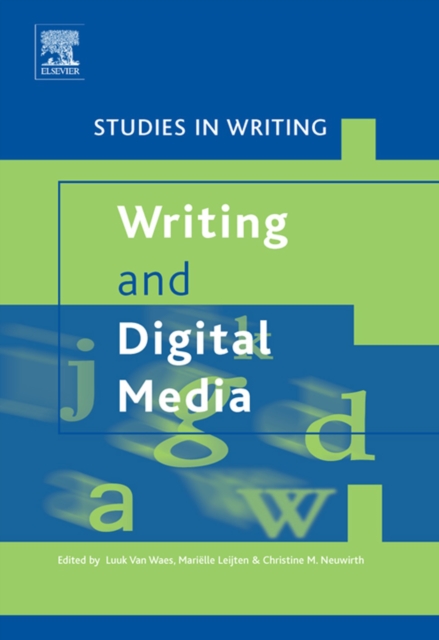
Writing and Digital Media
This indispensible volume reviews outstanding European, American and Australian research in the cognitive, social and cultural implications of writing for digital media. It addresses writing modes and environments, writing and communication, digital tools for writing research, online educational environments, and social and philosophical aspects.
eBook


Computing as Writing
This book examines the common metaphor that equates computing and writing, tracing it from the naming of devices (\"notebook\" computers) through the design of user interfaces (the \"desktop\") to how we describe the work of programmers (\"writing\" code).Computing as Writingponders both the implications and contradictions of the metaphor.
During the past decade, analysis of digital media honed its focus on particular hardware and software platforms. Daniel Punday argues that scholars should, instead, embrace both the power and the fuzziness of the writing metaphor as it relates to computing-which isn't simply a set of techniques or a collection of technologies but also anideathat resonates throughout contemporary culture. He addresses a wide array of subjects, including film representations of computing (Desk Set, The Social Network), Neal Stephenson's famous open source manifesto, J. K. Rowling's legal battle with a fan site, the sorting of digital libraries, subscription services like Netflix, and the Apple versus Google debate over openness in computing.
Punday shows how contemporary authors are caught between traditional notions of writerly authority and computing's emphasis ondoingthings with writing. What does it mean to be a writer today? Is writing code for an app equivalent to writing a novel? Should we change how we teach writing? Punday's answers to these questions and others are original and refreshing, and push the study of digital media in productive new directions.
eBook

Digital rhetoric : theory, method, practice
\"What is 'digital rhetoric'? This book aims to answer that question by looking at a number of inter-related histories, as well as evaluating a wide range of methods and practices from fields in the humanities, social sciences, and information sciences to determine what might constitute the work and the world of digital rhetoric. The advent of digital and networked communication technologies prompts renewed interest in basic questions such as 'what counts as a text?' and 'can traditional rhetoric operate in digital spheres or will it need to be revised? Or will we need to invent new rhetorical practices altogether?' Through examples and consideration of digital rhetoric theories, methods for both researching and making in digital rhetoric fields, and examples of digital rhetoric pedagogy, scholarship, and public performance, this book aims to provides a broad overview of digital rhetoric by investigating the histories and boundaries that arise from one version of a map of the emerging field, focusing on the theories that are taken up and revised by digital rhetoric scholars and practitioners, as well as the methods (both traditional and new) that can be used to both study digital rhetoric and to potentially make new forms that draw on digital rhetoric for their persuasive power\"-- Provided by publisher.
Book


The Columbia guide to online style
The Columbia Guide to Online Style is the standard resource for citing electronic and electronically accessed sources. It is also a critical style guide for creating documents electronically for submission for print or electronic publication. Updated and expanded, this guide now explains how to cite technologies such as Web logs and pod casts; provides more guidance on translating the elements of Columbia Online Style (COS) citations for use with existing print-based formats (such as MLA, APA, and Chicago); and features additional guidelines for producing online and print documents based on new standards of markup language and publication technologies. This edition also includes new bibliographic styles for humanities and scientific projects; examples of footnotes and endnotes for Chicago-style papers; greater detail regarding in-text and parenthetic reference and footnote styles; an added chapter on how to locate and evaluate sources for research in the electronic age; and new examples for citing full-text or full-image articles from online library databases, along with information on how to credit the source of graphics and multimedia files. Staying ahead of rapidly evolving technologies, The Columbia Guide to Online Style continues to be a vital tool for online researchers.
eBook
