
Catalogue Search | MBRL


Are you sure you want to remove the book from the shelf?

{{itemTitle}}
492
result(s) for
"Autism Pathophysiology."
Sort by:


The neurobiology of autism
In the decade since the first edition of The Neurobiology of Autism was published, research has revealed valuable new information about the nature and origins of autism, including genetics and abnormalities in such neurotransmitters as acetylcholine and serotonin. For this long-anticipated new edition, neurologists Margaret L. Bauman and Thomas L. Kemper bring together leading researchers and clinicians to present the most current scientific knowledge and theories about autism. The contributors cover genetics, imaging studies, physiology, neuroanatomy and neurochemistry, immunology, brain function, the epidemiology of the disease, and related disorders. Thoroughly updated, The Neurobiology of Autism remains the best single-volume work on the wide array of research being conducted into the causes, characteristics, and treatment of autism. Contributors: George M. Anderson, Yale Child Study Center; Tara L. Arndt, University of Rochester Medical Center (URMC); Trang Au, University of Massachusetts Medical School (UMMC); Jocelyne Bachevalier, University of Texas Health Science Center; Irina N. Bespalova, Seaver Autism Research Center, Mt. Sinai School of Medicine (SARC); Gene J. Blatt, Boston University School of Medicine (BUSM); Susan E. Bryson, IWK Health Centre–Dalhousie University; Timothy M. Buie, Massachusetts General Hospital (MGH); Joseph D. Buxbaum, SARC; Kathryn M. Carbone, The Johns Hopkins University School of Medicine (JHUSM); Diane C. Chugani, Wayne State University; Daniel F. Connor, UMMC; Edwin H. Cook, Jr., University of Chicago; S. Hossein Fatemi, University of Minnesota Medical School; Susan E. Folstein, Tufts University School of Medicine; Eric Fombonne, McGill University; Randi Jenssen Hagerman, UC Davis Medical Center; Elizabeth Petri Henske, Fox Chase Cancer Center, Philadelphia; Jeannette J. A. Holden, Queen's University; Ronald J. Killiany, BUSM; Omanand Koul, UMMC; Mandy Lee, Newcastle General Hospital, U.K.; Xudong Liu, Queen's University; Tara L. Moore, BUSM; Mark B. Moss, BUSM; Karin B. Nelson, National Institute of Neurological Disorders and Stroke; Phillip G. Nelson, National Institute of Child Health and Human Development; Elaine Perry, Newcastle General Hospital; Jonathan Pevsner, JHUSM; Mikhail V. Pletnikov, JHUSM; Stephen W. Porges, University of Illinois at Chicago; Lucio Rehbein, Universidad de la Frontera, Chile; Jennifer Reichert, SARC; Patricia M. Rodier, URMC; Beth Rosen-Sheidley, MGH; Susan L. Smalley, UCLA Neuropsychiatric Research Institute; Ronald J. Steingard, UMMC; Helen Tager-Flusberg, BUSM; Gary L. Wenk, University of Arizona; Andrew W. Zimmerman, JHUSM
eBook

Memory in autism : theory and evidence
Many people with autism spectrum disorders (ASD) are remarkably proficient at remembering how things look and sound and are good at rote learning. However, all ASD sufferers have poor ability to recall personal memories and relive experiences. This book assembles research to examine why this happens and the effects it has.
BOOK
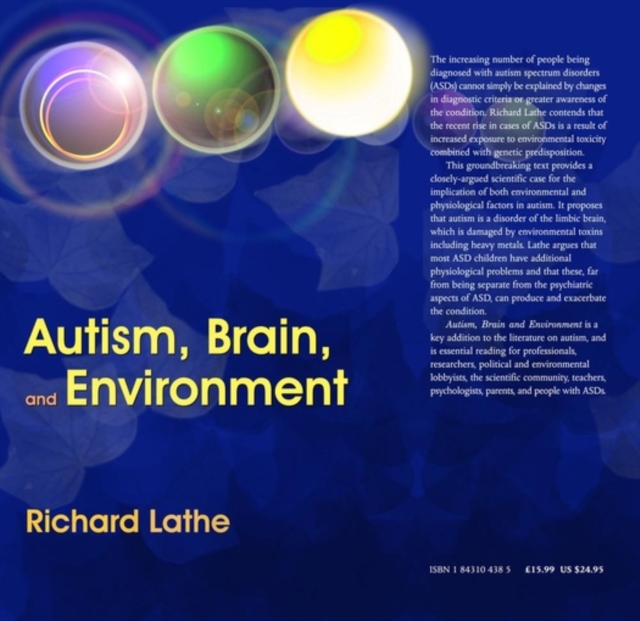
Autism, brain, and environment
The increasing number of people being diagnosed with autism spectrum disorders (ASDs) cannot simply be explained by changes in diagnostic criteria or greater awareness of the condition. In this controversial new book, Richard Lathe contends that the recent rise in cases of ASDs is a result of increased exposure to environmental toxicity combined with genetic predisposition. Autism, Brain, and Environment proposes that autism is a disorder of the limbic brain, which is damaged by toxic heavy metals present in the environment. Lathe argues that most ASD children have additional physiological problems and that these, far from being separate from the psychiatric aspects of ASD, can produce and exacerbate the condition. This important and groundbreaking text provides a closely-argued scientific case for the involvement of both environmental and physiological factors in autism. Lathe's argument will also have a direct impact on treatment strategies and options. It will be of great interest to the scientific community, professionals, researchers, political and environmental lobbyists, teachers, psychologists, and parents and people with ASDs.
eBook

Pathophysiologic similarities between autism spectrum disorder and Alzheimer's disease: therapeutic possibilities
The comparison of autism spectrum disorder (ASD) and Alzheimer's disease (AD) through shared pathophysiologic features offers intriguing insights into the similarities between the two disease states. The authors suggest diminished cerebrospinal fluid (CSF) drainage through the lymphatic system, perivascular system, and nasal turbinates may occur in ASD and AD, and be an important contributing factor in the occurrence of both disorders. Obstruction of the CSF's normal nasal lymphatic drainage results in abnormal processing of the waste proteins tau and amyloid in the brain in both of these disease states. Reproducible research has shown that ASD and AD patients, when compared to normal controls, exhibit increased extra-axial CSF, enlarged perivascular spaces, magnetic resonance imaging evidence of glymphatic dysfunction, and olfactory dysfunction. Some comparisons between the two disease states are robust while others remain speculative. However, the recognition of overlapping pathophysiologic and genetic features between the two disease states not only furthers understanding of these complex conditions, but could also pave the way for novel therapeutic avenues. The goal of this article is to demonstrate the empirically known similarities between ASD and AD and to stimulate research investigating CSF lymphatic drainage through the nasal turbinates. The authors suggest various ways to confirm their findings and provide suggestions for new therapeutic approaches for these disease states aimed at increasing the movement of CSF originating in the brain through the glymphatic system to meningeal and nasal turbinate lymphatics.
Journal Article


Oxidative Stress in Autism Spectrum Disorder
According to the United States Centers for Disease Control and Prevention (CDC), as of July 11, 2016, the reported average incidence of children diagnosed with an autism spectrum disorder (ASD) was 1 in 68 (1.46%) among 8-year-old children born in 2004 and living within the 11 monitoring sites’ surveillance areas in the United States of America (USA) in 2012. ASD is a multifaceted neurodevelopmental disorder that is also considered a hidden disability, as, for the most part; there are no apparent morphological differences between children with ASD and typically developing children. ASD is diagnosed based upon a triad of features including impairment in socialization, impairment in language, and repetitive and stereotypic behaviors. The increasing incidence of ASD in the pediatric population and the lack of successful curative therapies make ASD one of the most challenging disorders for medicine. ASD neurobiology is thought to be associated with oxidative stress, as shown by increased levels of reactive oxygen species and increased lipid peroxidation, as well as an increase in other indicators of oxidative stress. Children with ASD diagnosis are considered more vulnerable to oxidative stress because of their imbalance in intracellular and extracellular glutathione levels and decreased glutathione reserve capacity. Several studies have suggested that the redox imbalance and oxidative stress are integral parts of ASD pathophysiology. As such, early assessment and treatment of antioxidant status may result in a better prognosis as it could decrease the oxidative stress in the brain before it can induce more irreversible brain damage. In this review, many aspects of the role of oxidative stress in ASD are discussed, taking into account that the process of oxidative stress may be a target for therapeutic interventions.
Journal Article

Transcriptome-wide isoform-level dysregulation in ASD, schizophrenia, and bipolar disorder
Most genetic risk for psychiatric disease lies in regulatory regions, implicating pathogenic dysregulation of gene expression and splicing. However, comprehensive assessments of transcriptomic organization in diseased brains are limited. In this work, we integrated genotypes and RNA sequencing in brain samples from 1695 individuals with autism spectrum disorder (ASD), schizophrenia, and bipolar disorder, as well as controls. More than 25% of the transcriptome exhibits differential splicing or expression, with isoform-level changes capturing the largest disease effects and genetic enrichments. Coexpression networks isolate disease-specific neuronal alterations, as well as microglial, astrocyte, and interferon-response modules defining previously unidentified neural-immune mechanisms. We integrated genetic and genomic data to perform a transcriptome-wide association study, prioritizing disease loci likely mediated by cis effects on brain expression. This transcriptome-wide characterization of the molecular pathology across three major psychiatric disorders provides a comprehensive resource for mechanistic insight and therapeutic development.
Journal Article

The Role of Nutrition, Oxidative Stress, and Trace Elements in the Pathophysiology of Autism Spectrum Disorders
Autism spectrum disorder (ASD) is a neurodevelopmental condition characterized by deficits in social communication and interaction, alongside repetitive behaviors, and atypical sensory-motor patterns. The growing prevalence of ASD has driven substantial advancements in research aimed at understanding its etiology, preventing its onset, and mitigating its impact. This ongoing effort necessitates continuous updates to the body of knowledge and the identification of previously unexplored factors. The present study addresses this need by examining the roles of nutrition, oxidative stress, and trace elements in the pathophysiology of ASD. In this review, an overview is provided of the key dietary recommendations for individuals with ASD, including gluten-free and casein-free (GFCF) diets, ketogenic diets (KDs), and other nutritional interventions. Furthermore, it explores the involvement of oxidative stress in ASD and highlights the significance of trace elements in maintaining neuropsychiatric health. The impact of these factors on molecular and cellular mechanisms was discussed, alongside therapeutic strategies and their efficacy in managing ASD.
Journal Article

Altered mGluR5-Homer scaffolds and corticostriatal connectivity in a Shank3 complete knockout model of autism
Human neuroimaging studies suggest that aberrant neural connectivity underlies behavioural deficits in autism spectrum disorders (ASDs), but the molecular and neural circuit mechanisms underlying ASDs remain elusive. Here, we describe a complete knockout mouse model of the autism-associated
Shank3
gene, with a deletion of exons 4–22 (Δe4–22). Both mGluR5-Homer scaffolds and mGluR5-mediated signalling are selectively altered in striatal neurons. These changes are associated with perturbed function at striatal synapses, abnormal brain morphology, aberrant structural connectivity and ASD-like behaviour.
In vivo
recording reveals that the cortico-striatal-thalamic circuit is tonically hyperactive in mutants, but becomes hypoactive during social behaviour. Manipulation of mGluR5 activity attenuates excessive grooming and instrumental learning differentially, and rescues impaired striatal synaptic plasticity in Δe4–22
−/−
mice. These findings show that deficiency of Shank3 can impair mGluR5-Homer scaffolding, resulting in cortico-striatal circuit abnormalities that underlie deficits in learning and ASD-like behaviours. These data suggest causal links between genetic, molecular, and circuit mechanisms underlying the pathophysiology of ASDs.
SHANK3 mutations have been linked to autism spectrum disorders, although the underlying mechanisms remain unclear. Here, the authors generate a complete knockout Shank3 mouse model, identifying ASD-like behaviours associated with impaired mGluR5-Homer scaffolding and abnormal brain connectivity.
Journal Article