
Catalogue Search | MBRL


Are you sure you want to remove the book from the shelf?

{{itemTitle}}
56
result(s) for
"Autochtones Communication."
Sort by:

The new media nation : indigenous peoples and global communication
\"Around the planet, Indigenous people are using old and new technologies to amplify their voices and broadcast information to a global audience. This is the first portrait of a powerful international movement that looks both inward and outward, helping to preserve ancient languages and cultures while communicating across cultural, political, and geographical boundaries. Based on more than twenty years of research, observation, and work experience in Indigenous journalism, film, music, and visual art, this volume includes specialized studies of Inuit in Nunavut and the circumpolar north, and First Nations peoples in the Yukon.\"--Jacket.
Book


Producing Sovereignty
Exploring how Indigenous media has flourished across
Canada from the 1990s to the present
In the early 1990s, Indigenous media experienced a boom across
Canada, resulting in a vast landscape of film, TV, and digital
media. Coinciding with a resurgence of Indigenous political
activism, Indigenous media highlighted issues around sovereignty
and Indigenous rights to broader audiences in Canada. In
Producing Sovereignty, Karrmen Crey considers the
conditions-social movements, state policy, and evolutions in
technology-that enabled this proliferation.
Exploring the wide field of media culture institutions, Crey
pays particular attention to those that Indigenous media makers
engaged during this cultural moment, including state film agencies,
arts organizations, provincial broadcasters, and more.
Producing Sovereignty ranges from the formation of the
Aboriginal Film and Video Art Alliance in the early 1990s and its
partnership with the Banff Centre for the Arts to the Canadian
Broadcasting Corporation's 2016 production of Highway of
Tears -an immersive 360-degree short film directed by
Anishinaabe filmmaker Lisa Jackson-highlighting works by Indigenous
creators along the way and situating Indigenous media within
contexts that pay close attention to the role of media-producing
institutions.
Importantly, Crey focuses on institutions with limited scholarly
attention, shifting beyond the work of the National Film Board of
Canada to explore lesser-known institutions such as educational
broadcasters and independent production companies that create
programming for the Aboriginal Peoples Television Network. Through
its refusal to treat Indigenous media simply as a set of cultural
aesthetics, Producing Sovereignty offers a revealing media
history of this cultural moment.
eBook

Settler Aesthetics
In Settler Aesthetics , an analysis of renowned director
Terrence Malick's 2005 film, The New World , Mishuana
Goeman examines the continuity of imperialist exceptionalism and
settler-colonial aesthetics. The story of Pocahontas has thrived
for centuries as a cover for settler-colonial erasure, destruction,
and violence against Native peoples, and Native women in
particular. Since the romanticized story of the encounter and
relationship between Pocahontas and Captain John Smith was first
published, it has imprinted a whitewashed historical memory into
the minds of Americans. As one of the most enduring tropes of
imperialist nostalgia in world history, Renaissance European
invasions of Indigenous lands by settlers trades in a falsified
\"civilizational discourse\" that has been a focus in literature for
centuries and in films since their inception. Ironically, Malick
himself was a symbol of the New Hollywood in his early career, but
with The New World he created a film that serves as a
buttress for racial capitalism in the Americas. Focusing on settler
structures, the setup of regimes of power, sexual violence and the
gendering of colonialism, and the sustainability of colonialism and
empires, Goeman masterfully peels away the visual layers of settler
logics in The New World , creating a language in Native
American and Indigenous studies for interpreting visual media.
eBook
Indigiqueerness
Evolving from a conversation between Joshua Whitehead and Angie Abdou, Indigiqueerness is part dialogue, part collage, and part memoir. Beginning with memories of his childhood poetry and prose and travelling through the library of his life, Whitehead contemplates the role of theory, Indigenous language, queerness, and fantastical worlds in all his artistic pursuits. This volume is imbued with Whitehead’s energy and celebrates Indigenous writers and creators who defy expectations and transcend genres.
eBook
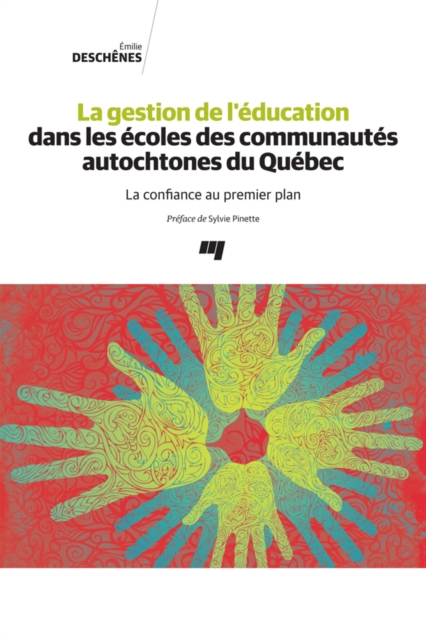
La Gestion de l'éducation Dans les écoles des Communautés Autochtones du Québec
Le present ouvrage propose une reflexion sur des modeles contemporains de gestion des ecoles en milieux multiculturels et autochtones. Dans ces etablissements, l'interculturalite influence presque toutes les actions des directions. Allant au-dela des aspects habituels de la recherche en gestion de l'education, l'auteure aborde des dimensions nouvelles qui mettent en lumiere la nature, le sens et la portee des interventions et des pratiques des directions dans ces environnements singuliers, marques par l'histoire de la colonisation et de la scolarisation, de meme que par des enjeux lies a l'appartenance et a l'identite des eleves comme des membres du personnel. L'auteure se penche sur les dfis particuliers de ces milieux, mconnus et peu documents, rapports par des directions d'coles autochtones, dont: la confiance interpersonnelle et les conditions de sa cration; la fonction et les rles de la direction d'tablissement; les effets et les facteurs de russite et d'chec des initiatives ainsi que des pratiques locales. Ces dfis les limitent dans leurs activits au quotidien. Pourtant, leur rle est dterminant dans ce systme scolaire du point de vue de l'efficacit de l'enseignement, de la russite ducative des lves et de la persvrance scolaire. Notamment grce la collaboration de plus d'une vingtaine de directions d'cole exerant en contexte autochtone, l'auteure propose une incursion au cA ur de cet environnement, o les enjeux culturels, ducatifs ou communicationnels sont nombreux. Ce livre, qui propose des pistes thoriques et des pratiques indites, intressera les directions et les professionnels travaillant dans des milieux autochtones, multiculturels ou multiethniques, mais aussi les chercheurs universitaires de ce domaine de l'ducation pour lequel l'interculturalit joue un rle fondamental. milie Deschnes, MBA, Ph. D., est professeure l'cole d'tudes autochtones de l'Universit du Qubec en Abitibi-Tmiscamingue. Elle possde plus d'une quinzaine d'annes d'exprience dans le domaine de l'ducation, plus prcisment en enseignement et en gestion de l'ducation, de mme qu'en confiance interpersonnelle dans les milieux autochtones et multiculturels. Elle a enseign et a t membre de plusieurs quipes de direction dans diverses communauts et nations au Canada et ailleurs.
eBook

Indigenous Graphic Communication Systems
Indigenous Graphic Communication Systems challenges the adequacy of Western academic views on what writing is and explores how they can be expanded by analyzing the sophisticated graphic communication systems found in Central Mesoamerica and Andean South America. By examining case studies from across the Americas, the authors pursue an enhanced understanding of Native American graphic communication systems and how the study of graphic expression can provide insight into ancient cultures and societies, expressed in indigenous words. Focusing on examples from Central Mexico and the Andes, the authors explore the overlap among writing, graphic expression, and orality in indigenous societies, inviting reevaluation of the Western notion that writing exists only to record language (the spoken chain of speech) as well as accepted beliefs of Western alphabetized societies about the accuracy, durability, and unambiguous nature of their own alphabetized texts. The volume also addresses the rapidly growing field of semasiography and relocates it more productively as one of several underlying operating principles in graphic communication systems. Indigenous Graphic Communication Systems reports new results and insights into the meaning of the rich and varied content of indigenous American graphic expression and culture as well as into the societies and cultures that produce them. It will be of great interest to Mesoamericanists, students, and scholars of anthropology, archaeology, art history, ancient writing systems, and comparative world history. The research for and publication of this book have been supported in part by the National Science Centre of Poland (decision no. NCN-KR-0011/122/13) and the Houston Museum of Natural Science. Contributors: Angélica Baena Ramírez, Christiane Clados, Danièle Dehouve, Stanisław Iwaniszewski, Michel R. Oudijk, Katarzyna Szoblik, Loïc Vauzelle, Gordon Whittaker, Janusz Z. Wołoszyn, David Charles Wright-Carr
eBook